Mercedes has taken 10 of the first 12 poles
The cleanest answer is Mercedes.
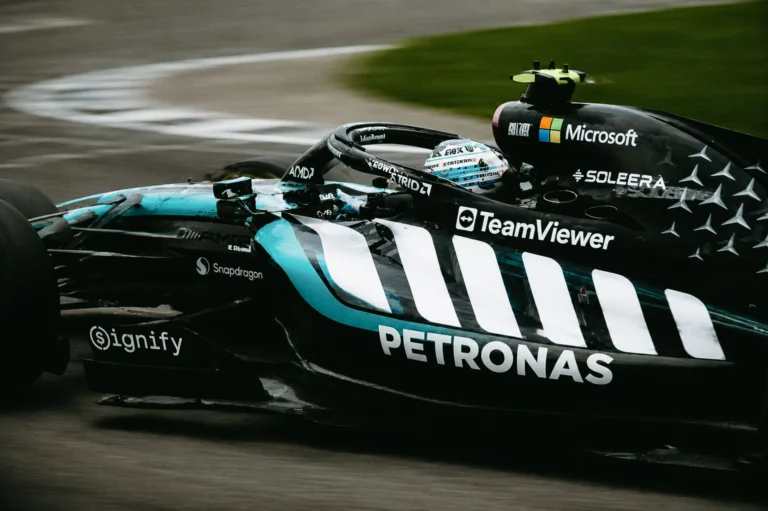
After 12 Grands Prix, Mercedes has taken pole position at 10 of them. Kimi Antonelli has six poles and George Russell has four. The only exceptions are Lando Norris at the Hungaroring and the Dutch Grand Prix at Zandvoort. (formula1.com)
That is a much stronger qualifying record than any rival team can claim.
It also explains why Mercedes remains the best answer to the question of which team has the strongest qualifying package in 2026, even though the gap has narrowed considerably since the start of the season.
The W17 has repeatedly shown an ability to produce peak lap time when the soft tyre comes alive in Q3. More significantly, it has done that across very different circuits. Antonelli took pole in China, Japan, Miami, Monaco, Britain and Belgium. Russell added Australia, Canada, Barcelona and Austria. (formula1.com)
That spread matters. It is harder to dismiss as a car simply suited to one type of circuit.
Mercedes was not merely fast in the opening rounds
The early-season evidence was unusually strong.
At Suzuka, Antonelli took pole with a 1:28.778 while Russell was second. Oscar Piastri was the closest McLaren, but still 0.354 seconds away from pole. Mercedes had both cars on the front row. (formula1.com)
The same pattern appeared elsewhere. Russell took pole in Barcelona after being consistently competitive throughout qualifying, while Antonelli completed the top three. McLaren's Norris was fourth and Piastri seventh. (formula1.com)
There was a tactical element to that Barcelona session that is useful when judging the package. McLaren initially found itself unusually low in Q2 after running used tyres, forcing Norris and Piastri to use fresh rubber earlier than expected simply to guarantee their passage into Q3. Mercedes, by contrast, was already operating at the sharp end.
That does not mean Mercedes was always dominant. It means its qualifying floor was unusually high.
The strongest evidence is what happened when rivals caught up
Miami was the first major warning that Mercedes' qualifying advantage was not permanent.
Lando Norris took McLaren's first non-Mercedes pole of the season in Sprint Qualifying, beating Antonelli by more than two tenths. McLaren had arrived with upgrades, and Norris extracted a particularly strong final lap after describing his Q2 performance as poor. (formula1.com)
Mercedes recovered immediately for the main Grand Prix qualifying session, with Antonelli taking pole. But the competitive picture had changed. McLaren, Ferrari and Red Bull were increasingly capable of putting pressure on the Mercedes cars over one lap.
That trend became clearer as the season progressed.
At the British Grand Prix Sprint, Ferrari's Lewis Hamilton beat Antonelli to pole by just 0.011 seconds. Norris and Piastri were sixth and seventh, showing that the McLaren was not uniformly the fastest car at every circuit despite its underlying progress. (formula1.com)
So the story is not "Mercedes is always fastest."
It is that Mercedes has been the most reliable team at producing the fastest qualifying lap.
Zandvoort showed that McLaren is now a genuine qualifying threat
The Dutch Grand Prix provided the most useful snapshot of the current competitive order.
Mercedes started the weekend strongly. Antonelli was fastest in the only practice session, 0.121 seconds ahead of Norris, while Russell was third. Sky Sports reported that Mercedes, McLaren and Ferrari appeared closely matched, with McLaren also bringing rear-car upgrades to complete the package introduced before the summer break. (skysports.com)
Then came Sprint Qualifying.
Russell took pole, Norris was second, Charles Leclerc third and Piastri fourth. The fastest sectors were shared between Mercedes and McLaren, and Russell's final lap was only 0.041 seconds faster than Norris'. (formula1.com)
There was also an important caveat: Antonelli had damaged the underside of his Mercedes after running through the gravel in SQ1. Sky Sports reported that the initial assessment indicated a loss of around 25 points of downforce, with the damage particularly affecting the car in low-speed corners. (skysports.com)
So his fifth-place Sprint qualifying result should not be treated as evidence that Mercedes had suddenly lost its edge.
The main qualifying session the following day was a better test.
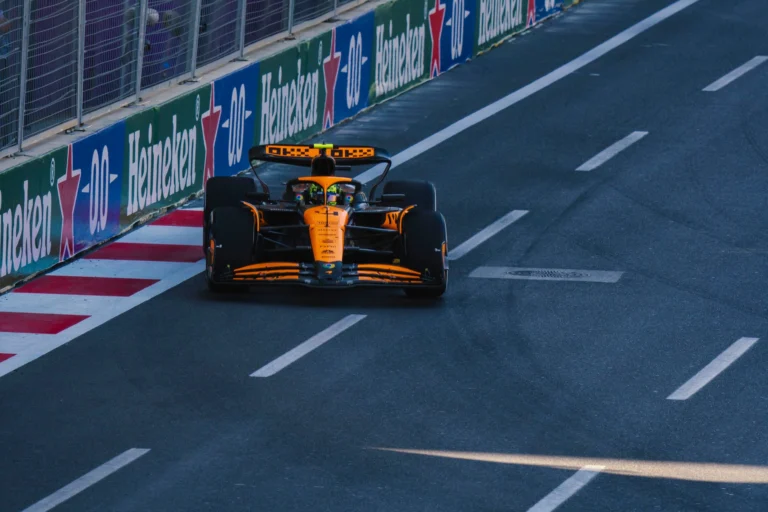
Norris took pole in 1:11.163. Russell was 0.102 seconds behind, Antonelli 0.133 behind and Piastri 0.142 behind. Ferrari's Hamilton and Leclerc were fifth and sixth, while Max Verstappen was seventh. (formula1.com)
That is not a Mercedes qualifying defeat by a rival disappearing into the distance. It is a four-car fight decided by less than 0.15 seconds.
And it is significant that both Mercedes drivers were ahead of Piastri, despite McLaren's obvious improvement.
McLaren may have the fastest current trend, but Mercedes owns the qualifying season
This is where the distinction between "strongest package" and "fastest car right now" matters.
McLaren has arguably become the most serious threat to Mercedes over the last two rounds.
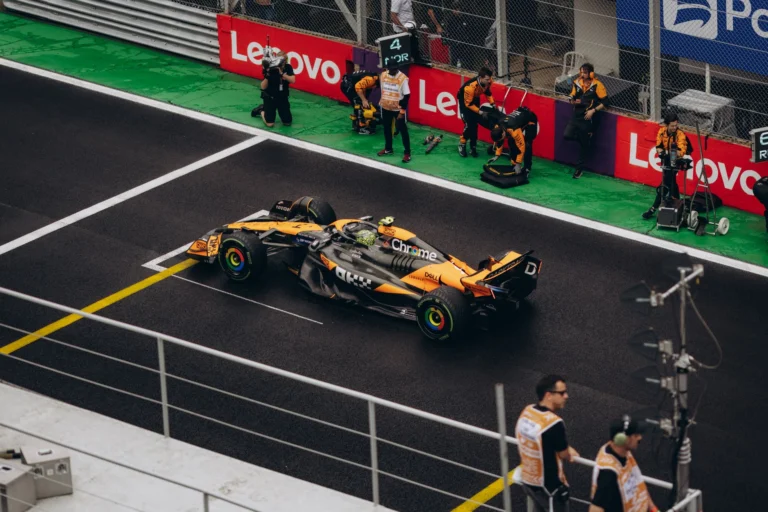
Norris took pole and won in Hungary, then followed it with pole and victory at Zandvoort. Formula 1's own report on the Dutch weekend notes that McLaren tweaked the car after the Sprint, with the changes paying off in qualifying. Piastri also looked extremely competitive through much of the session before Norris found the decisive final-lap performance. (formula1.com)
The race itself reinforced the point without changing the qualifying conclusion.
After Antonelli passed Norris at the second standing start, Norris struggled to attack initially. But after the first round of stops, the McLaren was much stronger on the hard tyre. Norris eventually regained the lead and won by more than 11 seconds, despite staying out during the late Virtual Safety Car while Antonelli stopped for fresher tyres. (formula1.com)
That is evidence of a very strong McLaren race package.
It is not evidence that Mercedes has lost its qualifying crown.
In fact, the Dutch qualifying order makes the distinction unusually clear: Norris had the fastest single lap, but Mercedes put both of its cars immediately behind him.
The Mercedes advantage is also backed by both drivers
A qualifying package becomes much more convincing when two different drivers can exploit it.
Mercedes has that advantage.
At the halfway point of the season, Antonelli led Russell 7-4 in their qualifying head-to-head. Six of Antonelli's seven qualifying victories at that stage were poles. (formula1.com)
Russell's own season record was also substantial: four Grand Prix poles by the current 12-race mark. Antonelli had six. (formula1.com)
The combination is difficult for rivals to match.
A team can have one driver capable of finding an exceptional Q3 lap. Mercedes has two drivers who have repeatedly put the W17 on the front row and, more often than not, on pole.
That is the strongest indication that the underlying car has genuine one-lap performance rather than simply benefiting from one driver's ability to extract an unusual final sector.
Ferrari and Red Bull can still disrupt the picture
Ferrari is closer than the pole count suggests.
Hamilton and Leclerc have repeatedly appeared near the front, including Monaco, Austria, Britain and Zandvoort. Ferrari's new floor also appeared to work well at Zandvoort, with both drivers within three tenths of Antonelli in practice before qualifying. (skysports.com)
Red Bull remains more circuit-dependent in qualifying. Verstappen can still produce an exceptional lap, but the team's 2026 record has not matched Mercedes' consistency. At Belgium, for example, Antonelli beat Verstappen to pole by 0.317 seconds. (motorsport.com)
The current championship standings tell a related story. Mercedes leads the Drivers' Championship with Antonelli and Russell first and second, while the team has also built a substantial constructors' advantage. (formula1.com)
That does not prove qualifying performance by itself, but it is consistent with what the Saturday data shows.
Mercedes remains the benchmark, but the margin is no longer comfortable
If the question is which team has produced the strongest qualifying package across the 2026 season so far, Mercedes is the clear choice.
Ten poles from 12 Grands Prix is the decisive statistic.
If the question is which team looks most capable of challenging Mercedes right now, the answer is McLaren. Norris has taken the last two Grand Prix poles, McLaren has improved its car during the summer, and the Zandvoort qualifying gap was measured in hundredths rather than tenths.
That makes the next phase of the season more interesting than the raw pole count suggests.
Mercedes still owns qualifying. McLaren has started to make it a fight.