F1 2026: Which Teams Are Improving Fastest?
Lando Norris has won the last two Grands Prix, McLaren has moved from occasional front-runner to a genuine race-winning threat, and Ferrari has spent much of the summer closing the gap to Mercedes. The standings still say Mercedes is comfortably ahead, but the more revealing question is what the cars are doing now compared with the first half of the season.
After 12 rounds, Mercedes leads the constructors' championship with 425 points, ahead of Ferrari on 338 and McLaren on 263. Mercedes has won eight Grands Prix, Ferrari two and McLaren two. Yet the recent competitive order is much tighter than those totals suggest. (formula1.com)
If "improving fastest" means which team has changed its competitive position most convincingly during the season, McLaren has the strongest case. Ferrari is close behind. Mercedes remains the benchmark, but its advantage is no longer expanding at the rate it did in the opening months.
McLaren has made the clearest late-season jump
McLaren's 2026 season did not begin with the same authority as its championship-winning 2025 campaign. Its first Grand Prix victory came only at the Hungarian Grand Prix in July, but the subsequent evidence has been much stronger than a single win.
At Budapest, Norris won after a race in which McLaren's own strategy initially put Oscar Piastri ahead. Piastri led through the opening phase, but after his second stop he was caught in traffic and made contact with Carlos Sainz. Norris then found the clean-air pace he needed and ultimately jumped both Piastri and Kimi Antonelli to take the victory. Piastri later retired with a gearbox problem. (formula1.com)
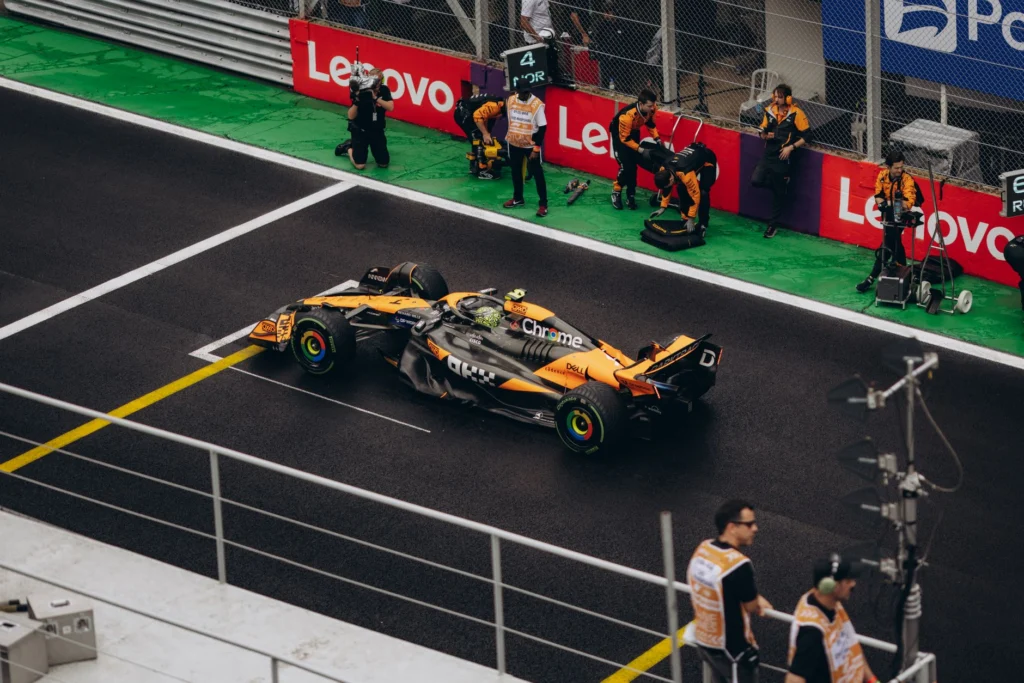
The Dutch Grand Prix was more convincing because McLaren had to beat Mercedes on pace rather than simply capitalise on another team's failure.
Norris started from pole but lost the lead to Antonelli after the restart following Max Verstappen's first-lap crash. The Mercedes initially controlled the race. Once the cars moved onto the hard tyre, however, Norris began closing the gap. He eventually passed Antonelli into Turn 1 and then managed the race from the front. (formula1.com)
There was also a significant tactical moment late in the race. A Virtual Safety Car caused by Esteban Ocon's stranded Haas gave Mercedes an opportunity to pit Antonelli for fresh soft tyres. Norris stayed out. Mercedes then switched its two cars, allowing Antonelli through George Russell for second, but Norris had already built enough of a margin to remain safe. He won by 11.536 seconds. (formula1.com)
That matters because it separates McLaren's recent improvement from a simple "they won because of strategy" explanation. The strategy shaped the result, but the car had enough pace to recover from losing the lead and control the final stint.
McLaren's development programme supports the impression. For Zandvoort, the team introduced a new rear-wing assembly, revised central bodywork and a new rear brake duct, with the aerodynamic changes designed to work together rather than as isolated parts. (formula1.com)
That combination of upgrades and race execution makes McLaren the clearest answer to the question of who is improving fastest.
Ferrari has closed the gap, but its progress has been more uneven
Ferrari's improvement is easier to see if the season is viewed as a sequence rather than through the current points table.
Mercedes dominated the opening phase. Ferrari's breakthrough came in Barcelona, where Lewis Hamilton won after Ferrari committed to a three-stop strategy. The team also benefited from a Virtual Safety Car that effectively gave Hamilton a free stop, but his subsequent pace was sufficient to turn the opportunity into victory. (formula1.com)
Charles Leclerc then won at Silverstone, while Hamilton finished third. The result was particularly significant because Mercedes had still been the strongest overall team, but Ferrari was now capable of beating it over a full Grand Prix. (formula1.com)
Ferrari's development approach has also been aggressive. At Barcelona, it introduced one of the more extensive upgrade packages of the weekend. Later, at Zandvoort, Ferrari continued working on the floor, floor edge and diffuser geometry to increase aerodynamic load and improve the flow reaching the rear of the car. (formula1.com)
The result is not yet consistent domination. Ferrari finished fourth and fifth at Zandvoort, behind both Mercedes cars and Norris, although the gap was small enough for Lewis Hamilton to finish only 16.755 seconds behind the winner and Leclerc 17.258 seconds back. (formula1.com)
So Ferrari's trajectory is real, but it is better described as closing the gap to Mercedes than overtaking Mercedes as the fastest overall package.
There is another complication. Mercedes boss Toto Wolff has argued that Ferrari's aggressive development rate could become difficult to sustain under the cost cap. That is Wolff's assessment, not an established fact about Ferrari's remaining resources, so it should be treated accordingly. (formula1.com)
Mercedes is still the benchmark, even if its advantage is shrinking
Calling Mercedes a declining team would be misleading.
The numbers are overwhelming. Mercedes has won eight of the first 12 Grands Prix and leads Ferrari by 87 points and McLaren by 162. Kimi Antonelli leads the Drivers' Championship with 242 points, while George Russell is second on 183. (formula1.com)
But Mercedes itself has acknowledged that Ferrari has gradually caught it.
Before the summer break, Mercedes said it was targeting a larger upgrade after the shutdown, following a period in which Ferrari had become an increasingly serious threat. (formula1.com)
That is a useful distinction. Mercedes is not necessarily getting slower. Its competitors are getting closer.
At Zandvoort, Mercedes brought only one modified component, a front-corner change intended to improve airflow toward the rear of the car. Ferrari and McLaren arrived with considerably more extensive packages. (formula1.com)
And yet Mercedes still produced two podiums.
Antonelli led after the restart and controlled much of the first half of the race. When Norris eventually passed him, Mercedes used the late Virtual Safety Car to put Antonelli onto fresh soft tyres. The move left him behind Russell, but the team ordered Russell to let his team-mate through on Lap 65. Antonelli finished second and Russell third. (formula1.com)
That is not the profile of a team losing its competitive foundation. It is the profile of the team that everyone else is trying to catch.
Red Bull has not matched the front three's development rate
Red Bull's position is harder to describe as improvement.
Max Verstappen remains sixth in the championship with 112 points, while Isack Hadjar and Liam Lawson have also scored heavily enough to put Red Bull on 186 constructors' points. But the team has not converted development into the same sustained front-running performance as Mercedes, Ferrari or McLaren. (formula1.com)
Its Austrian upgrade package was significant, including changes to the front suspension and engine-cover area, while other aerodynamic revisions were also introduced. (formula1.com)
But by Zandvoort, Red Bull's listed change was comparatively small: a modification to the wishbone-shroud area aimed at reliability and reducing strain at high steering angles. (formula1.com)
The Dutch Grand Prix made the underlying problem particularly visible. Verstappen crashed on the opening lap, leaving Lawson as Red Bull's only finisher. Lawson eventually took seventh. (formula1.com)
One race cannot establish a development trend, especially after a crash, but Red Bull currently has less evidence of a sustained upward trajectory than McLaren or Ferrari.
The midfield is moving too, but not at the same rate
There is a smaller development race behind the leading four.
Alpine entered Zandvoort with a substantial package after losing fifth place in the constructors' standings to Racing Bulls. Its changes included a new floor, revised floor edges, a reprofiled diffuser and several rear-wing and cooling-related modifications. Only Pierre Gasly received the complete package because it had been rushed through. (formula1.com)
Audi had also scored points in three consecutive rounds before the Dutch Grand Prix, with Nico Hülkenberg adding another point in Hungary and finishing eighth at Zandvoort. Aston Martin, meanwhile, continued developing its car around its new Honda power unit. (formula1.com)
These are genuine signs of movement, but none has yet produced the sustained front-of-field pace required to challenge the top four.
McLaren has the strongest evidence of a new competitive baseline
The most useful comparison is not simply who has scored the most points. Mercedes started the year far ahead and therefore had much more to lose. Ferrari has progressively reduced that advantage. McLaren has gone from waiting for its first win to winning twice in succession.
The Dutch Grand Prix is the clearest evidence.
Norris lost the lead, struggled initially behind Antonelli, changed onto hard tyres, recovered the gap, overtook the championship leader and then resisted the strategic opportunities created by the late Virtual Safety Car. The result was his second consecutive Grand Prix victory. (formula1.com)
That does not make McLaren the best team of 2026. Mercedes still has the points, the wins and the championship leader.
It does make McLaren the team with the strongest upward curve.
Ferrari is improving quickly enough to keep Mercedes under pressure. Mercedes is still the reference point. Red Bull is searching for consistency. But as Formula 1 heads to Monza on September 4-6, the more interesting question is no longer whether McLaren can return to the front.
It already has.
The question is whether the latest McLaren gains are enough to turn two late-season wins into a sustained challenge for Mercedes over the remaining 11 rounds. (formula1.com)
If your company or product is mentioned in this article, you're welcome to share it.