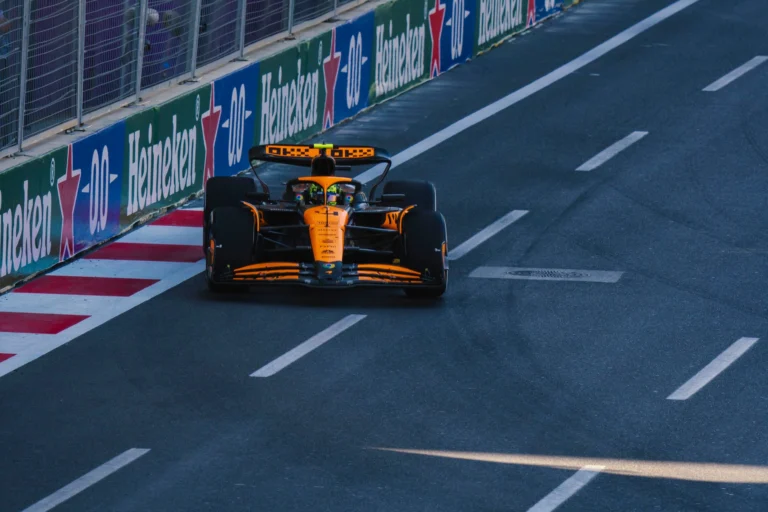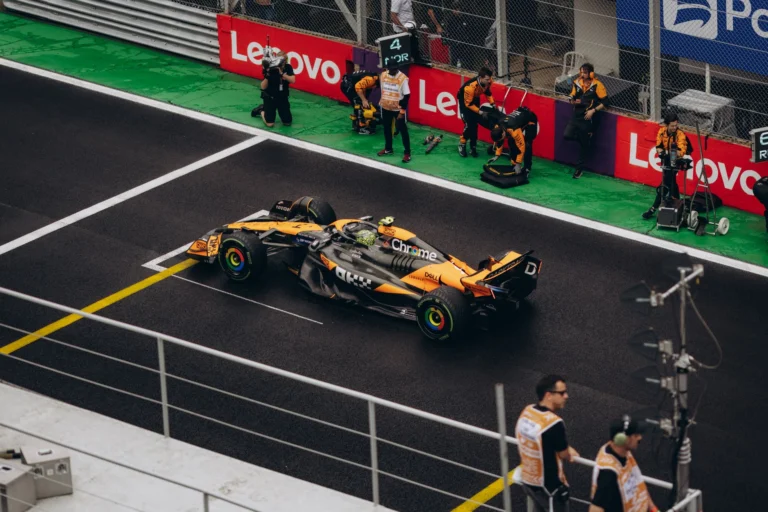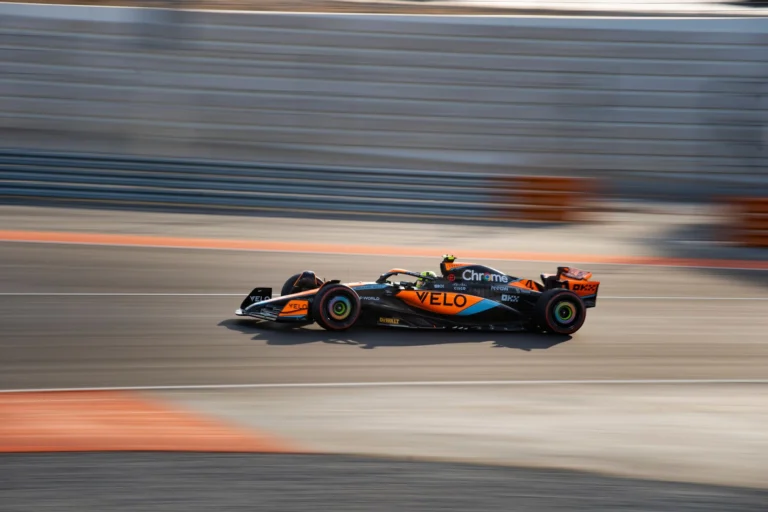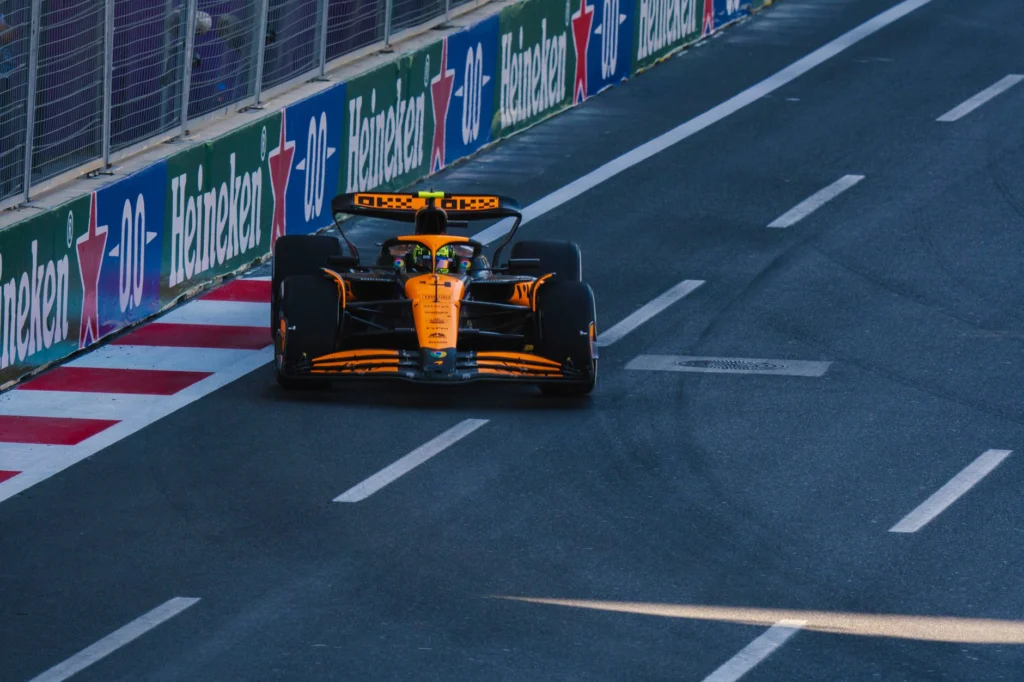
At the 2026 Hungarian Grand Prix, McLaren and Red Bull reached the podium by solving two very different problems.
Lando Norris won after McLaren created the conditions for his pace to matter. Max Verstappen finished second after Red Bull repeatedly adjusted around a car that was difficult to drive and a race that kept changing shape.
The difference was visible in the strategy sequence. Norris started on the Medium, as did Oscar Piastri and Verstappen. McLaren then used Piastri's second stop to release Norris into clean air, while Red Bull moved Verstappen onto Hard tyres, later switched him to Softs for a long final stint, and deliberately kept him out during a late Virtual Safety Car.
That does not mean one team has a permanently fixed "strategy style." Formula 1 strategy is too dependent on tyre behaviour, traffic, car performance and race interruptions for that. But Hungary provides a useful case study in how the two teams approached the same race from very different competitive positions. (formula1.com)
McLaren's biggest strategic weapon was clean air
McLaren entered Hungary with a car capable of producing serious pace, and that changed the strategic calculation.
Norris took pole by just 0.012 seconds over Lewis Hamilton. Piastri started third and Verstappen fourth after grid penalties elsewhere. All three started on Medium tyres, giving them broadly similar opening-stint options. (formula1.com)
Piastri immediately changed the order. Norris ran wide at Turn 2, allowing his team-mate to use a cut-back and take the lead.
For the first half of the race, McLaren therefore had a useful problem: both cars were fighting for the same victory, while Norris was convinced he had more pace but was losing performance by following Piastri closely.
The radio messages captured the issue. Piastri was told McLaren was considering Plan A, while Norris complained about being quicker but stuck in dirty air. The underlying strategic question was whether to protect track position or give one car the freedom to exploit its pace. (formula1.com)
McLaren eventually chose the latter.
Piastri made his second stop on Lap 33. Norris stayed out, gaining the clean track he had been asking for. He then produced a sequence of faster laps while Piastri emerged into traffic.
That was the decisive strategic mechanism. McLaren did not need an exotic tyre gamble. It needed to separate its faster car from its slower car.
Red Bull was solving a different problem
Verstappen's Red Bull did not have the same level of performance around the Hungaroring.
The Dutchman complained about balance and gear-shift problems during the race, while Red Bull team principal Laurent Mekies later described the weekend as one in which the team had struggled to give its drivers a car they could properly push. (formula1.com)
That matters because strategy cannot be separated from underlying pace.
If a car is comfortably the fastest in clean air, a conventional strategy can be enough. If it is slower, the pit wall has more incentive to create uncertainty: undercuts, tyre offsets, unusual compound choices and staying out during neutralisations can all become ways of manufacturing an opportunity.
Red Bull initially followed the same basic pattern as McLaren: Medium to Hard.
Verstappen stopped on Lap 15 for Hards, shortly after Hamilton had made his own stop. But Red Bull did not simply copy the Ferrari and McLaren decisions from there. The team continued to look for ways to keep Verstappen in the fight.
Later, Verstappen made a second stop and took Soft tyres with roughly 32 laps remaining. That was a much more aggressive proposition than simply completing the race on another set of Hards. (formula1.com)
The strategy only works if the tyres can survive the remaining distance. Red Bull therefore accepted tyre risk in exchange for performance.
The key difference was not one-stop versus two-stop
It would be easy to reduce the Hungary strategy battle to pit-stop counts. That misses the interesting part.
Before the race, Pirelli's simulations suggested that one-stop and two-stop strategies were broadly equal in overall race time. Higher-than-expected degradation had brought the two options close together, while traffic and the difficulty of overtaking made a one-stop potentially attractive. Pirelli identified the Hard tyre as the likely finishing compound for a conventional one-stop. (formula1.com)
So teams were not choosing between an obviously correct strategy and an obviously inferior one.
They were deciding how much risk to accept.
McLaren's Norris strategy ultimately revolved around pace and clean air. Red Bull's Verstappen strategy increasingly revolved around track position and tyre performance.
That distinction is more useful than simply saying McLaren stopped twice or Red Bull stopped twice.
McLaren used its second car to change the race for Norris
The Piastri situation is particularly revealing.
Piastri had led for much of the first half, but his second stint on Hards was not producing the pace McLaren wanted. Norris, meanwhile, was able to exploit clear air after Piastri's stop.
The team therefore gained something strategically valuable without directly instructing Norris to pass his team-mate on track: it removed the slower car from Norris' immediate path.
Piastri's subsequent traffic problems made the effect even larger. He encountered Carlos Sainz's Williams after the stop and made contact between Turns 2 and 3. Norris then stopped on Lap 39 and emerged with enough of a margin to remain ahead of Piastri. (formula1.com)
Piastri's eventual gearbox failure was separate from that strategic decision. The strategy did not cause the mechanical retirement, and Piastri himself said there was no point blaming the team for the incident with Sainz because "you don't plan strategy" around being taken out by a backmarker. (formula1.com)
That distinction matters. The strategic story ends before the gearbox failure.
Red Bull's strategy was built around preserving Verstappen's position
Red Bull's most interesting calls came when the race presented opportunities to protect track position.
After Verstappen switched to Soft tyres for the final stint, the team faced another decision when Piastri's late retirement brought out the VSC.
Norris, Hamilton and Leclerc all used the neutralisation to pit. Verstappen did not.
Red Bull chose track position rather than a cheaper pit stop under the VSC. Verstappen remained on his Softs and ultimately finished second. Mekies specifically credited the pit wall for that decision and for an earlier call not to cover Hamilton's first stop. (formula1.com)
This is where Red Bull's strategy differed most sharply from McLaren's.
McLaren could afford to optimise Norris' race around raw pace because Norris had enough performance to create the necessary gap. Red Bull had less margin. Giving up track position for theoretically fresher tyres could have left Verstappen behind cars he was capable of racing but not necessarily passing easily.
So Red Bull protected the position it had.
Verstappen's Soft-tyre gamble only made sense because of the traffic
The final Soft stint looks aggressive in isolation.
Thirty-two laps is a long distance for a Soft tyre, particularly when the driver has to manage degradation. But Verstappen was not simply chasing the fastest theoretical lap time. He was trying to remain competitive against cars around him while exploiting the performance advantage of a softer compound.
He was also operating in a race where overtaking was difficult enough that track position had genuine strategic value.
That is why Red Bull's VSC decision and the Soft-tyre decision should be viewed together.
The team accepted tyre risk to gain performance, then accepted the cost of not pitting during the VSC to retain position. It was a coherent strategy rather than two unrelated gambles. (formula1.com)
Hungary also showed why McLaren cannot simply copy Red Bull
The temptation after a successful strategy call is to treat it as transferable.
McLaren did not need to put Norris on a 32-lap Soft-tyre run because it already had the faster race package. Its main challenge was extracting that pace without having Norris trapped behind Piastri.
The solution was comparatively straightforward: create clean air, let Norris build pace, then use the resulting advantage to control the race.
Norris ultimately won by 15.080 seconds over Verstappen. That margin should not be interpreted as the result of strategy alone. McLaren had a faster package in Hungary, and Norris drove at a pace he described afterwards as among the best of his career. (formula1.com)
Red Bull's second place, meanwhile, was more impressive relative to its starting point. Verstappen had qualified sixth, roughly half a second away from Norris, before penalties moved him onto the second row. The strategy then helped him turn a difficult weekend into a podium. (formula1.com)
The 2026 pattern is really about adapting strategy to car performance
Hungary should not be treated as proof that McLaren is always the aggressive team or Red Bull is always the opportunistic one.
Earlier in 2026, Red Bull used a different approach in Barcelona, gambling on Softs at the start before eventually three-stopping Verstappen. In Canada, Verstappen's first stint on Softs helped create the gap he needed, while McLaren made an aggressive call to start both cars on Intermediates in drizzle that quickly proved wrong when the rain failed to arrive. (formula1.com)
McLaren has also shown that its strategy can be questioned. At Spa, Norris started on Hards from P13 after a grid penalty, eventually finding himself in the lead before the team concluded it had not been bold enough with the strategy. Andrea Stella later acknowledged that McLaren could have "given it a go" differently. (formula1.com)
That is the more useful lesson from 2026.
Red Bull and McLaren are not operating with two permanent strategic philosophies. They are responding to what their cars allow them to do.
When McLaren has enough pace, the team can use clean air and tyre life to make a conventional strategy extremely difficult to beat. When Red Bull is closer to the limit, it has more reason to create a race within the race, using tyre offsets and track-position calls to compensate.
Hungary made that contrast unusually clear. Norris won because McLaren found a way to let its fastest car run free. Verstappen finished second because Red Bull kept finding ways to make a difficult car competitive.
That is the real strategic difference between them in 2026: McLaren is increasingly able to make the race come to its pace; Red Bull is still often having to make the strategy come to the race.