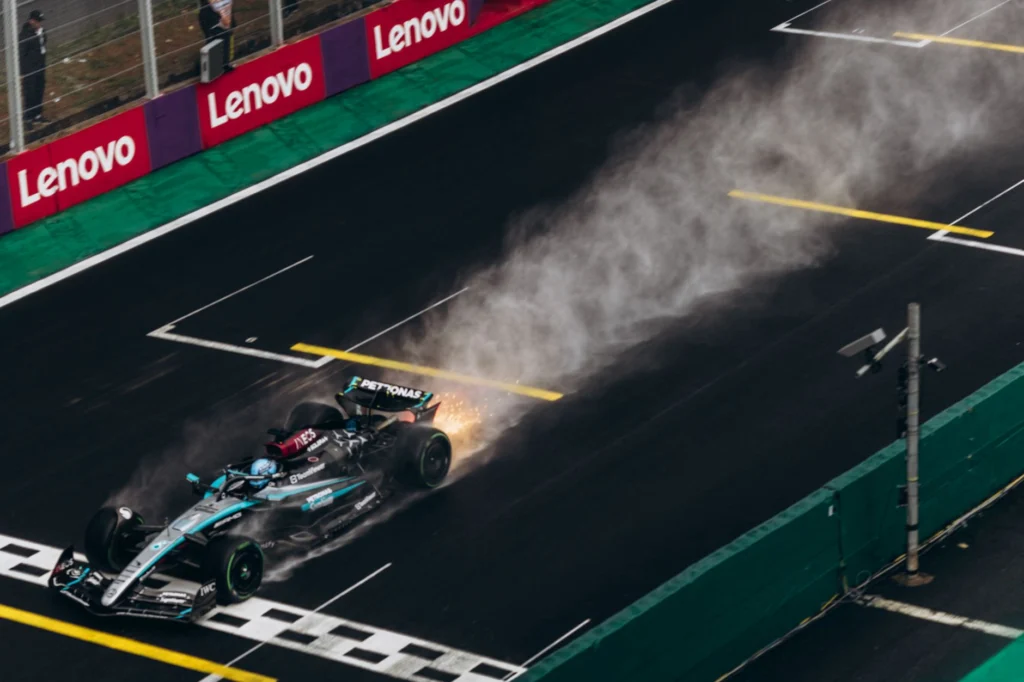
Kimi Antonelli left Zandvoort with second place and a larger championship lead, while Lando Norris left with something arguably more revealing: a second straight victory after McLaren had spent most of the season chasing Mercedes.
After 12 Grands Prix, Antonelli has 242 points, George Russell and Lewis Hamilton have 183 each, and Norris has 159. Mercedes leads the constructors' championship with the combined strength of its two drivers, while McLaren has only recently turned its improved car into consistent race-winning form. (formula1.com)
That makes the answer to the season's strategic question less straightforward than simply counting wins.
Mercedes has executed the best overall championship strategy. Kimi Antonelli has been the most effective driver at converting those decisions into points. But the best individual strategic victory belongs to Ferrari's Lewis Hamilton at Barcelona, while McLaren's late-season execution is now the biggest threat to Mercedes.
The distinction matters because F1 strategy is not just about choosing when to pit. It is about managing tyre life, reacting to Safety Cars and Virtual Safety Cars, protecting track position, understanding when an undercut is actually valuable, and making decisions that maximise championship points rather than one spectacular result.
Mercedes built its championship lead by getting the big decisions right
Mercedes won the opening six Grands Prix of the season, with Antonelli winning five of them and Russell taking Australia. The official results show just how strong that opening run was: Mercedes won Australia, China, Japan, Miami, Canada and Monaco before Ferrari interrupted the sequence in Barcelona. (formula1.com)
That is not evidence that Mercedes made six perfect strategic calls. The car was also extremely competitive. Strategy only works when the underlying pace gives a team something to work with.
But the team repeatedly put both drivers into positions where that pace could produce points.
Antonelli's consistency has been particularly valuable. By the Dutch Grand Prix, he had built a 59-point advantage over both Russell and Hamilton. Mercedes' current position is therefore not the product of one lucky Safety Car or one unusually strong weekend. It is the accumulation of a large number of decisions made correctly over 12 rounds. (skysports.com)
The team's biggest strategic strength has been its willingness to treat the championship as a two-car exercise.
That was visible again at Zandvoort.
The Dutch Grand Prix showed Mercedes' strategy at its most calculated
Antonelli had led after the second standing start and spent much of the first stint ahead of Norris. But once the cars moved onto harder tyres, Norris found substantially better pace and eventually passed him.
Then, with 16 laps remaining, a Virtual Safety Car created an opportunity.
Mercedes brought Antonelli into the pits for fresh tyres. Russell stayed out and therefore inherited second place, while Antonelli rejoined in third. On paper, that could have looked like a failed call: Antonelli gained fresher tyres but lost track position.
Mercedes then made the second part of the calculation.
On Lap 65, Russell was instructed to let Antonelli through. The move protected the championship leader's second place while leaving Russell to defend from the Ferraris behind. (formula1.com)
It was not risk-free. Hamilton was on fresher tyres and was attacking Russell for the final podium position. Russell nevertheless held him off, with another VSC interruption helping Mercedes' defence.
Antonelli finished second and Russell third.
The decision did not win Mercedes the race. Norris had already established enough pace to control the finish. But it did exactly what a championship-leading team should want: it converted a difficult late-race situation into 33 points for Mercedes and preserved Antonelli's championship advantage.
That is strategic execution, rather than simply strategic cleverness.
Hamilton's Barcelona victory was the season's best single strategy
If Mercedes owns the best body of work, Ferrari produced the most satisfying single strategic execution at Barcelona.
Hamilton started on soft tyres and failed to take the lead at Turn 1. Ferrari then committed to a three-stop strategy, which initially looked like a gamble.
The decisive moment came under a Virtual Safety Car.
Hamilton received what Formula 1 described as a "free stop", allowing Ferrari to make his final tyre change at a heavily reduced strategic cost. He emerged in the lead and then used the pace available from the Ferrari to pull away from Russell.
He won by 19.561 seconds. (formula1.com)
The important detail is that the VSC did not magically create the victory. Ferrari had already committed to a three-stop race, and Hamilton had demonstrated strong pace across the medium and hard tyres. The neutralisation simply turned a potentially aggressive strategy into the optimal one.
That makes Barcelona the clearest example of a team accepting strategic risk and then being rewarded by circumstances without relying entirely on luck.
Hamilton did his part, too. Ferrari's post-race account noted that he was set to challenge for the win even before the VSC handed him the cheap final stop. (formula1.com)
So if the question is which driver executed the best individual strategic race?, Hamilton has the strongest case.
Antonelli's strength is different: he rarely wastes a good strategic position
Antonelli's 2026 campaign has not depended on spectacular recovery drives every weekend.
That is precisely why it is so impressive.
He has won seven of the 12 Grands Prix so far: China, Japan, Miami, Canada, Monaco and Belgium, alongside his other victories recorded across the season. Mercedes' official results confirm that he has been the driver most consistently converting the team's competitive car into victories. (formula1.com)
Belgium is a useful example. Antonelli recovered the lead after Max Verstappen passed him at Eau Rouge on the opening lap, then resisted pressure from Charles Leclerc to win by 1.952 seconds. Russell's early retirement made the team result less complete, but Antonelli still executed the race that Mercedes needed. (formula1.com)
His biggest advantage over the chasing drivers is therefore not one particular pit-wall trick.
It is repeatability.
A championship leader does not need to win every strategic battle by taking an unconventional tyre gamble. More often, the valuable skill is avoiding the bad decision, taking the available points and being ready when circumstances create an opportunity.
Antonelli has done that more consistently than anyone else.
McLaren's strategy became much better when its car became faster
McLaren's season is the clearest warning against judging strategy without considering the car underneath it.
The team struggled badly early in the year. By June, it was already 113 points behind Mercedes after five rounds, and team principal Andrea Stella acknowledged that the season had been below expectations. (skysports.com)
Then came the major upgrade package in Hungary.
Norris won there, giving McLaren its first Grand Prix victory of 2026. One race later, he won again at Zandvoort. (formula1.com)
The Dutch Grand Prix was particularly revealing because Norris did not win by simply controlling the race from pole.
He lost the lead to Antonelli at the restart. He initially struggled to pressure the Mercedes. But after the first round of stops, the McLaren's performance on the hard tyre changed the race. Norris closed the gap, passed Antonelli and then extended the advantage.
McLaren also chose not to stop Norris under the late VSC. That left him on older tyres while Antonelli had fresher rubber, yet Norris was still able to pull away and win by 11.536 seconds. (formula1.com)
That is an important strategic distinction.
Mercedes made the aggressive call with Antonelli and gained track position over Russell. McLaren made the opposite call with Norris and trusted its existing track position and pace.
Both decisions were rational. The difference was that McLaren had the car capable of making its decision work.
Miami remains the clearest example of what Mercedes did better than McLaren
Earlier in the season, McLaren had the opportunity to beat Antonelli in Miami.
Norris was leading the race by nearly two seconds as the pit-stop phase approached. Mercedes stopped Antonelli first, giving him a lap on fresher tyres.
When Norris eventually stopped, he rejoined just ahead of Antonelli, but the Mercedes driver carried enough momentum to take the effective lead into Turn 4.
Antonelli won by 3.264 seconds. (skysports.com)
That was not a dramatic tactical masterstroke. It was a small timing advantage converted into track position.
Those are exactly the margins that have allowed Mercedes to build its enormous championship lead.
The championship numbers favour Mercedes, even as McLaren's momentum shifts
After Zandvoort, Antonelli has 242 points, with Russell and Hamilton tied on 183. Norris has moved to 159, while Leclerc sits on 155. Mercedes therefore has 425 points from its two drivers, compared with Ferrari's 338 and McLaren's 263. (formula1.com)
But the raw totals hide an important change.
Mercedes won all of the first six Grands Prix. Since then, it has won only two of the next six. Ferrari and McLaren have each taken two victories in that period, while McLaren has now won the last two races. (skysports.com)
Mercedes' advantage is therefore built on its first-half execution. McLaren's threat is based on its current trajectory.
That is why the remaining races should not be treated as a simple march toward an Antonelli championship.
There are still 11 Grands Prix scheduled after the Dutch round, beginning with Monza on September 4-6. (formula1.com)
And Mercedes knows the strategic problem has changed. Its early-season performance advantage has narrowed, while McLaren and Ferrari are bringing more development to their cars.
So who executed the best strategy in F1 2026?
Best team overall: Mercedes.
The evidence is the championship itself. Mercedes has turned early-season pace into the largest points advantage in both championships, and its handling of Antonelli and Russell has generally prioritised the team's title position.
Best driver overall: Kimi Antonelli.
He has converted Mercedes' opportunities more consistently than anyone else and leads the championship by 59 points after 12 rounds. That does not mean he has made every strategic decision himself; F1 strategy is a driver-team collaboration. It means he has been the most reliable driver at turning good strategic situations into championship points.
Best single strategic race: Lewis Hamilton at Barcelona.
Ferrari's three-stop gamble, Hamilton's pace and the VSC-created free final stop combined into the cleanest example of strategy changing the outcome of a race.
Biggest strategic threat for the second half: Lando Norris and McLaren.
Their victories in Hungary and the Netherlands are not merely two isolated wins. They came immediately after a major upgrade and showed that McLaren can now make different tyre and pit-stop strategies work against Mercedes.
That leaves Mercedes with the best strategic record, but not necessarily the fastest strategic package heading into Monza.
The first half of 2026 was about Mercedes finding ways to maximise an advantage. The next phase will test whether it can keep doing that after the advantage itself has started to disappear.
If your company or product is mentioned in this article, you're welcome to share it.