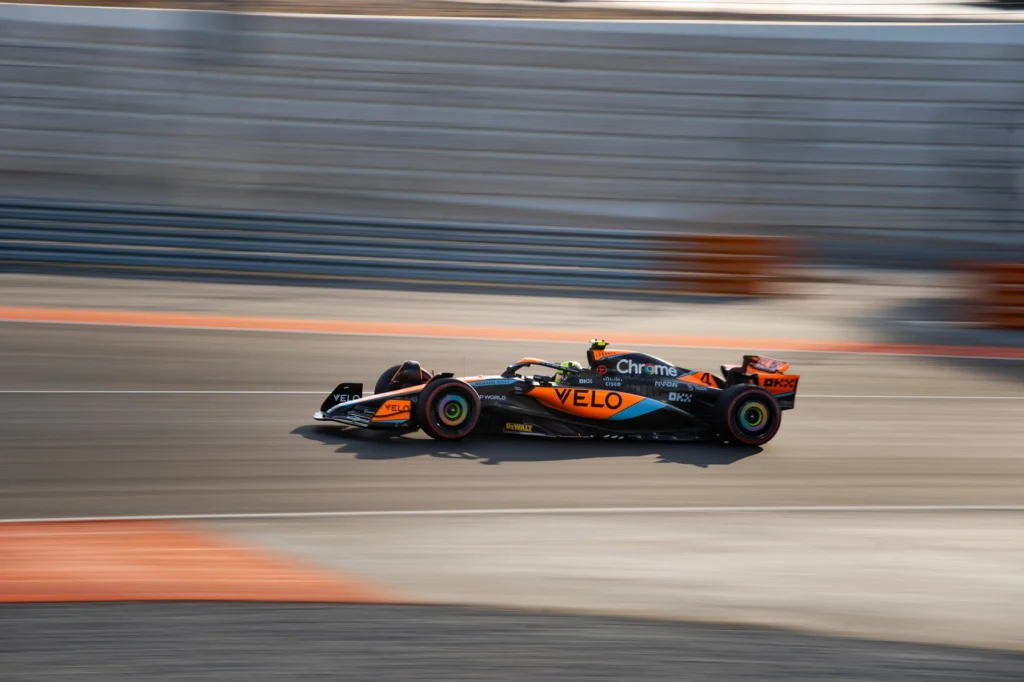
Lando Norris has made the most convincing case at the front
The clearest answer, through the Dutch Grand Prix, is Lando Norris.
That does not mean he has made the most overtakes. Formula 1 does not publish a single, clean season-long statistic that can settle that question, and raw overtaking counts would also be a poor way to judge the skill involved. A driver recovering from the back of the grid has many more opportunities than a driver protecting a podium.
Norris' case is about when and how he chooses to attack.
At Zandvoort on August 23, he lost the lead to Kimi Antonelli at the second standing start. The Mercedes driver then controlled the first stint, but Norris stayed close enough to keep the fight alive. After the pit-stop sequence, Norris eventually swept past Antonelli into Turn 1 and then passed Lewis Hamilton moments later to reclaim the lead. He did it despite Antonelli having access to Overtake Mode for defensive purposes. (formula1.com)
That was not a simple case of having the faster car and driving past somebody.
It followed a pattern that has appeared elsewhere this season. In Hungary, Norris spent much of the opening half behind team-mate Oscar Piastri after Piastri passed him at Turn 2 on the first lap. Norris did not force the issue immediately, and ultimately inherited the lead when Piastri's race unravelled. (formula1.com)
The more revealing evidence is the Dutch race. Norris stayed within striking distance, managed the tactical problem of Overtake Mode and waited until he could make the move stick.
That is overtaking as racecraft rather than spectacle.
Max Verstappen remains the benchmark for opportunistic overtaking
If Norris currently has the strongest overall case, Max Verstappen remains one of the hardest drivers to exclude from the conversation.
His 2026 season has produced some unusually clear examples of his particular style: identify the moment when the car ahead is vulnerable, commit early and make the braking phase decide the move.
At the Hungarian Grand Prix, Verstappen emerged from a pit stop behind Lewis Hamilton. On the following lap he surprised Hamilton with a pass into Turn 1, a move Formula 1's race report described as bold. Earlier, he had also moved past Arvid Lindblad around the outside of Turn 5. (formula1.com)
The Hungarian race was particularly useful because the overtaking was not simply a consequence of a massive straight-line advantage. Autosport highlighted Verstappen's late-braking move on Hamilton as one of the race's standout examples, alongside Hamilton's outside-line overtakes on Lindblad and Isack Hadjar. (autosport.com)
Verstappen also showed the other side of his overtaking ability in Australia. Starting from P20, he worked his way into the points despite running the hard tyre and later trying to attack Lando Norris. He finished sixth, with Red Bull noting that he made several overtakes during the recovery drive. (formula1.com)
There is a difference between making a lot of passes and making difficult passes.
Verstappen continues to be exceptionally good at the second category.
Lewis Hamilton is still one of the best at creating a pass that should not be there
Hamilton's 2026 Ferrari campaign has added another dimension to the question.
His strongest overtaking evidence is not necessarily the number of cars he has passed. It is the variety of places from which he has completed moves.
At the Hungarian Grand Prix, Hamilton made two particularly notable overtakes around the outside, against Lindblad and Hadjar. Those moves required the attacking car to maintain speed through the corner rather than simply relying on a late-braking lunge. (autosport.com)
That distinction matters.
An outside pass requires confidence that the car will remain stable, enough grip to hold the longer radius and enough commitment to prevent the defending driver from simply closing the door. It is a different skill from a conventional Turn 1 dive.
Hamilton also produced a significant pass on Verstappen at the British Grand Prix, overtaking the Red Bull for third place. (formula1.com)
And in Barcelona, his Ferrari strategy helped him win rather than merely gain positions. He started on soft tyres, switched into an aggressive three-stop strategy and ultimately used a Virtual Safety Car to make his final stop while maintaining the lead. (formula1.com)
Hamilton's advantage, then, is not just attacking ability. It is knowing how an overtaking opportunity fits into the wider race.
George Russell may be the most persistent attacker
Russell's overtaking style is more aggressive and sometimes more costly.
The Australian Grand Prix provided an almost perfect example. Russell and Charles Leclerc repeatedly exchanged the lead. Russell passed Leclerc on Lap 2, lost the position when Leclerc used Overtake Mode, passed him again at Turn 3 and then watched Leclerc regain the position through Turns 9 and 10. Later, Russell locked up while attempting another move into Turn 1. (formula1.com)
It was messy. It was also real racing.
Russell himself later acknowledged that he could have used his energy more intelligently when defending after his first overtake. (formula1.com)
That is particularly relevant in 2026 because Overtake Mode has changed the tactical equation. The new system replaces DRS and allows a driver to deploy stored electrical energy strategically rather than simply activating a fixed straight-line aid. (formula1.com)
Russell has repeatedly shown that he is willing to spend that resource to create an opportunity.
Miami offered another example. Despite a difficult weekend and a lack of outright pace, Russell recovered from fifth on the grid to fourth by overtaking Verstappen late in the race and Leclerc on the final lap. (formula1.com)
That makes Russell one of the more reliable drivers when there is an actual position to be taken.
Kimi Antonelli is already unusually good at timing his attack
Antonelli's reputation in 2026 is built largely on qualifying speed, race pace and consistency. But his overtaking is becoming harder to overlook.
At Silverstone, he started the Sprint from P2 behind Hamilton. He lost places early, recovered to second and then spent several laps studying Hamilton before making his decisive move on Lap 8. Antonelli subsequently used the car's available energy to complete the pass and win the Sprint. (formula1.com)
That patience is significant.
He did not need to attack every time Hamilton was within reach. He kept applying pressure until the opportunity became sufficiently strong.
The same quality appeared at Spa. Antonelli waited until the latter stages of the Belgian Grand Prix before powering past Leclerc with ten laps remaining to retake the lead. (formula1.com)
And at Zandvoort, he made the decisive move at the second start to pass Norris for the lead, before later losing the position back to the McLaren. (formula1.com)
Antonelli is already showing the most important trait of a high-level overtaker: he is learning that the first available opportunity is not always the best one.
Charles Leclerc's overtaking is often about precision rather than volume
Leclerc belongs in the discussion for a slightly different reason.
At Suzuka, he started fourth and jumped both Mercedes cars off the line. Later, after Hamilton initially defended successfully, Leclerc used Overtake Mode to pass him into Turn 1 on Lap 42. Russell then passed Hamilton, and the fight continued until Leclerc and Russell exchanged positions again in the closing laps. (formula1.com)
The Belgian Grand Prix showed another useful aspect of Leclerc's racecraft. He held the lead for much of the closing phase before Antonelli eventually passed him with ten laps remaining. Leclerc finished second, only 1.952 seconds behind the Mercedes. (formula1.com)
He is not necessarily the driver generating the largest number of headline overtakes. But when the opportunity arrives, Leclerc is generally capable of putting the car in exactly the place required.
The 2026 rules make “best overtaker” harder to measure
There is a reason simple overtaking tables can be misleading this year.
The 2026 cars use Overtake Mode instead of the old DRS system. Energy deployment is now part of the tactical battle, and drivers can choose how aggressively to use that resource. Formula 1's own glossary describes Overtake as something that can be deployed strategically across a lap rather than only in a predetermined activation zone. (formula1.com)
That means a successful pass can begin several corners before the actual braking zone.
A driver may deliberately stay close, conserve energy, pressure the car ahead, force defensive deployment and then attack when the defending driver has less available power. Another driver may spend everything in one attempt and get the position immediately.
Both appear as “one overtake” in a basic statistic.
They are not necessarily equivalent pieces of driving.
Early-season data already suggested that passing had become more frequent under the new regulations. Isack Hadjar said in April that 149 overtaking moves had been recorded across the opening three Grands Prix, with that figure described as conservative because it excluded first-lap changes and only counted position changes at the finish line. (motorsport.com)
So the 2026 question is less about who has the biggest number and more about who consistently turns an opportunity into a position.
So who is actually the best overtaker in F1 in 2026?
On the evidence through Zandvoort, Norris is the strongest overall answer.
Verstappen remains the driver most likely to produce the audacious late-braking move. Hamilton remains exceptional at unconventional passes, particularly around the outside. Russell is relentlessly willing to attack. Antonelli is developing into a remarkably patient and efficient overtaker. Leclerc is precise when the opening appears.
But Norris has combined the most convincing ingredients.
He can attack immediately when necessary, as at Zandvoort. He can wait through a long tactical battle, as he did before taking the lead there. He can manage the energy game introduced by the 2026 regulations, and he has repeatedly shown that he does not need to turn every opportunity into an attempted pass.
The most telling move of the season so far may therefore be the one that looked simplest: Norris staying close to Antonelli, waiting for the race to turn in his favour, then taking Turn 1 when the opportunity finally arrived.
In 2026, the best overtaker is increasingly not the driver who attacks most often.
It is the driver who knows which attack is worth making.
If your company or product is mentioned in this article, you're welcome to share it.