OpenAI's Stargate project was announced with an extraordinary target: up to $500 billion of investment in AI infrastructure in the United States over four years. The project initially named OpenAI, SoftBank, Oracle and MGX as equity funders, with companies including Nvidia, Arm and Microsoft involved as technology partners.
That number is large enough to obscure what is actually being built.
AI infrastructure is not simply "the cloud." It is the collection of physical and technical systems required to train and run modern artificial intelligence at scale: semiconductor factories producing advanced chips, servers packed with GPUs, networking equipment connecting those servers, data centers housing them, cooling systems preventing them from overheating, and power plants and electricity grids supplying the enormous amount of energy they consume.
The reason everyone appears to be investing in it is relatively straightforward. The companies building the most ambitious AI models increasingly need access to compute and electricity on an industrial scale. The competition is therefore no longer only about who can build the best model. It is also about who can secure enough chips, land, data-center capacity and power to run it.
AI infrastructure begins with the hardware that actually performs the computation
When someone uses an AI chatbot, the interaction feels intangible. Somewhere, however, physical machines are performing the calculations.
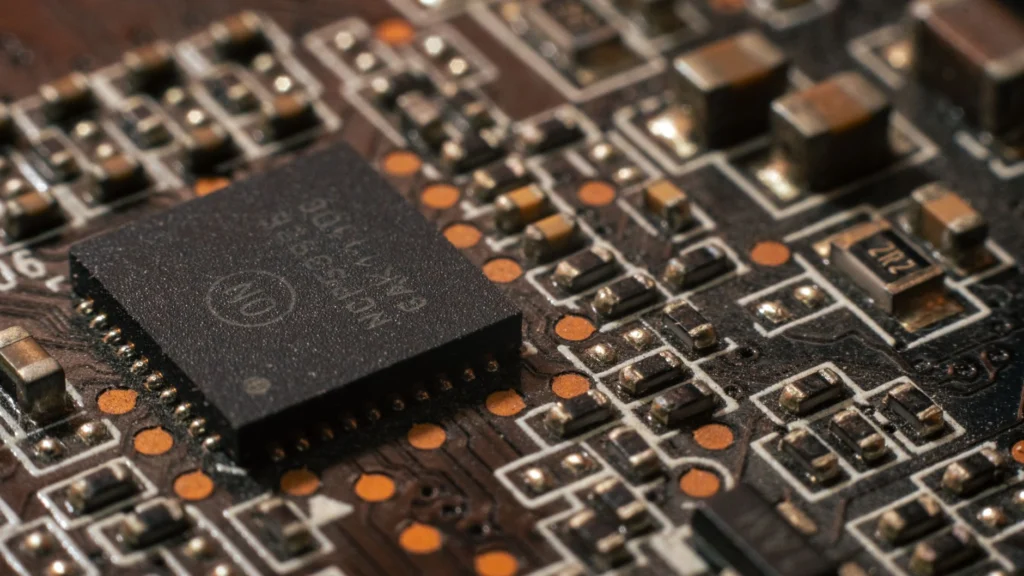
Modern generative AI relies heavily on specialized processors, particularly GPUs and other AI accelerators. Nvidia has become the most visible company in this part of the supply chain because its hardware is widely used to train and operate large AI systems.
But a chip is only one part of the infrastructure.
Thousands or tens of thousands of processors must be installed in servers, connected through extremely high-speed networking and operated together as a computing system. Those machines need storage, cooling and uninterrupted electricity. At sufficient scale, building AI capacity starts to resemble industrial construction as much as traditional software development.
That is why Nvidia's expansion itself has become partly a manufacturing and supply-chain story. In 2025, the company said Blackwell chip production had started at TSMC facilities in Phoenix, Arizona, while manufacturing facilities for AI supercomputers were being developed in Texas with Foxconn and Wistron. Nvidia said it had commissioned more than a million square feet of manufacturing space for Blackwell chips and AI supercomputers.
Later that year, Nvidia and TSMC marked the production of the first Nvidia Blackwell wafer manufactured in the United States.
That is AI infrastructure in its most literal form: factories, semiconductor equipment and supply chains before the AI system ever reaches a data center.
The Stargate project shows why AI infrastructure has become a real-estate and construction business
Stargate is one of the clearest examples of how large the infrastructure race has become.
When OpenAI announced the project in January 2025, it described an intention to invest $500 billion over four years in new AI infrastructure in the United States, beginning with deployment in Texas.
By July 2025, OpenAI said Oracle and OpenAI had agreed to develop 4.5 gigawatts of additional Stargate data-center capacity in the United States. Combined with the initial Abilene, Texas site, OpenAI said Stargate had more than 5 gigawatts of capacity under development and was expected to involve more than 2 million chips.
The terminology matters here. A gigawatt is a unit of power, not computing performance.
The fact that AI projects are increasingly described in gigawatts illustrates the shift underway. For many of the largest AI companies, the constraint is no longer simply buying enough servers. They must also find places where those servers can physically operate and where the electrical system can support them.
In September 2025, OpenAI announced five additional U.S. Stargate sites. The company said the projects, combined with its Abilene campus and ongoing CoreWeave projects, represented nearly 7 gigawatts of planned capacity and more than $400 billion in investment over three years. Those are company projections and commitments rather than a statement that all of that infrastructure had already been completed.
That distinction is important. AI infrastructure announcements often involve planned capacity, multi-year contracts and projected investment. A headline figure can represent an intention to build, a contractual commitment or infrastructure still under construction rather than money already spent.
The electricity problem may be just as important as the chip problem
A data center full of advanced AI processors is not useful without electricity.
That has pushed technology companies into parts of the energy industry that once seemed far removed from software.
Microsoft's agreement with Constellation provides one of the most striking examples. In September 2024, Constellation announced a 20-year power purchase agreement with Microsoft that would support the restart of Three Mile Island Unit 1 under a new name, the Crane Clean Energy Center. Constellation said the restarted facility would add approximately 835 megawatts of carbon-free power to the grid.
Microsoft's role in the agreement was tied to its broader data-center electricity needs.
The arrangement also illustrates why the phrase "AI infrastructure" can now include assets that have nothing visually resembling artificial intelligence. Nuclear reactors, transmission systems, substations and power-generation facilities are becoming part of the conversation because advanced computing requires reliable electricity around the clock.
OpenAI and SoftBank have also moved directly into energy-related infrastructure. In January 2026, Reuters reported that the two companies were jointly investing $1 billion in SB Energy, with $500 million from each company, to support data-center and energy infrastructure connected to the Stargate buildout. Reuters reported that SB Energy was developing a 1.2-gigawatt data center in Milam County, Texas.
This is one reason AI infrastructure spending is so much larger than simply purchasing GPUs. The machines are expensive, but the facilities and energy systems required to operate them can be enormous projects in their own right.
The real competition is increasingly about securing capacity before someone else does
AI infrastructure has a supply problem.
The best chips cannot be manufactured instantly. Data centers take time to construct. Grid connections can require lengthy planning and approval processes. Large quantities of electricity cannot necessarily be added wherever a technology company decides to build.
That creates a powerful incentive to secure capacity years in advance.
OpenAI's Stargate arrangements involve long-term development of computing capacity. Nvidia is expanding manufacturing and assembly capacity. Companies are signing major electricity agreements and partnering with utilities and energy developers.
The same pattern is visible outside the United States. In Taiwan, Nvidia and Foxconn announced in 2025 that they were working with the Taiwanese government on an AI factory supercomputer expected to use 10,000 Nvidia Blackwell GPUs. TSMC researchers were expected to use the system for research and development.
These investments are effectively bets on future demand.
A company building a major AI model cannot wait until it needs another data center and then expect one to appear immediately. Securing infrastructure is becoming part of product strategy.
Why AI infrastructure spending can look circular, and why the distinction matters
The infrastructure boom has also created a more complicated financial ecosystem.
Cloud providers buy AI chips. AI companies rent cloud capacity. Infrastructure developers build data centers based partly on long-term customer commitments. Chip companies sell equipment into those projects and, in some cases, also invest in the broader ecosystem supporting demand for their products.
That does not automatically make the spending artificial or meaningless. Building physical infrastructure requires interconnected commercial relationships.
But it does mean that announced investment figures deserve careful reading.
A "$500 billion project" does not necessarily mean $500 billion has already changed hands. A multiyear infrastructure agreement may combine future construction costs, power purchases, leases and hardware spending. A company's projected capacity may depend on projects that still require construction, financing or regulatory approval.
The most useful way to understand AI infrastructure is therefore to look past the largest headline number and ask a more concrete question: What is actually being built, who is paying for it, and what physical bottleneck does it solve?
In Stargate's case, the answer includes data centers and massive amounts of computing capacity. In Microsoft's agreement with Constellation, it includes nuclear generation. In Nvidia's case, it includes semiconductor manufacturing and AI supercomputer assembly.
AI infrastructure is becoming the physical foundation beneath software
For years, software companies could often scale primarily by renting more cloud capacity.
AI is changing that equation at the highest end.
The companies developing frontier systems still use cloud infrastructure, but the scale of their requirements is pushing them toward direct involvement in data-center development, chip supply and energy procurement. The infrastructure underneath AI is becoming strategic enough that access to compute may shape which companies can train larger models and deploy them to millions of users.
That does not mean every AI company needs to build a power plant or manufacture chips. Most will continue to buy services from infrastructure providers.
But the companies at the center of the AI race are increasingly making decisions that once belonged to industrial companies: where to build, how much electricity to secure, which factories can supply the hardware and how many years ahead to reserve capacity.
That is why everyone is investing in AI infrastructure. The AI model may be software, but the competition to build and run it is becoming intensely physical.
If your company or product is mentioned in this article, you're welcome to share it.