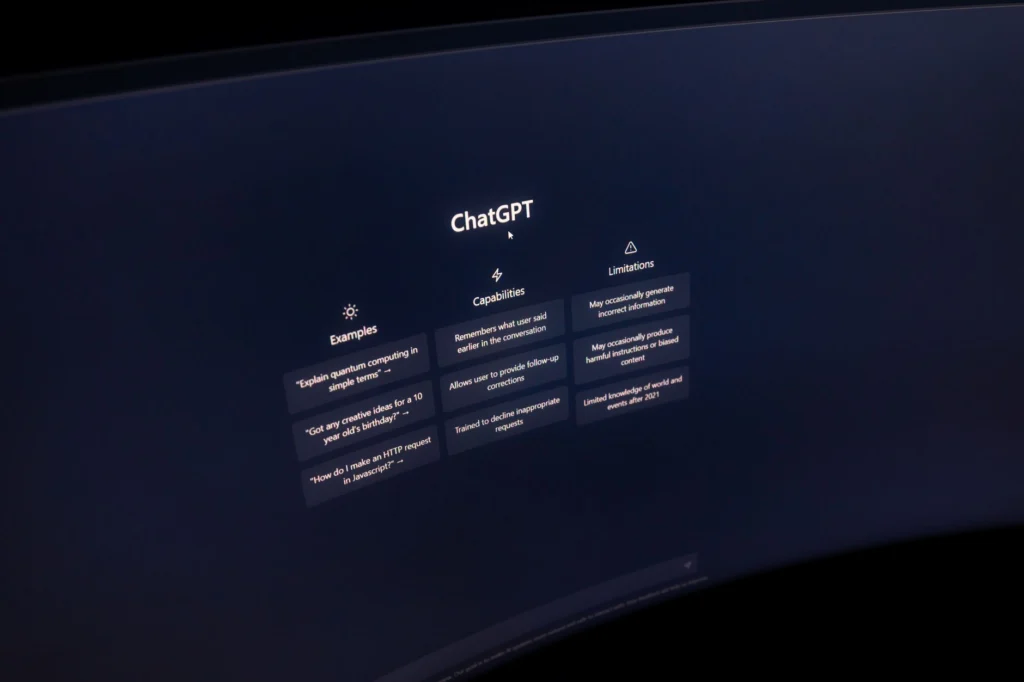
ChatGPT made the modern AI boom feel conversational. You typed a question, the model answered, and then waited for the next prompt.
That interaction is now starting to look like an intermediate stage rather than the final form of consumer and workplace AI.
The strongest current signal is not that chatbots are about to disappear. They plainly are not. The more plausible shift is that the chatbot interface will become less visible as AI systems are given tools, memory, access to software and permission to complete larger pieces of work.
If there is a next big AI trend after chatbots, my best guess is that it will not be a single product category at all. It will be the transition from AI you talk to toward AI that does things, supported by smaller models running closer to users and an enormous buildout of the computing infrastructure needed for the work that cannot.
That is an analysis of where the evidence currently points, not a prediction that can be treated as settled fact.
The chatbot may become the front door, not the whole building
Chatbots solved an important interface problem. They made advanced AI accessible without requiring people to learn programming languages or complicated software menus.
But a chatbot is fundamentally reactive. It usually waits for an instruction, produces an answer, and waits again.
AI agents are trying to change that unit of interaction.
An agent can be given a goal and access to tools, then work through multiple steps: searching for information, using software, editing files, running code or checking its own output before returning to the user. That does not mean today's agents are universally reliable. They are not. Long-running tasks, planning and error recovery remain difficult problems.
Still, there are meaningful signs that companies are moving in this direction.
OpenAI said in August 2026 that enterprise AI usage among its customers was becoming increasingly agentic. According to its published analysis, Codex accounted for 64% of the combined output tokens from Codex and ChatGPT among enterprise customers as of June, which OpenAI interprets as evidence of a shift from assistance toward delegated work. The company's data also showed rapid growth in Codex use beyond engineering, including legal, sales, recruiting and marketing.
Those numbers should be interpreted carefully. They describe OpenAI's own enterprise ecosystem, not the entire AI industry. But they are still a useful signal.
The distinction matters because the next wave of AI adoption may be measured less by how many people ask a model questions and more by how much work they are comfortable delegating to it.
A chatbot helps write an email. An agent may eventually find the relevant information, prepare the draft, update the attached document and leave the result ready for approval.
That is a much more consequential change in software behaviour.
Agentic AI has a clearer commercial argument than another chatbot
There is a reason companies keep pushing agents despite their reliability problems: the economic case is easier to understand.
A better chatbot gives users better answers. An effective agent could potentially complete a task that previously required multiple pieces of software and a human moving information between them.
OpenAI's enterprise research describes this difference as a movement from assistance to execution. Its May 2026 data similarly found that companies using AI most intensively were increasingly adopting delegated workflows rather than simply using AI for isolated prompts.
That does not mean every company should immediately hand important processes to autonomous software. AI systems can still make mistakes with considerable confidence, and Stanford's AI Index has noted that complex reasoning remains a significant weakness, particularly on problems requiring reliable logical reasoning and planning.
This may be exactly why the near-term trend is likely to be supervised agency rather than science-fiction autonomy.
The useful version of an AI agent may not be a digital employee operating completely independently. It may be software that can complete 80% of a workflow and knows when to stop and ask a human for approval.
That is less dramatic. It may also be considerably more practical.
The second shift may happen inside the devices people already own
At the same time, another part of AI is moving in the opposite direction from giant data centres.
Models are getting smaller and more efficient.
Stanford's 2025 AI Index found that the smallest model exceeding 60% on the MMLU benchmark fell from Google's 540-billion-parameter PaLM in 2022 to Microsoft's 3.8-billion-parameter Phi-3-mini by 2024. The report also found that the cost of inference for a system performing around the GPT-3.5 level fell more than 280-fold between November 2022 and October 2024.
Those trends help explain why on-device AI is becoming more plausible.
Apple's June 2026 announcement of its third-generation Apple Foundation Models included dedicated on-device models alongside more powerful server-based systems. Apple described the architecture as a combination of local processing and Private Cloud Compute rather than a simple choice between running everything on a phone or sending everything to a distant server.
That hybrid approach may be more important than the headline claim that AI is moving "onto devices."
Some tasks are small, repetitive or privacy-sensitive and may benefit from local processing. Others require substantially more computing power. The likely future is not entirely on-device AI or entirely cloud AI. It is software deciding where a particular piece of AI work should happen.
If that model wins, AI could become less conspicuous. Instead of opening a chatbot, users may simply notice that their devices can understand context, organise information, translate speech or perform actions without sending every interaction through the same visible chat window.
The biggest AI trend may be invisible infrastructure
There is also a less glamorous answer to the question.
The next major AI trend could be infrastructure.
The public conversation around AI often focuses on models and products, but the industry is simultaneously spending extraordinary amounts on the chips, networking, power generation and data centres required to operate increasingly capable systems.
Reuters reported in July 2026 that capital expenditure by Microsoft, Alphabet, Amazon, Meta and Oracle was putting pressure on free cash flow as those companies expanded AI investment. The same analysis highlighted the growing question investors are asking: whether AI revenue will eventually justify the scale of infrastructure spending.
That question is important because infrastructure is not merely a background detail.
Agents can consume substantially more computation than short chatbot exchanges. Systems that continuously process information, use tools and work through long tasks need somewhere to run. More capable models also create demand for larger and more sophisticated computing systems.
Nvidia's continued importance to the AI economy is part of that story, but so are networking companies, cloud providers, data-centre operators and energy suppliers. Recent reporting has also highlighted the increasingly complicated financing arrangements supporting large AI infrastructure projects, alongside concerns about whether some investment structures are sustainable.
The AI boom may therefore produce two trends at once: increasingly invisible AI on personal devices and increasingly enormous industrial infrastructure behind the services that cannot run locally.
The next breakthrough may be the disappearance of the AI interface
This is the possibility I find most interesting.
The chatbot was revolutionary partly because it made AI visible. You went to the AI, opened the conversation and started typing.
The next phase may make AI less visible precisely because it becomes more useful.
An agent might sit inside a work application rather than a separate chatbot. A small model might process a request on a phone without the user knowing which model handled it. A larger cloud model might take over only when the local system cannot complete the task.
The consumer may not care.
People rarely think about the database architecture behind an online store or the specific machine-learning model deciding whether a photo is blurry. They care whether the result works.
That is why I would be cautious about declaring "AI agents" the single inevitable successor to chatbots. Agentic systems are the strongest current candidate for the next major product shift, but on-device AI and infrastructure expansion are not separate stories. They are parts of the same transition.
Chatbots taught people how to interact with AI. The next stage may be defined by software that requires less interaction in the first place.
And if that happens, the biggest sign that AI has moved beyond the chatbot era may be surprisingly simple: we may stop opening AI apps to use AI at all.
If your company or product is mentioned in this article, you're welcome to share it.