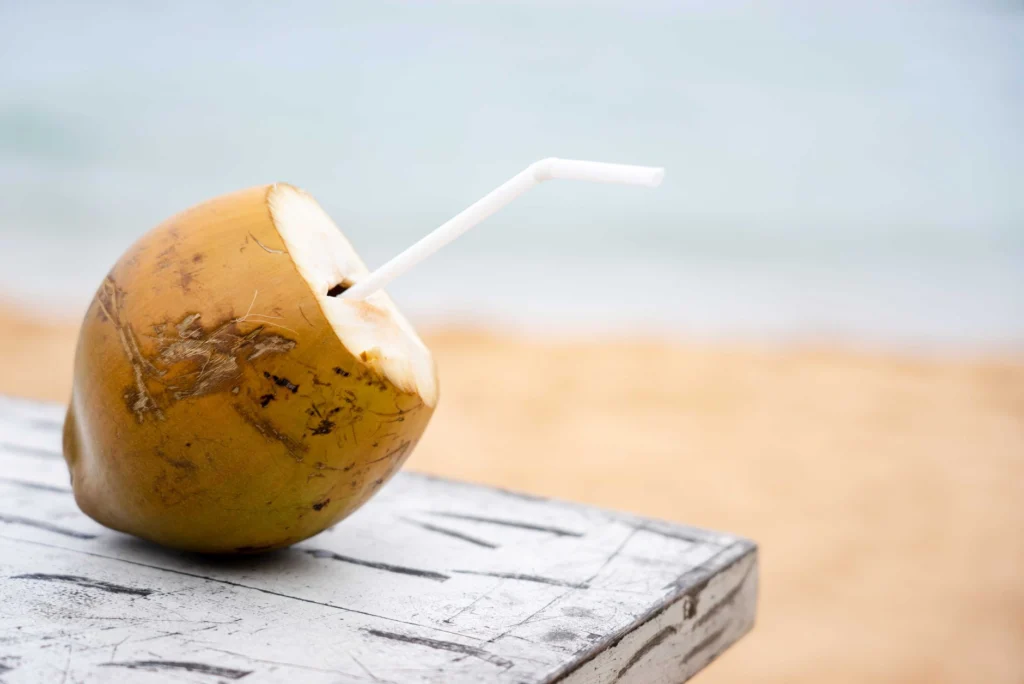
Every tropical beach photo seems to come with the same prop: a coconut, straw in, sitting in the sand. That image feels like modern wellness marketing — but the actual story behind it runs through a battlefield, a genuine medical emergency, and now a multi-billion-dollar industry. Here’s the real version, not the postcard one.
Long before the wellness industry, coconuts were a survival tool
For centuries across the Pacific and Indian Ocean tropics, coconut palms weren’t a beach aesthetic — they were one of the most reliable sources of clean, sealed liquid available on remote coastlines and islands, long before bottled water existed anywhere. A young, unopened coconut is naturally sterile inside its shell, which made it a genuinely trustworthy drinking source in places where any other standing water carried real risk. That practical fact, not marketing, is the actual root of the coconut’s association with beach and island survival.
The real WWII story — and what it actually proved
The most dramatic chapter of coconut water’s history happened on real battlefields. In the Pacific theater of World War II, when sterile saline supplies ran out, battlefield medics on both sides genuinely turned to coconuts growing overhead: British forces in Sri Lanka and Japanese forces in Sumatra both used coconut water intravenously as an emergency substitute for standard IV fluids, tapping directly into fresh young coconuts to help stabilize soldiers suffering from dehydration and blood loss. In 1942, a documented case in Havana, Cuba saw a physician inject filtered coconut water into the veins of 12 children with no adverse reactions reported at the time.
It’s worth being precise about what this actually proves, because the popular version of this story oversells it. Coconut water isn’t chemically close to blood plasma at all — analysis shows it’s actually closer in composition to intracellular fluid, the fluid inside your body’s cells. It contains real electrolytes, mainly potassium and sodium, in concentrations that could temporarily support circulation in a genuine emergency, buying time until proper medical supplies arrived. But modern medicine has fully abandoned the practice: its sodium content isn’t high enough to stay usefully in the bloodstream, and infusing it can push potassium levels dangerously high. The WWII story is real and documented — it just proves coconut water was a genuine, clever stopgap under desperate conditions, not a real substitute for blood plasma, then or now.
What the real hydration science actually says
Strip away the wartime drama and modern marketing both, and the honest science lands somewhere reasonable rather than miraculous. Coconut water genuinely contains potassium, sodium, and magnesium, and real research has found it provides hydrating effects comparable to standard carbohydrate-electrolyte sports drinks after exercise — a legitimate, evidence-backed use case, not just branding. At 45-60 calories and 11-12 grams of sugar per cup, it’s also genuinely lower in added sugar than most commercial sports drinks. The honest caveat researchers are direct about: current evidence doesn’t support the broader wellness-industry claims built on top of that real baseline, and coconut water shouldn’t replace plain water as anyone’s primary hydration source — it’s a reasonable exercise-recovery option, not a health elixir.
From island staple to a real, booming global industry
The modern coconut water business has scaled into something genuinely large. Market valuations vary by research firm, but every estimate agrees on the direction: the global coconut water market was valued in the billions in 2025 and is projected to keep growing at a real double-digit annual rate through the early 2030s, driven by demand for clean-label, plant-based, lower-sugar beverages. Vita Coco, the category’s dominant brand, reported $216 million in net sales in a single recent quarter — a 28% increase, with coconut water sales specifically up 21%. The company has been actively consolidating the category too, acquiring the super-premium coconut water brand Copra in a deal worth $175 million, split between cash and company stock — a real, current signal that a product once split open on a beach with a machete is now a serious, actively-expanding consumer packaged goods category.
How coconut water actually became a global product, not just a local one
Turning a tropical drink meant to be consumed within hours of opening into a shelf-stable global product was a real, specific technical problem, not just a marketing rollout. Fresh coconut water begins fermenting and spoiling quickly once exposed to air, which meant the entire modern industry depended on flash-pasteurization and aseptic packaging technology reaching a point where it could preserve the drink’s taste without the metallic, cooked flavor early attempts produced. That technical hurdle is a genuine part of why coconut water only became a mainstream global commodity in the last two decades, despite having been consumed locally in tropical regions for centuries — the fruit didn’t change, the packaging science did.
Why the beach image still fits, honestly
What’s genuinely interesting is that the modern marketing image — a fresh coconut on a tropical beach — isn’t actually disconnected from the product’s real history the way most wellness branding is. Coconuts really were a practical coastal survival resource for centuries before anyone bottled the water, they really were used as a real, documented emergency medical intervention during an actual war, and the hydration science behind them, while more modest than the marketing suggests, is genuinely real rather than fabricated. The postcard image and the actual history point in the same direction — they just disagree, honestly, about how miraculous the drink inside the shell actually is.
If your company or product is mentioned in this article, you're welcome to share it.