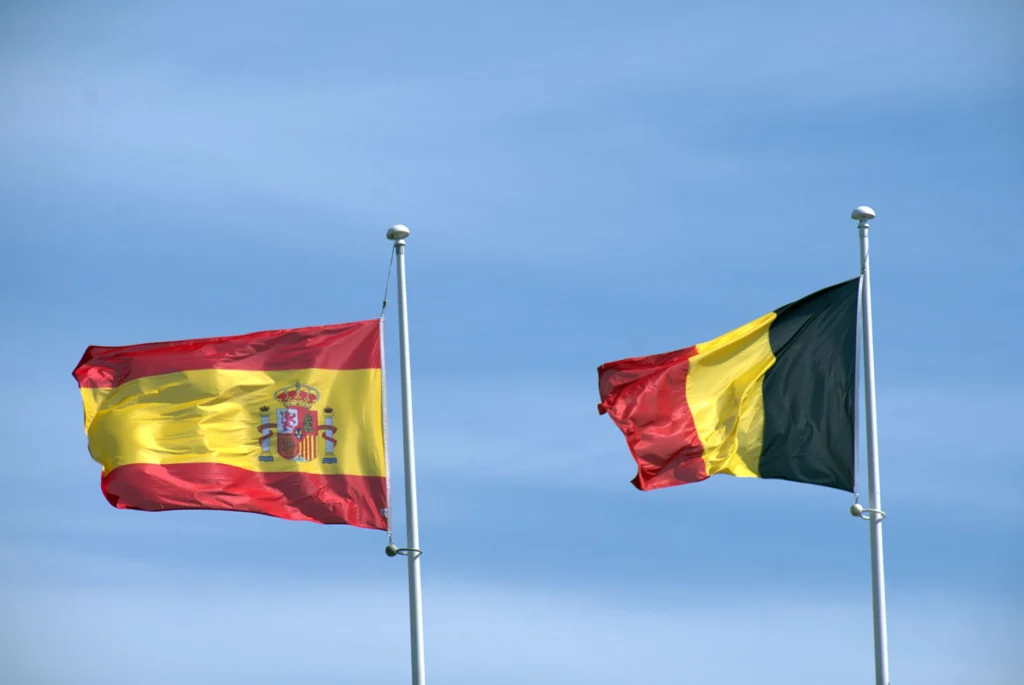
Spain did not need a spectacular quarter-final against Belgium to keep its World Cup campaign alive. It needed to solve a specific problem: how to break down a compact Belgium side without losing control of the transitions that could hurt it.
The 2-1 win in Los Angeles on July 10 ultimately answered that question, although not cleanly. Spain had 67.9% possession, 17 shots and eight on target, compared with Belgium’s five shots and two on target. (skysports.com) Yet Belgium still found a way through Spain’s defence for the first time at the tournament, and the game remained level until Mikel Merino’s 88th-minute winner.
That combination matters. Spain did not simply overpower Belgium. It controlled most of the match, absorbed the one major punishment Belgium produced, then used its depth and patience to find the decisive moment.
The result sent Spain into the semi-finals against France. More significantly, it showed what this Spain could look like when an opponent refused to give it the easy spaces it had enjoyed earlier in the tournament.
Spain controlled the ball, but Belgium controlled the problem
Belgium’s plan was straightforward: stay compact, deny Spain central space and attack quickly when possession changed hands.
FIFA’s match report describes Belgium’s approach as a clearly defined defensive plan built around denying space and using Jérémy Doku’s pace and dribbling ability in transition. That was the correct problem to pose to Spain. (fifa.com)
Spain responded by moving the ball patiently and repeatedly looking for openings on the right. Lamine Yamal was the principal source of penetration, with his dribbling forcing Belgium’s defensive line to react rather than simply hold its shape. FIFA identified Yamal as Spain’s most prominent attacking threat during the match. (fifa.com)
The numbers show that Spain was not merely circulating possession for its own sake. The 17-5 shot advantage and 8-2 advantage in shots on target indicate that the possession was producing attempts. Spain also completed 598 accurate passes at a 90.1% accuracy rate, compared with Belgium’s 243 accurate passes at 77.9%. (skysports.com)
That distinction became important later in the tournament. Spain’s possession was functioning as territorial control, not just aesthetic control.
Yamal gave Spain the width Belgium could not ignore
The first Spanish goal illustrated the mechanism.
At around the half-hour mark, Yamal accelerated on the right and created the sequence that eventually produced Fabián Ruiz’s opener. Pedro Porro delivered the cross, Dani Olmo’s effort was parried by Thibaut Courtois, and Ruiz reacted first to the rebound. (fifa.com)
It was not a goal created by one intricate passing combination through the middle. Spain moved Belgium laterally, then exploited the space created by Yamal’s ability to attack defenders directly.
That is one of the more consequential features of this Spain side. Its possession game has an obvious historical connection to the Spanish teams of the past, but the presence of players such as Yamal changes the geometry of the attack. A winger who can receive wide, drive inside or beat his defender forces a low or mid-block to make decisions before Spain has even played the final pass.
Against Belgium, Yamal repeatedly created that tension. Sky Sports recorded six efforts at goal and four successful dribbles, while describing much of Spain’s patient build-up as being channelled through him. (skysports.com)
Belgium could contain Spain for long periods. It could not make Yamal irrelevant.
Belgium’s equaliser exposed the risk Spain cannot eliminate
The 41st-minute equaliser was the other side of the tactical equation.
Spain had spent much of the half controlling the ball, but Belgium did not need sustained possession to create its goal. Timothy Castagne supplied a dangerous cross and Charles De Ketelaere, operating as a makeshift No. 9, headed it past Unai Simón. (skysports.com)
That was Spain’s first concession of the tournament.
It also reinforced a recurring trade-off in possession-heavy football. When Spain pushes players forward and commits numbers to the opponent’s half, it can control the game while still leaving moments in which a fast attack can bypass the pressure.
Belgium had the players to exploit exactly that type of opening. Doku could carry the ball, while Kevin De Bruyne could provide the next pass. Spain therefore had to defend transitions without abandoning the attacking structure that had given it control in the first place.
Pau Cubarsí’s yellow card in the 43rd minute came after he stopped a counter involving De Bruyne, another indication of the danger Belgium represented when it escaped Spain’s pressure. (live-result.com)
The lesson was not that Spain’s system had failed. It was that Belgium had identified the narrow route through it.
Courtois kept Belgium alive longer than the score suggested
Spain’s territorial advantage did not translate immediately into a second goal because Courtois repeatedly intervened.
Lamine Yamal was denied after being released by Cubarsí, and Courtois later saved another Yamal effort as well as an attempt from Mikel Oyarzabal. (skysports.com)
This is where the final score can be misleading. A 2-1 quarter-final suggests a narrow contest. The underlying shot numbers tell a different story: Spain produced 17 attempts to Belgium’s five and eight shots on target to Belgium’s two. (skysports.com)
Belgium remained dangerous, but it was increasingly dependent on isolated moments rather than sustained attacking pressure.
That distinction became even more pronounced as the match progressed. Spain kept returning the ball into dangerous areas, while Belgium’s defensive block had to repeatedly clear, recover and reset.
The longer that continued, the more Spain’s bench mattered.
Merino’s late arrival showed why Spain’s squad depth mattered
Mikel Merino entered in the 86th minute. Two minutes later, he scored.
The goal itself was scrappy rather than artistic. Pau Cubarsí’s low shot was spilled by substitute goalkeeper Senne Lammens, who had replaced Courtois after the Belgian goalkeeper was forced off injured. Merino reacted to the rebound and finished with his second touch. (skysports.com)
That sequence contained an element of fortune. Spain did not manufacture a perfect final move and carve Belgium open. It capitalised on a goalkeeper error at exactly the moment Belgium’s margin for error had become almost nonexistent.
But Merino’s positioning and readiness were not accidental.
He had already scored Spain’s late winner against Portugal in the round of 16, again after coming from the bench. (fifa.com) Against Belgium, he again provided a solution after Spain’s starting attackers had spent most of the match trying to break the same defensive structure.
That is a useful distinction when assessing Spain’s tournament credentials. The team was not dependent on its first-choice attacking pattern producing a goal every time. It had another route: change the personnel, alter the physical profile of the attack and keep applying pressure.
Merino’s two late knockout goals became a defining feature of Spain’s route through the bracket.
The result changed the stakes for Spain’s campaign
The immediate consequence was obvious: Spain reached its first World Cup semi-final since 2010 and earned a meeting with France. FIFA’s tournament record confirms the sequence: Spain beat Austria 3-0 in the round of 32, Portugal 1-0 in the round of 16 and Belgium 2-1 in the quarter-final. (uefa.com)
But the Belgium match mattered beyond simply adding another victory.
Spain had entered the knockout rounds after a mixed group stage. It opened with a surprising 0-0 draw against World Cup debutants Cabo Verde before beating Saudi Arabia 4-0 and Uruguay 1-0. (fifa.com)
The knockout phase then showed a different side of the team. Austria was beaten convincingly. Portugal required a 90th-minute winner. Belgium required an 88th-minute winner.
The pattern was becoming clear: Spain could dominate matches without necessarily turning that control into an early separation.
That could be viewed as a weakness. It could also be evidence of tournament maturity. Spain was finding ways to win when the ideal version of its football was not enough.
Against Belgium, it had to do all of those things at once: dominate possession, create chances, defend transitions, withstand an equaliser and find a winner against a compact opponent.
It managed all of them.
What Belgium revealed about Spain before the semi-final
The most useful conclusion from the quarter-final was not that Spain was unbeatable. The match demonstrated almost the opposite.
Belgium showed that a disciplined defensive structure could make Spain work for every opening. It also showed that Spain’s high-possession approach could leave opportunities for transition attacks.
France presented a much more dangerous version of that test.
By the time Spain reached the semi-final, FIFA noted that La Roja had conceded only one goal in the tournament, despite that clean-sheet run ending against Belgium. (fifa.com) France, meanwhile, had the attacking quality to punish any defensive transition with players such as Kylian Mbappé, Ousmane Dembélé and Michael Olise.
So the Belgium result was not evidence that Spain had solved every problem. It was evidence that Spain had enough control, attacking variety and bench quality to survive the problems an elite knockout opponent could create.
That turned out to be the defining trait of the campaign.
Spain eventually went beyond France, reached the final and beat Argentina 1-0 after extra time to win the 2026 World Cup. FIFA recorded the tournament as Spain’s second World Cup title, while Rodri won the Golden Ball and Unai Simón the Golden Glove. (fifa.com)
Seen from the end of the tournament, the 2-1 victory over Belgium looks less like a narrow escape and more like a useful preview of the champions Spain became: dominant with the ball, vulnerable in isolated moments, and capable of finding a different way to win when the first plan stopped being enough.