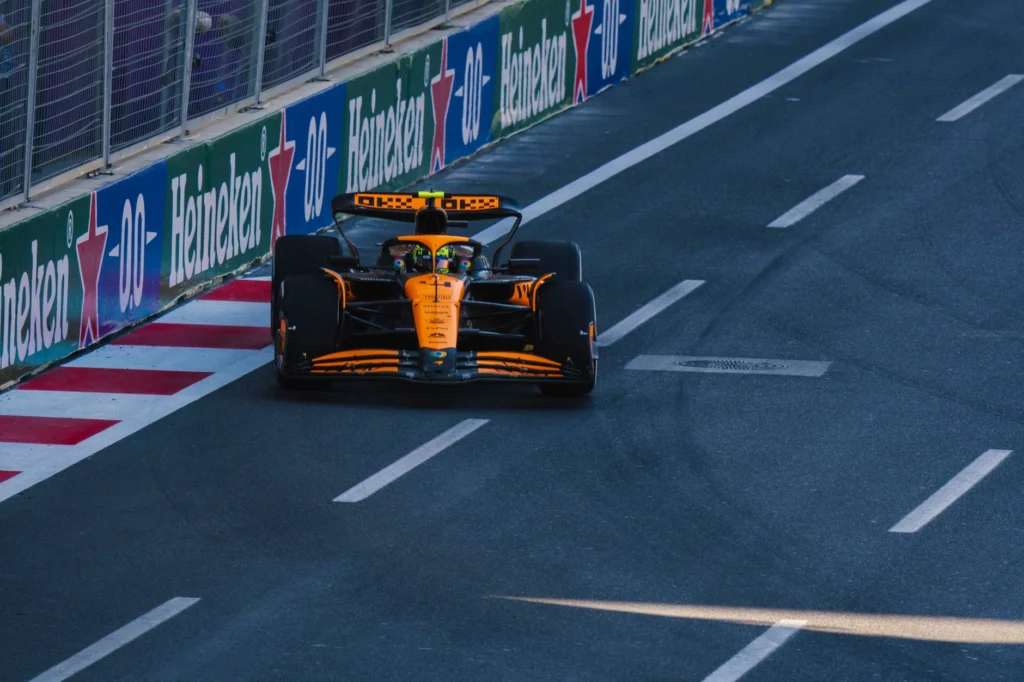
Lando Norris started the 2026 Dutch Grand Prix from pole, lost the lead to Kimi Antonelli at the first restart, regained it later, and ultimately won by 11.536 seconds. The finishing order makes qualifying look straightforward: Norris started first and finished first. The race itself was anything but.
The decisive qualifying session put Norris ahead of George Russell, Antonelli and Oscar Piastri by margins of 0.102s, 0.133s and 0.142s respectively. Max Verstappen, meanwhile, qualified seventh. (formula1.com)
Those positions mattered because Zandvoort gave the leading cars very little room to recover from a bad starting position. The first-lap red flag then reset the race, but it did not erase the advantage of being near the front. Instead, it created another standing start in which the qualifying order became strategically relevant all over again.
Norris's pole mattered even after Antonelli took the lead
Norris did not convert pole into an immediate, uninterrupted lead.
At the original start, Antonelli moved ahead of Russell and held second, while Norris retained first. One lap later, Verstappen crashed after losing the rear of his Red Bull, bringing out the red flag. The race was then restarted from a standing start using the order at the end of Lap 1. (formula1.com)
That gave Antonelli another opportunity.
He launched better than Norris and took the lead into Turn 1. The Mercedes driver then established enough of a gap to make the McLaren's qualifying advantage temporarily irrelevant. Norris could not simply drive past him. At Zandvoort, track position was still worth a great deal.
But Norris's pole position had given the team the position it needed to control the restart and, crucially, to remain directly behind the Mercedes rather than fighting through traffic.
That distinction became important later.
The top four started on different tactical footing
The qualifying order was unusually compact, but the race strategies were not identical.
Norris, Russell, Antonelli and Piastri all qualified in the top four, yet the teams did not put those cars on the same tyre at the restart. After the red flag, Norris switched to the soft tyre, while both Mercedes cars stayed on mediums. Piastri went onto hards. (formula1.com)
That was one of the clearest examples of qualifying position interacting with strategy.
Norris had the luxury of changing his tyre choice while remaining at the front. Piastri, starting fourth, could make a more aggressive alternative choice without having to fight through the midfield. Mercedes, with Russell and Antonelli occupying second and third, retained track position while choosing the medium compound.
The result was not immediately obvious. Antonelli's medium tyre helped him lead after the restart, and Norris initially struggled to put serious pressure on him.
But the McLaren's race pace changed once the first major pit-stop cycle arrived.
Norris's qualifying advantage became a tyre advantage later
Norris and Antonelli both stopped at the end of Lap 21, moving onto hard tyres. That initially put the two championship contenders on broadly comparable footing.
Then the performance picture shifted.
According to Sky Sports' race report, Norris was significantly faster on the hard tyre during the second stint. The McLaren eventually regained the lead, showing why the value of pole position at Zandvoort cannot be measured simply by asking who led the first lap. (skysports.com)
Norris had started the race with clean air and spent most of the opening phase directly behind the Mercedes rather than having to overtake several cars before reaching it. That made it possible for McLaren to keep its strategy centred on the Mercedes battle.
The eventual winning margin was 11.536 seconds. (formula1.com)
Qualifying did not win the race by itself. Norris's pace and McLaren's tyre strategy did that. But starting first gave the team the track position from which those decisions could work.
Antonelli gained a place from qualifying and turned it into second
Antonelli's third-place qualifying result was arguably more valuable than the raw number suggests.
He started behind Norris and Russell, but passed Russell at the opening start and repeated the move at the restart. That put him into second place, where he could attack Norris without first having to dispose of another car. (formula1.com)
The final result was second place.
That is a direct one-place improvement over his qualifying position, but it also had championship significance. Antonelli entered the weekend as the championship leader and left Zandvoort with his advantage intact. Sky Sports reported that his championship lead extended to 59 points after the race. (skysports.com)
His qualifying position therefore did two jobs: it put him within striking distance of pole at the start, and it protected him from the midfield battles that could have complicated his race after the red flag.
Russell's second-place start was harder to convert
Russell qualified second, just 0.102 seconds behind Norris, after taking pole for Saturday's Sprint.
His Grand Prix started well enough. He lost second to Antonelli but remained inside the leading group. His problem came much later, when strategy began reshuffling the podium.
During a Virtual Safety Car caused by Esteban Ocon's Haas stopping on track, Antonelli pitted for fresh soft tyres. Russell and Norris did not stop at that moment, leaving Antonelli behind Russell when he returned to the circuit. (formula1.com)
That created a classic trade-off between track position and tyre life.
Russell had the position because he had qualified second and maintained it through the early race. Antonelli had the newer tyres because Mercedes had used the VSC to make a relatively cheap pit stop.
Eventually Mercedes ordered Russell to let Antonelli through on Lap 65. Russell then had to defend from Lewis Hamilton and Charles Leclerc, both of whom were on fresher rubber after their own stops.
He survived and finished third. (skysports.com)
So Russell's second-place qualifying position did not translate into second place. It did, however, put him in exactly the position Mercedes needed to preserve a double podium when the strategy became complicated.
Piastri shows why fourth on the grid was not the same as fourth in the race
Piastri's qualifying result was particularly revealing.
He was only 0.142 seconds off Norris's pole time and started fourth, yet finished sixth. (skysports.com)
The Australian initially gained a position at the restart, passing Russell for third. But he later fell behind the two Ferraris and finished 32.332 seconds behind his team-mate. (formula1.com)
His choice of hard tyres at the restart illustrates the problem. Piastri had enough qualifying pace to start near the front, but his alternative tyre strategy did not produce the same race outcome as Norris's approach.
That is why the Dutch GP should not be reduced to the usual claim that "pole position won the race." The qualifying result established the tactical board. What each team did with that board determined the finishing order.
Verstappen's seventh-place qualifying result never had time to matter
Max Verstappen qualified seventh, 0.455 seconds slower than Norris in Q3. (formula1.com)
At his home race, that was already a difficult starting position. The situation became irrelevant almost immediately.
Verstappen crashed at the end of the opening lap after losing the rear of his Red Bull, triggering the red flag and retiring from the race without completing a classified racing lap. (formula1.com)
His result is a useful reminder of the limits of any qualifying-based analysis. Starting position can influence strategy, overtaking opportunities and tyre choices, but it cannot protect a car from an incident.
The Dutch GP turned qualifying into a race-long strategic asset
The final classification makes the qualifying effect unusually easy to trace.
Norris went P1 to P1. Antonelli went P3 to P2. Russell went P2 to P3. Hamilton went P5 to P4. Leclerc went P6 to P5. Piastri went P4 to P6. Verstappen went P7 to DNF. (formula1.com)
The positions were not mechanically preserved, but the front of the qualifying grid remained the centre of the race.
Most importantly, Norris's pole gave him the cleanest possible starting position for a race that featured a red flag, a second standing start, multiple tyre strategies and two late Virtual Safety Car periods. He did not lead every phase. He did not even lead after the decisive restart.
He still ended up winning because the position earned on Saturday gave McLaren the platform to fight the race on its own terms.
At Zandvoort, that was the real value of qualifying. It was not simply about starting ahead. It was about making sure that when the race changed shape, Norris was already in the place from which the next move could be made.
If your company or product is mentioned in this article, you're welcome to share it.