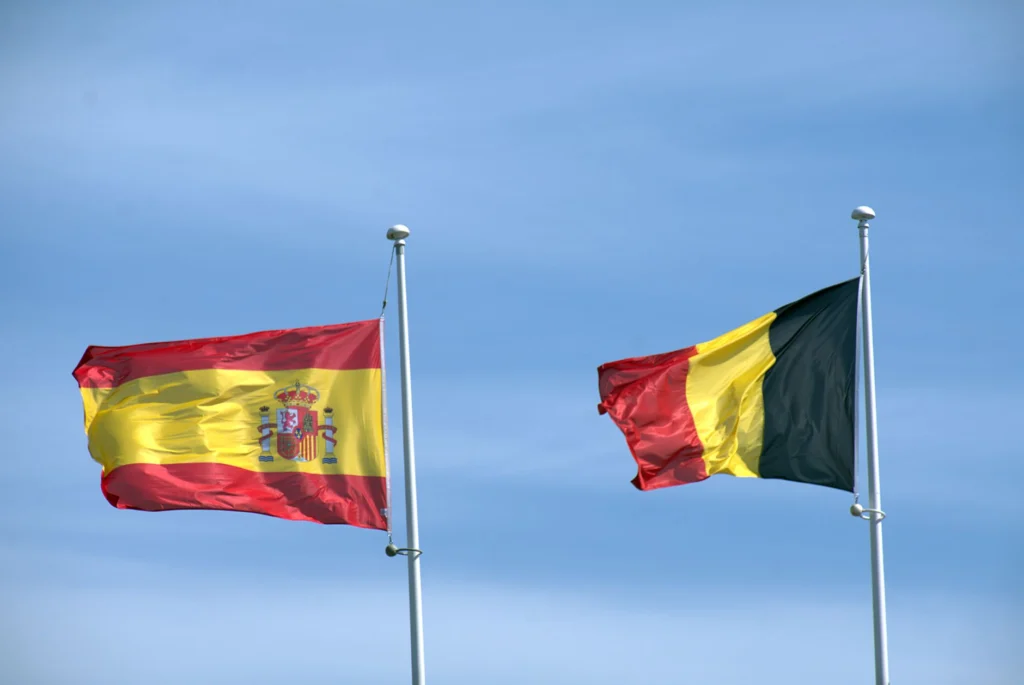
Spain had 68% of the ball against Belgium in their 2026 World Cup quarter-final, completed 665 passes to Belgium’s 314, and finished with 17 shots to five. Yet Belgium found a way to make the game uncomfortable for long stretches, and the reason was not possession. It was what happened immediately after Spain lost it.
The 2-1 result at Los Angeles Stadium on July 10 ultimately sent Spain into the semi-finals, but Belgium’s approach offered a useful test of a weakness that can be hidden by Spain’s control: the space left behind an attacking structure when the ball turns over.
Belgium did not spend the match launching hopeful balls forward. Their plan was more selective. They defended compactly, waited for opportunities to release Jérémy Doku, and relied on Kevin De Bruyne’s ability to turn those transitions into something more dangerous. FIFA’s match report specifically described Belgium’s plan as denying Spain space and using Doku’s pace and dribbling to hurt them. (fifa.com)
That plan produced Belgium’s only goal.
Spain controlled the ball, but Belgium controlled the dangerous moments after turnovers
Luis de la Fuente’s Spain started in a 4-2-3-1, with Rodri behind Fabián Ruiz, Lamine Yamal and Álex Baena operating from the wider attacking areas, and Dani Olmo behind Mikel Oyarzabal. Belgium used a similar nominal shape, with Doku and De Bruyne positioned behind Charles De Ketelaere. (fbref.com)
The difference was how those shapes behaved without the ball.
Spain wanted to establish possession high up the pitch. Their full-backs could advance, Yamal would receive in the right half-space or wide channel, and the midfield would circulate the ball until a gap appeared.
Belgium accepted that pressure.
The Belgian defensive block stayed compact rather than trying to match Spain possession for possession. That reduced the amount of central space available to Olmo and Oyarzabal and encouraged Spain to work around the outside.
It also created the conditions Belgium wanted when Spain eventually lost the ball.
Doku was particularly important because he could turn a defensive recovery into territory without requiring several passes. His first movement was often vertical. Instead of slowing the transition down, he could carry the ball toward Spain's defensive line and force defenders to retreat.
That distinction matters. Belgium did not need to create ten counterattacks. It needed a few situations in which Spain's rest defence was moving backwards.
Spain’s first goal showed why Belgium had to defend so deep
Spain's opening goal was almost the opposite of Belgium's approach.
At the half-hour mark, Yamal accelerated down the right and found Pedro Porro advancing into the penalty area. Porro pulled the ball back toward Dani Olmo, whose first-time effort was saved by Thibaut Courtois. Fabián Ruiz followed the play and converted the rebound. (theguardian.com)
It was a useful illustration of the problem Belgium faced.
If its defensive line stepped out too aggressively, Yamal could attack the space behind it. If the midfield pushed too high, Spain could combine through the gaps. And if Belgium defended too deep, Spain could keep circulating the ball until players such as Porro arrived from deeper positions.
The numbers reflected that territorial imbalance. Spain had 68% possession and 17 shots, while Belgium managed five shots and two on target. (extratime.com)
But Spain's dominance did not eliminate Belgium's transition threat.
It merely meant Belgium had fewer opportunities to use it.
Belgium’s equaliser was a transition, but not a simple counterattack
The equaliser in the 41st minute is the clearest example of why the scoreline was more complicated than the possession figures.
Belgium's move began with Doku driving forward. The attack then developed around De Bruyne, whose first-time pass released Timothy Castagne. Castagne delivered the cross and De Ketelaere attacked the space ahead of Pau Cubarsí to head Belgium level. (theguardian.com)
Calling this a classic counterattack would oversimplify it. Belgium did not simply win the ball and race 60 metres toward goal.
It was a transition sequence built around three qualities: Doku's ability to advance the ball quickly, De Bruyne's ability to make an early forward pass, and Castagne's willingness to join the attack immediately.
That combination mattered because Spain's defenders were being asked to reorganise while moving toward their own goal.
For a possession-heavy team, this is one of the inherent trade-offs of attacking with numbers. The more players committed ahead of the ball, the more important the rest-defence structure becomes behind it.
Belgium found that moment once, and it was enough to change the match.
Doku was the outlet Spain could not completely remove
Doku's role was not simply to stay wide and wait for a long pass.
His value came from what happened when Spain's defensive shape was incomplete.
If Spain's full-back moved toward him, Doku could attack the outside. If the defender held position, he could carry the ball inside. If Spain's midfield collapsed toward him, Belgium could use De Bruyne to connect the next pass.
That gave Belgium a mechanism for escaping pressure.
FIFA's own report identified Doku as the central part of Belgium's planned method, while its account of the second half described the duel between Yamal and Doku as one of the match's defining individual contests. (fifa.com)
There was a revealing moment after half-time. Doku and De Bruyne combined to put Maxim De Cuyper into a shooting position, and De Cuyper's effort struck the side-netting. (theguardian.com)
Belgium therefore had a second route to threaten Spain: Doku could initiate the transition, De Bruyne could accelerate it with his passing, and another Belgian player could arrive into the space created.
Spain were still the better team. They simply could not treat possession as the same thing as control.
Spain’s answer was to keep Belgium pinned back
The important tactical point is that Spain did not respond by becoming cautious.
They continued to attack.
Yamal remained heavily involved, Courtois made several saves, and Spain repeatedly moved the ball around Belgium's compact block. The Spanish attack continued producing chances even after De Ketelaere's equaliser. (theguardian.com)
That persistence eventually changed the nature of the transition problem.
A counterattack requires the defending team to regain possession and then have enough players available to attack. If Spain could sustain pressure for long enough, Belgium's forwards had fewer opportunities to participate in those moments.
This is where Spain's territorial dominance mattered more than the possession percentage itself.
Belgium were spending increasing amounts of time defending their own penalty area.
Courtois became central to their survival. According to the match statistics, Spain forced six goalkeeper saves compared with one for Belgium's Unai Simón. (news.bet365.com)
The longer Belgium stayed deep, the more difficult it became to turn defensive recoveries into clean counterattacks.
Courtois’ injury changed the final calculation
Belgium's defensive resistance took another blow in the 71st minute when Courtois was forced off with a thigh injury. Senne Lammens replaced him. (theguardian.com)
That did not suddenly make Belgium's structure ineffective. They continued to defend compactly and Spain still had to find a way through.
But the goalkeeper change removed a player who had already kept the score level on several occasions.
By the closing stages, Belgium were defending deeper and Spain were repeatedly recycling possession around the final third.
Then came the decisive moment.
Merino exposed the final weakness Spain had been waiting for
Mikel Merino entered in the 86th minute for Olmo.
Less than two minutes later, Spain had the winner.
Pedri, who had replaced Fabián Ruiz earlier, helped create the sequence with a shot that Lammens saved. The Belgian goalkeeper could not hold the ball, and Merino reacted first to finish from close range in the 88th minute. (beinsports.com)
It was not a counterattack. It was the product of sustained pressure finally producing a mistake.
That distinction explains the match better than the final score does.
Belgium's counterattacking plan genuinely tested Spain. Doku's running, De Bruyne's passing and De Ketelaere's movement produced the equaliser and another dangerous second-half opportunity. But Belgium could not sustain those attacks because Spain kept winning territory and forcing them back.
The numbers make the imbalance clear: Spain's 17 shots and 68% possession compared with Belgium's five shots and 32%. (extratime.com)
Belgium did not lose because the counterattack failed as an idea. It lost because Spain's possession eventually became territorial pressure, and territorial pressure reduced the number of clean transitions Belgium could generate.
For Spain, that may be the more useful lesson from the quarter-final. The team did not eliminate every danger created by its attacking structure. It overwhelmed the opponent often enough that those dangers became isolated rather than continuous.
Belgium found the opening once.
Spain kept asking the same question until Belgium finally ran out of answers.