Lando Norris won the 2026 Dutch Grand Prix by making two planned stops, while the race that Pirelli had expected to be a one-stop event evolved into a tyre-management contest shaped by rain, a red flag and unexpectedly high degradation.
That change is the key to understanding the strategy at Zandvoort.
Before the race, Pirelli's projection was straightforward: the quickest plan was expected to be a Medium-to-Hard one-stop, with the first stop somewhere around Laps 27-33. A Soft-to-Hard one-stop was considered roughly one second slower. Two stops were competitive in clean air, but Zandvoort's limited overtaking opportunities made the extra pit stop a significant risk. (formula1.com)
By the end of Sunday, almost none of that pre-race picture survived intact.
Pirelli's post-race assessment said degradation, which had looked relatively limited during the previous sessions, became significant after the rain altered the track surface. The resulting slipperiness increased wear and pushed teams toward two- and three-stop strategies. (formula1.com)
The one-stop race disappeared almost immediately
The original tyre picture was already complicated before the lights went out.
Heavy rain had fallen before the start, leaving parts of the circuit damp. Most of the field nevertheless chose slicks, with many drivers starting on Softs. Norris, Antonelli, Russell and Piastri were among those on Mediums, while Cadillac's Valtteri Bottas and Sergio Perez started on Hards. (formula1.com)
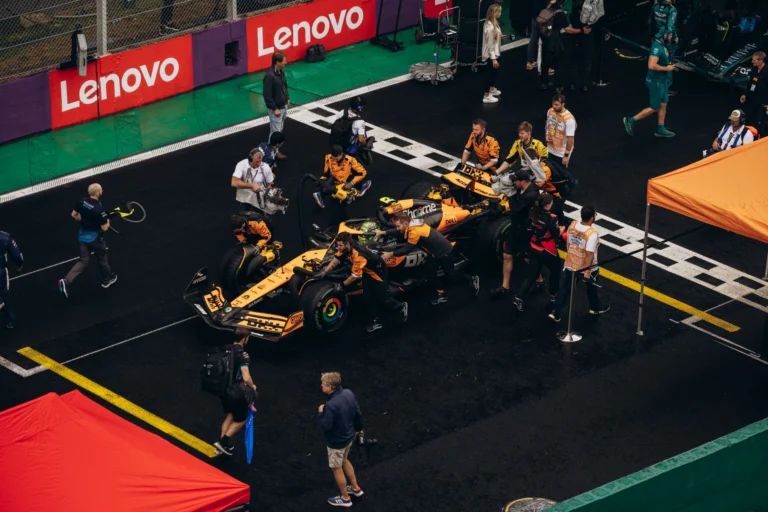
Then came Max Verstappen's Lap 1 crash and the red flag.
The stoppage created an unusual strategic reset. Norris changed to Softs for the restart, Mercedes kept Antonelli and Russell on Mediums, and Piastri switched to Hards. The race was effectively given another strategic starting point, but teams were still operating on incomplete information about how quickly the tyres would deteriorate over a full stint. (formula1.com)
The important detail is that the red flag did not simply create a different tyre allocation. It changed the assumptions teams had made about stint length.
The track had not behaved like the dry, relatively stable surface seen during Saturday's Sprint.
Pirelli's pre-race model underestimated what the rain would do
On Saturday, the Soft tyre had looked much more usable than expected. Ferrari's Charles Leclerc had used it successfully in the Sprint, and Pirelli reported limited thermal degradation. Its pre-race conclusion was that the harder compounds should dominate the Grand Prix, but that all three slick compounds were viable. (formula1.com)
Sunday produced a different tyre environment.
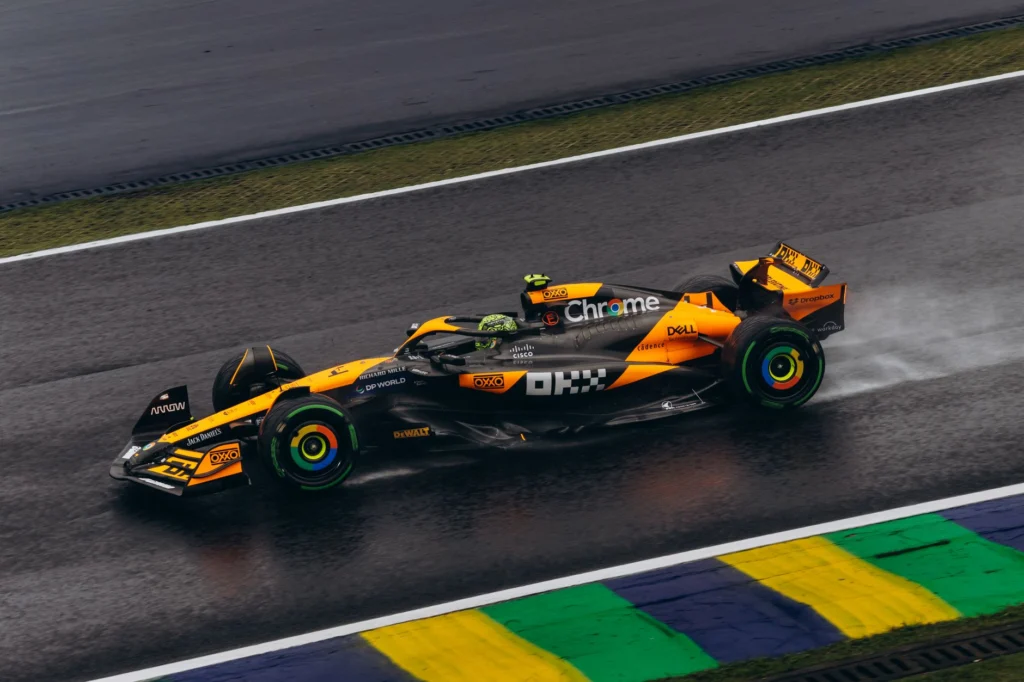
The rain altered the grip level and, according to Pirelli, left the circuit particularly slippery. That increased wear and changed the degradation picture enough that teams discovered almost immediately after the restart that staying competitive on one set for the originally anticipated distance would be difficult. (formula1.com)
This distinction matters. The problem was not simply that the Soft tyre was too fragile.
All three compounds eventually found useful roles. Pirelli's post-race analysis specifically pointed to the fact that teams exploited different compounds according to their cars and circumstances. Lawson never used the Hard, McLaren did not return to the Medium after the opening phase, while Leclerc used all three compounds. (formula1.com)
The strategic variable was therefore not "which tyre is fastest?" It was "which tyre remains useful for this car, in this track condition, at this point in the race?"
Norris and Antonelli were already managing different races by Lap 22
The first major strategic sequence showed how quickly the original one-stop plan was being stretched.
Russell stopped first among the leading Mercedes and McLaren runners, taking Hards and dropping into traffic. Piastri stopped one lap later for Hards, but a slow pit stop left him behind Russell.
Then, on Lap 22, Antonelli and Norris both stopped and fitted Hards. Both suffered slower-than-ideal stops. (formula1.com)
The significance was not just the pit-lane time.
Norris had spent the opening phase trying to remain within striking distance of Antonelli. Once both drivers switched to Hards, the race became a test of who could extract performance from the tyre without destroying its useful life.
By Lap 30, Norris had brought the gap to Antonelli below one second. But the McLaren's pursuit was not entirely linear. A snap cost Norris some momentum, illustrating the compromise teams were dealing with: pushing hard could close the gap, but excessive tyre stress could undermine the later part of the stint.
The race was beginning to reward tyre preservation without making outright pace irrelevant.
The second stop became an advantage rather than a concession
The clearest strategic turning point came after the first cycle of stops.
Antonelli continued to lead Norris, but his rear tyres became increasingly problematic. By Lap 40 the gap was only 0.7 seconds after Norris had worked through traffic, and Antonelli eventually made another stop for Hards on Lap 41. Russell also stopped. (formula1.com)
Norris stayed out longer.
That decision created a temporary advantage because track position at Zandvoort is valuable. Passing is difficult, so surrendering position for fresh tyres cannot be treated as an automatic improvement.
But the longer Norris remained out, the more the team had to balance track position against tyre condition.
He eventually stopped on Lap 48 and rejoined third, just over five seconds behind Antonelli. That might initially look like the cost of giving up track position.
It turned out to be the setup for the decisive phase of the race.
Norris's fresher tyres allowed him to close the gap rapidly. Three laps after the stop, the deficit was down to 1.4 seconds. By Lap 52, he was right behind Antonelli, whose rear tyres were beginning to struggle. (formula1.com)
The tyre advantage gave Norris the chance to attack
Norris passed Antonelli on Lap 54, sweeping around the outside into Turn 1 before passing Lewis Hamilton later in the same lap to reclaim the lead. (formula1.com)
The overtaking move was not simply a product of fresher tyres, but the tyre offset created the opportunity.
Norris later explained that he knew he would have few chances to pass Antonelli and that every lap spent behind him reduced those opportunities. He also described making adjustments to his brake balance before committing to the move. (formula1.com)
That is the strategic lesson from the race.
A pit stop at Zandvoort costs track position, but refusing to stop can cost tyre performance. The winning strategy was not necessarily the one that minimised pit stops. It was the one that produced the right tyre advantage at the moment when overtaking became possible.
Mercedes then used a late tyre gamble to protect second place
The final strategic twist came with the Virtual Safety Car caused by Esteban Ocon stopping his Haas.
Antonelli took the opportunity to pit for Softs while Norris and Russell stayed out. Antonelli rejoined behind Russell, meaning Mercedes had traded track position for a significant tyre advantage with roughly 15 laps remaining. (formula1.com)
Norris briefly considered whether he should have made the same call, but the VSC ended before he could respond.
The result was an unusual situation: Antonelli had fresher tyres but was stuck behind his own team-mate, while Norris had older rubber but a substantial lead.
Mercedes eventually ordered Russell to let Antonelli through on Lap 65. The team judged that allowing the championship leader onto the fresher-tyre strategy gave Antonelli the best chance of securing second. (formula1.com)
Antonelli could not close the gap to Norris.
He finished second, 11.536 seconds behind the McLaren, while Russell held third ahead of the two Ferraris. (formula1.com)
Zandvoort showed why degradation matters more than the tyre compound itself
The most revealing part of the 2026 Dutch GP was how quickly the strategic hierarchy changed.
Before the race, Pirelli expected a Medium-Hard one-stop to be the fastest conventional strategy. During the race, the combination of rain-affected track conditions and higher degradation pushed teams toward two or even three stops. Pirelli said almost ten different strategies emerged after the first red flag, with major differences even among the leading teams. (formula1.com)
That is why the Dutch GP cannot be reduced to "Norris had better tyres."
Norris won because McLaren managed the changing tyre picture well enough to preserve the car's race pace while creating a useful tyre offset for the decisive attack. Antonelli led for much of the race, but his strategy eventually left him vulnerable when his rear tyres deteriorated and Norris arrived with the pace to attack.
The late Soft-tyre gamble also showed the other side of the equation. Antonelli gained enough performance to pass Russell, but the pit stop cost him the position temporarily and the fresh rubber was not enough to overcome Norris's advantage.
Zandvoort had looked like a race where the safest strategy was to stop once and protect track position.
Instead, the rain changed the surface, the tyres degraded more than expected, and the value of fresh rubber increased as the race progressed. The winner was the driver who timed that transition best.
At the final Dutch Grand Prix, tyre degradation did not merely influence the strategy. It rewrote it.