Motorcycle racing isn’t one sport — it’s a whole family of them, sharing a governing body and not much else. A MotoGP rider leaned over at 350 km/h on smooth tarmac and a trials rider crawling a motorcycle up a wet boulder face at walking pace are both, technically, competing in FIM-sanctioned motorcycle sport. Here’s how the whole structure actually fits together, and what genuinely separates each discipline from the next.
Who actually runs motorcycle racing
The Fédération Internationale de Motocyclisme (FIM), founded in 1904 and based in Switzerland, is the sport’s global governing body — an independent association formed by national motorcycling federations from around the world, and recognized by the International Olympic Committee as the sole competent authority over motorcycle sport. The FIM doesn’t run every race directly; it sanctions national federations (like America’s AMA, or Britain’s Auto-Cycle Union) and commercial promoters (like Dorna, which runs MotoGP) to organize championships under its rules, and it owns the World Championship titles those series compete for.
The FIM’s own list of flagship World Championships gives away just how broad the sport actually is: MotoGP, Superbike, Endurance, Motocross, Supercross, Trial, Enduro, and Speedway — eight genuinely distinct disciplines, each with its own bikes, tracks, and skill set, all under one federation’s umbrella.
Road racing: the paved-surface disciplines
MotoGP is the premier class of the FIM Road Racing World Championship, and the one most people mean when they say “motorcycle racing.” A MotoGP weekend is built around three classes racing together at every round: Moto3 (single-cylinder, 250cc, the entry tier for the youngest riders), Moto2 (identical 765cc Triax engines for every team, so the class becomes a pure test of chassis and rider skill), and MotoGP itself, where manufacturers like Ducati, Yamaha, Honda, KTM, and Aprilia field prototype machines built specifically for racing, not derived from any bike sold to the public.
Since 2023, every MotoGP round has run two races instead of one: a Saturday afternoon Sprint over half race distance, paying points to the top nine finishers (12-9-7-6-5-4-3-2-1), and the full-distance Sunday Grand Prix, paying points 25 down to 1 across the top fifteen. A rider can bank a maximum of 37 points in a single weekend — win the Sprint, win the Sunday race. Moto2 and Moto3 still run a single race each, on Sunday only.
Superbike (WorldSBK) is road racing’s other major road-course championship, and its defining rule is the opposite of MotoGP’s: the bikes have to start life as real, showroom-available motorcycles, heavily modified for racing but recognizably related to something you could actually buy. That single distinction — prototype versus production-based — is the cleanest way to tell MotoGP and Superbike apart.
Endurance racing flips the format entirely: instead of one rider chasing the fastest single lap, teams of two or three riders share a single motorcycle across races that run for hours instead of minutes, the Le Mans 24 Heures Motos among the best known, testing reliability and pit strategy as much as outright speed.
Then there’s road racing’s most extreme outlier: the Isle of Man TT. Run since 1907 and organized by the island’s own Auto-Cycle Union, it isn’t held on a purpose-built circuit at all — it’s raced on 37.7 miles of closed public road, the Snaefell Mountain Course, with riders passing stone walls and hedgerows at genuine racing speed. It sits outside the FIM World Championship structure entirely, which is part of why it’s developed its own singular, dangerous mystique rather than folding into the mainstream road-racing calendar.
Off-road on dirt: motocross, supercross, and enduro
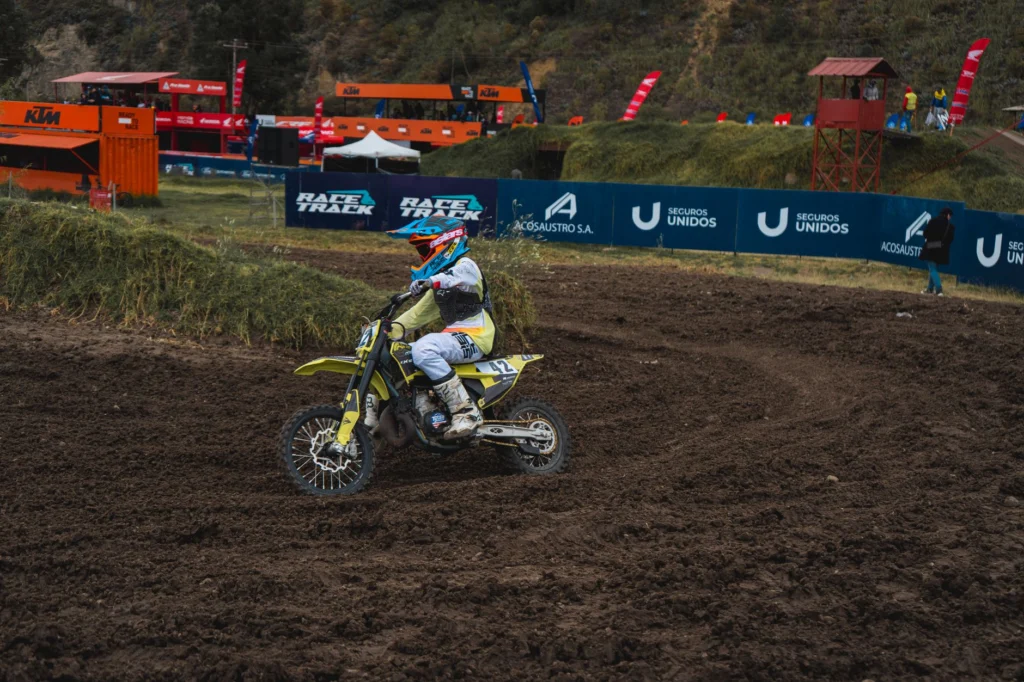
Motocross is raced on closed-loop natural-terrain circuits — dirt, jumps, berms, elevation changes — and is widely regarded as the most physically demanding discipline in the sport, since riders are wrestling a bike over rough ground for the length of an entire moto rather than holding a clean racing line. The FIM’s MXGP World Championship is the top tier, itself split into classes by engine displacement.
Supercross is motocross’s stadium-built cousin: the name is literally a mashup of “Super Bowl” and “motocross,” born in 1972 when the discipline moved off natural terrain and into constructed dirt tracks inside major sports stadiums, tighter, more technical, and built for a paying indoor crowd rather than an open field.
Enduro takes the opposite approach to distance: long, timed off-road courses through forest and rough countryside, testing endurance and navigation as much as raw speed, with special timed sections scored against a target time rather than a simple first-past-the-post finish. Its most extreme sub-category, Hard Enduro, is built almost entirely around near-impossible obstacles — rock faces, waterfalls, log piles — where simply finishing counts as a real result.
Speedway and flat track: oval racing without brakes
Speedway is raced on short oval dirt tracks with a genuinely stripped-down machine: no brakes, a single gear, and riders controlling the bike almost entirely through throttle and a deliberate, sustained rear-wheel slide through every corner. Flat track is speedway’s close North American relative, run on larger ovals — from short tracks up to full-mile ones — with a similar sliding, brakeless riding style but its own bikes, rules, and championship lineage separate from the FIM Speedway World Championship.
Trials: the slowest, most technical discipline in the sport
Trials inverts nearly every assumption people bring to motorcycle racing: there’s no straight-line speed at all. Riders navigate a course over rocks, ledges, and near-vertical obstacles at walking pace, and the winner isn’t whoever’s fastest — it’s whoever accumulates the fewest penalty points for putting a foot down or failing a section. It’s arguably the purest test of raw bike control in the entire sport, precisely because speed is taken almost entirely off the table.
Rally-raid: navigation across a continent
Rally-raid racing, headlined by the Dakar Rally, is a different kind of endurance test altogether: multi-day, cross-country events through deserts and mountains where riders navigate largely by roadbook rather than following a marked track, and getting lost can cost more time than any mechanical problem. Organized by the Amaury Sport Organisation since its first running in 1978 (originally Paris to Dakar, now based in Saudi Arabia), it blends raw speed with real-time navigation and mechanical survival in a way no closed-circuit discipline does.
Why the sport is organized this way
The throughline across all of it is the FIM’s role as a rules-and-sanctioning body rather than a single race promoter: it sets technical regulations, safety standards, and awards World Championship status, while commercial partners and national federations actually run the events on the ground — Dorna for MotoGP, the Auto-Cycle Union for the Isle of Man TT, the ASO for Dakar, and so on. That’s why the sport can hold together as one federation while looking, discipline to discipline, almost nothing alike: a MotoGP prototype and a brakeless speedway bike are both motorcycle racing in the FIM’s eyes, built to entirely different rulebooks, for entirely different tests of what a rider and a machine can actually do.
Sources: FIM, MotoGP.com, Isle of Man TT, Dakar Rally.