A perfectly smooth golf ball, struck with exactly the same swing as a real dimpled one, travels a genuinely shorter distance — not slightly shorter, dramatically shorter. That’s a strange enough result that it took real aerodynamics research to explain, because the dimples work by deliberately making the airflow around the ball rougher, not smoother, which is the opposite of what most people would guess “less drag” requires.
Where the drag actually comes from
As a golf ball flies through the air, a thin layer of air right against its surface — the boundary layer — determines almost everything about how much the ball is slowed down. On a smooth sphere, that boundary layer stays laminar (smooth, orderly flow) for only a short distance before separating from the ball’s surface, well before reaching the back of the ball. Once it separates, it leaves behind a large, low-pressure wake trailing the ball, and that wake is the actual source of most of the drag: the pressure difference between the high-pressure air pushing on the front of the ball and the low-pressure wake behind it is what physically slows the ball down. A bigger wake means a bigger pressure difference, which means more drag.
What the dimples are actually doing
Dimples deliberately trip the boundary layer from smooth, laminar flow into turbulent flow — genuinely rougher, more chaotic airflow right at the ball’s surface. That sounds like it should make things worse, and in one narrow sense it does: a turbulent boundary layer does generate more skin-friction drag than a laminar one would. But turbulent flow has a crucial advantage laminar flow doesn’t — it carries more kinetic energy right at the surface, which lets it stay attached to the ball’s curved surface much longer before separating. Delaying that separation point shrinks the low-pressure wake behind the ball dramatically, and that shrinkage reduces the dominant form of drag — pressure drag — by far more than the small increase in skin friction costs. The net physics: turbulent flow costs a little in friction and saves a lot in wake size, and the trade is decisively worth it.
Why dimple design isn’t arbitrary
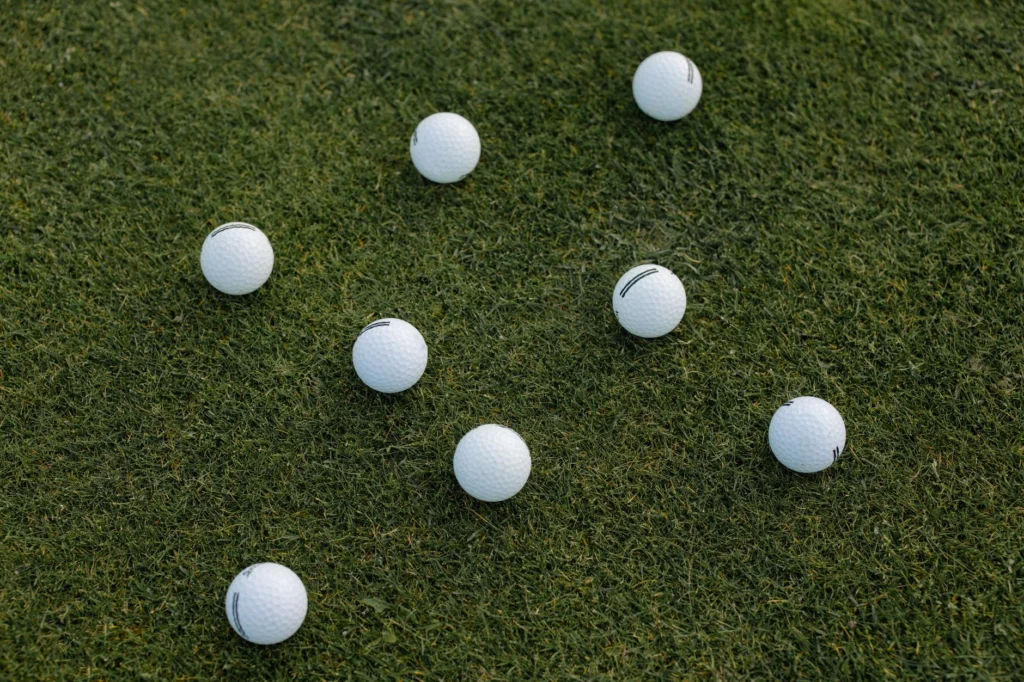
The number, size, depth and shape of the dimples all directly tune this tradeoff. Deeper or more numerous dimples increase surface roughness and the associated skin-friction drag, but they also more effectively trip the boundary layer into turbulence earlier, which is a genuine balancing act — golf ball manufacturers run real aerodynamic testing to land on dimple patterns that minimize total drag rather than just maximizing one side of the tradeoff. This is also why dimple patterns vary meaningfully between manufacturers and ball models, rather than converging on one universal design.
The actual takeaway
Dimples don’t work by smoothing the airflow around a golf ball — they work by deliberately roughening it, tripping the boundary layer into turbulence specifically so it clings to the ball’s surface longer and leaves behind a smaller, lower-drag wake. It’s a genuinely counterintuitive piece of aerodynamics: making the surface rougher produces a ball that flies measurably farther, and the entire effect only exists because pressure drag from a large wake is a far bigger problem than the small skin-friction cost of turbulent flow.