Lando Norris did not win the 2026 Dutch Grand Prix by controlling it from pole. He won after losing the lead, struggling on the opening tyre, finding a much stronger balance on the hard compound, and then making the crucial strategic decision to stay out when Mercedes pitted under a late Virtual Safety Car.
The final margin was 11.536 seconds over Kimi Antonelli. But the number hides how uncertain the race looked for Norris for much of the afternoon. (formula1.com)
Norris' biggest advantage appeared only after McLaren switched to the hard tyre
Norris started from pole, having beaten George Russell by roughly a tenth in a wet-threatened qualifying session. The first start was interrupted almost immediately when Max Verstappen crashed at the end of Lap 1, bringing out the red flags.
At the restart, Antonelli made the better launch and took the lead from Norris.
That created the first strategic problem. Norris could stay within striking distance, but he was not fast enough to attack consistently. Once Antonelli stretched the gap beyond a second, Norris could not use Overtake Mode to pressure the Mercedes. By Lap 16, Norris was telling McLaren that he had essentially nothing left in the tyre. (formula1.com)
The tyre choice also mattered. Most of the field had started on softs for what was expected to be a one-stop race, while Norris and the other leading Mercedes cars had started on mediums. The front-runners subsequently moved toward the hard compound during their stops.
Norris stopped on Lap 22 and took hards. Antonelli did the same lap, also switching to the hard tyre.
That was when the character of Norris' race changed.
McLaren's post-race account says Norris found substantially more pace and confidence on the hard tyre. Norris himself said the car "came alive" after the change, allowing him to push Mercedes rather than simply follow it. (formula1.com)
Norris did not need to pass Antonelli immediately
The important part of the second stint was not an instant attack. Norris gradually reduced the gap.
By Lap 30, he was back to within a second of Antonelli. The gap fluctuated as Norris dealt with traffic and a snap, but the underlying pace was now much closer to what McLaren needed.
Antonelli's position also became more complicated when Mercedes began making its second-round strategy decisions.
On Lap 41, Antonelli stopped for another set of hard tyres. Russell followed. Antonelli emerged behind Lewis Hamilton, while Norris remained on track.
That gave Norris something he had lacked earlier: a strategic opportunity created by Mercedes' own pit cycle.
He soon caught Hamilton and moved into the lead. Antonelli eventually cleared Hamilton as well, but Norris had already established track position. (formula1.com)
The decisive call came when Ocon triggered a Virtual Safety Car
The race's most consequential strategic moment arrived later.
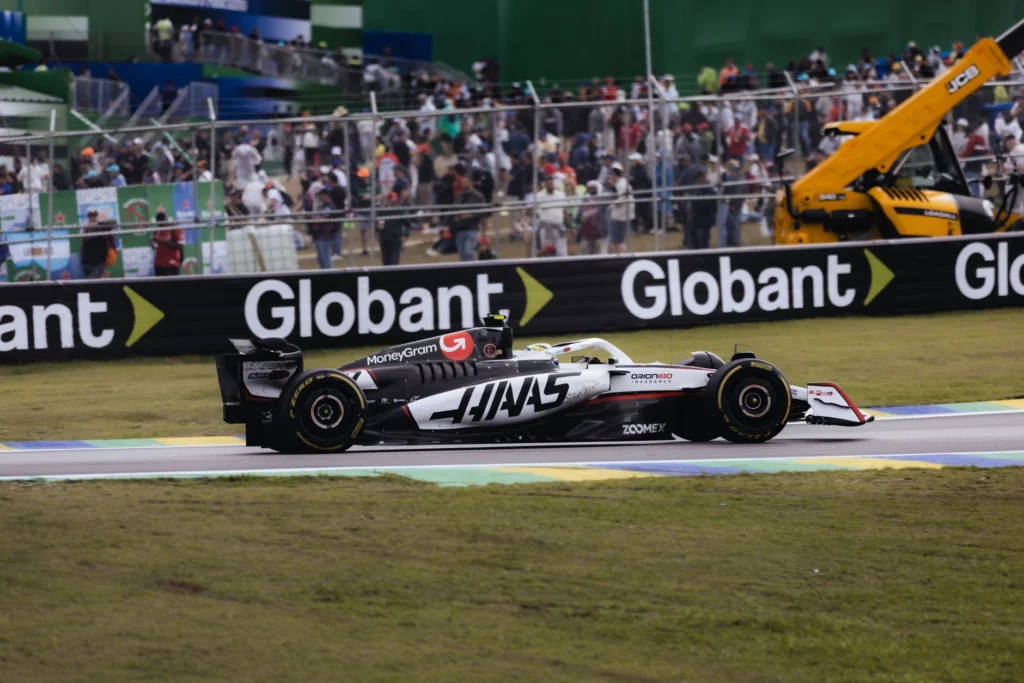
Esteban Ocon's Haas stopped on track, triggering a Virtual Safety Car. Under a VSC, cars must slow to a prescribed delta, which can make a pit stop considerably less expensive in time than during normal racing.
Antonelli took the opportunity. He pitted for soft tyres.
Norris did not.
This was not an obviously comfortable decision. Norris himself questioned the call over the radio, asking whether they should take the stop. But the VSC ended before McLaren made the switch.
Norris therefore restarted with older hard tyres while Antonelli had much fresher softs.
On paper, that looked like the sort of situation that could turn a comfortable lead into a late-race problem.
Instead, Norris pulled away.
When racing resumed on Lap 58, Norris led Russell by 6.8 seconds, with Antonelli another 5.6 seconds behind Russell. With ten laps remaining, Antonelli had closed on Russell, but Norris was still around ten seconds clear. (formula1.com)
The decision worked because the advantage of fresh soft tyres was not enough to overcome the track position and pace Norris retained on the hard compound.
That distinction matters. The strategy was not simply "Norris stayed out and got lucky." The VSC gave Mercedes an attractive opportunity, but McLaren had a car and driver combination capable of making the alternative work.
The pass on Antonelli was set up before Turn 1
Norris' actual winning move came earlier, during the first sequence of second-stint battles.
As Antonelli attempted to defend against Norris, he had to manage Hamilton as well. Once Antonelli was able to use Overtake Mode behind Hamilton, Norris' window became narrower.
Norris eventually committed around the outside of Turn 1 and completed the pass for the lead.
That was the moment the race effectively changed.
The official Formula 1 account of the race quotes Norris describing the outside-line commitment as the move that won him the race. McLaren's assessment is similar: Norris' improved pace on the hard tyre allowed him to pressure Mercedes into an earlier stop, creating the opportunity to take the lead. (formula1.com)
The significance of the move was not merely that Norris overtook Antonelli. It meant McLaren had converted a pace advantage into track position before the late VSC complicated the strategy again.
Mercedes' second strategy left Antonelli chasing from behind
Antonelli ultimately finished second, but his late-race position was partly created by Mercedes' decision to pit under the VSC.
He came back onto soft tyres behind George Russell, who had remained ahead. Mercedes subsequently ordered Russell to let Antonelli through on Lap 65.
Russell complied, putting the championship leader into second.
But by then Norris was too far ahead.
The team order became relevant to the fight for second and third, not the victory. Antonelli could not use the fresher tyres to close the gap to Norris quickly enough, while Russell had to defend from Hamilton and Ferrari in the closing laps. (espn.com)
Russell eventually held third by less than a second over Hamilton.
That made the final result unusually revealing. Mercedes had the fresher tyres and two cars in contention, but the strategic advantage created by the VSC did not translate into a realistic attack on Norris.
McLaren's strategy worked because Norris managed the uncertainty
It would be too simple to describe the Dutch GP as a case of one perfect pit-wall call.
There were several separate decisions.
McLaren started Norris on the medium tyre rather than the soft used by much of the field. It switched him to the hard tyre at the first stop. Norris then used the stronger second-stint performance to force Mercedes to react.
Later, McLaren chose not to pit under the VSC.
Each decision had a different risk profile.
The first was about managing the opening stint. The second unlocked Norris' pace. The third protected track position at the moment when Mercedes had a chance to use fresh soft tyres.
Norris also had to execute the strategy. His radio messages during the first stint showed that he was struggling with the car, and the eventual victory came after that difficult phase rather than because it never existed.
His own assessment after the race was telling: he credited the hard-tyre performance and the team's strategy, but also acknowledged that the McLaren still had weaknesses, particularly in slow-speed corners. (formula1.com)
The Dutch GP was won before the chequered flag, but not by one decision
Norris' 2026 Dutch Grand Prix victory is best understood as a sequence rather than a single strategic gamble.
Antonelli took the lead at the restart. Norris stayed close enough to remain relevant. The hard tyre transformed the McLaren's competitiveness. Norris applied pressure. Mercedes stopped Antonelli. Norris took the lead at Turn 1. Then McLaren resisted the temptation to pit during the late VSC.
That final decision looked dangerous because Antonelli had much fresher tyres.
It became decisive because Norris did not give Mercedes the pace or opportunity it needed.
He crossed the line 11.536 seconds clear, taking his second consecutive Grand Prix victory after winning in Hungary and keeping his championship challenge alive. Antonelli retained second, while Russell completed the podium. (formula1.com)
The important detail is that Norris' victory was not built on having the fastest car at every stage. For much of the first stint, he clearly did not. It was built on McLaren recognizing where its car was stronger, Norris converting that pace into pressure, and both driver and team accepting the risk of staying out when the safer-looking choice was to pit.
At Zandvoort, that risk was the difference between following Mercedes home and winning the final Dutch Grand Prix.