Kimi Antonelli finished second at Zandvoort after leading much of the race, but Mercedes did not simply lose the Dutch Grand Prix on pace. The decisive sequence was more complicated: Antonelli gained positions at both starts, Mercedes lost performance when it moved onto the hard tyre, Norris recovered the lead through a stronger second stint, and a late Virtual Safety Car forced Mercedes into a choice between protecting Antonelli from Ferrari and protecting George Russell’s podium.
The result was a Mercedes double podium, with Antonelli second and Russell third. Lando Norris won by 11.536 seconds, while Lewis Hamilton finished fourth and Charles Leclerc fifth. (formula1.com)
For Antonelli, the strange part was that the race he felt Mercedes could win became a race about limiting damage.
Antonelli’s two starts did more work than his strategy
The first important tactical move happened before Mercedes made a single pit stop.
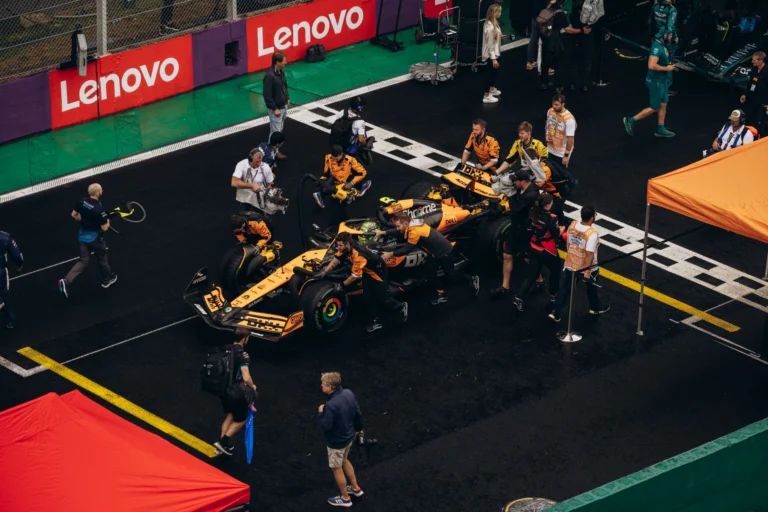
Norris started from pole, with George Russell and Antonelli alongside him near the front. Antonelli launched better than Russell and moved into second at Turn 1. Then Max Verstappen’s crash on the opening lap caused the red flag and a standing restart.
That restart effectively created a second launch opportunity.
Before it, Norris changed to the soft tyre, while both Mercedes cars stayed on mediums. When the race restarted, Antonelli again made the better getaway. He passed Norris and took the lead. (formula1.com)
That was significant because Antonelli later said his two starts had effectively “saved” his race. Mercedes had not arrived at Zandvoort with a car that was consistently comfortable in every phase of the weekend, and Antonelli himself said it was one of the weekends on which he had felt least confident in the car. (formula1.com)
The starts gave him track position that Mercedes' underlying race pace could not necessarily have produced on its own.
The mediums worked. The hard tyres changed the race
The opening stint was the strongest part of Antonelli's afternoon.
Mercedes had started both cars on mediums while many rivals, including much of the field, chose softs. That gave the Silver Arrows a different tyre-management profile and helped Antonelli maintain the lead after the restart.
But the advantage did not survive the first major tyre change.
Antonelli and Norris both pitted on Lap 22 and switched to hard tyres. Norris had been unable to immediately attack Antonelli earlier in the race, but the balance changed once the McLaren was on the hard compound. Mercedes' own post-race assessment was blunt: Antonelli had the measure of Norris in the first stint, then struggled for pace after the change. (formula1.com)
Norris eventually began closing rapidly. By Lap 52, Antonelli was struggling with his rear tyres while Norris was close enough to attack. Antonelli had some temporary protection because he was within a second of Lewis Hamilton and could use Overtake Mode, but that was not enough to keep Norris behind.
Norris passed him into Turn 1 and then took the lead from Hamilton shortly afterwards. (formula1.com)
This is where the strategy story needs some care. It would be too simplistic to say Mercedes “made the wrong tyre call.” The team had chosen a different opening compound and initially gained from it. The harder problem was that the Mercedes did not extract enough performance from the hard tyre later in the race.
Toto Wolff said after the race that Mercedes believed it had the pace to win, but that advantage “ran away” once the team went onto the hard tyre. (formula1.com)
Norris won the strategic battle by making the second stint last
McLaren's winning move was not a single spectacular pit-lane gamble. It was the way Norris managed the race after the first stop.
Norris stopped on Lap 22 with Antonelli, then later made a second stop on Lap 48. The timing mattered because it gave him a fresher tyre advantage for the final phase. He emerged just over five seconds behind Antonelli, then reduced the gap to 1.4 seconds within three laps. (formula1.com)
Mercedes therefore faced a problem that no pit-wall instruction could completely solve. Antonelli was leading because of track position, but Norris had the faster package once the race reached its later stages.
When Norris eventually passed, Mercedes' objective changed.
The win was gone. The priority became keeping Ferrari behind and getting both Mercedes cars onto the podium.
That distinction explains the late strategy call much better than simply saying Antonelli “lost the race.”
The late VSC gave Mercedes one last strategic choice
With Norris out front, Antonelli was running behind him and Russell. Then Esteban Ocon's Haas stopped on track, triggering a Virtual Safety Car.
This was the critical moment.
Antonelli came into the pits for a fresh set of soft tyres. Norris and Russell stayed out. The Mercedes stop dropped Antonelli behind Russell, but it gave him significantly fresher rubber for the closing laps. (formula1.com)
On paper, this looked dangerous. Mercedes had voluntarily put its championship leader behind his teammate with only a handful of laps remaining.
The reason was Ferrari.
Hamilton and Leclerc were closing rapidly, and Mercedes wanted Antonelli protected from the Ferrari threat. Fresh soft tyres gave him the pace to attack Russell rather than spend the remaining laps defending on older tyres.
Antonelli later acknowledged that the decision was risky and suggested Mercedes might have been able to stay out and reach the finish on the existing tyres. But he also accepted that the team's execution ultimately produced the maximum available result. (skysports.com)
Mercedes swapped Russell and Antonelli because fighting would have been worse
The next decision was even more consequential.
Antonelli caught Russell quickly. Mercedes could have allowed the two drivers to race, but that would have created exactly the situation the late pit stop was supposed to prevent: both Mercedes cars fighting each other while Ferrari closed in.
Instead, Mercedes ordered Russell to let Antonelli through on Lap 65.
Russell was not enthusiastic. He questioned whether the team might have thrown away a double podium. But he obeyed, and Antonelli moved into second. (formula1.com)
Toto Wolff described the switch as the logical consequence of Mercedes' strategy. Antonelli had been ahead before the VSC and had taken the different tactical option by stopping. Once he had the fresher tyres and caught Russell, keeping them in their original order would have meant unnecessary fighting. (formula1.com)
There was a real downside: Russell was now the Mercedes driver on older tyres defending from two Ferraris.
And he had to do it without making a mistake.
Russell’s defence was what made Antonelli’s strategy work
This is the part of the result that can disappear when the focus stays on Antonelli.
Mercedes did not secure second and third simply because it used team orders. Russell still had to hold off Hamilton and Leclerc after moving aside for his teammate.
The margin was tiny. Russell finished third only 0.849 seconds ahead of Hamilton, with Leclerc another 0.503 seconds behind the Ferrari team-mate. (formula1.com)
Mercedes' trackside engineering director Andrew Shovlin explained the logic after the race: once Antonelli caught Russell, allowing them to race each other would have exposed both cars to the Ferraris. Russell staying out was effectively his only realistic route to keeping a podium place, while Antonelli's fresh tyres gave him the speed to move ahead. (formula1.com)
So the late strategy was not really “pit Antonelli and swap the cars.”
It was a two-part calculation:
- Give Antonelli fresh softs so Ferrari could not attack him easily.
- Leave Russell out so Mercedes still had a car positioned to defend the podium.
That second part depended entirely on Russell executing under pressure.
P2 was the maximum once McLaren found its pace
Antonelli's disappointment was understandable. He had led for much of the race and had briefly looked capable of controlling the Dutch GP.
But the final result reflects the competitive picture more accurately than the opening stint did.
Norris had the pace to recover after losing the lead, and his second stop gave him the tyre advantage needed to pass Antonelli. Mercedes could not match McLaren's performance in the latter part of the race. (skysports.com)
Antonelli's championship position also made the conservative ending valuable. He finished second and extended his championship lead to 59 points over Russell and Hamilton, who were tied on 183 points after the race. Antonelli had 242. (reuters.com)
That changes how the Dutch GP should be judged from Mercedes' side.
The team did not execute a strategy that converted a clearly dominant car into second. The evidence from the race does not support that reading. Instead, Mercedes extracted second and third from a car that was strong enough to lead early but lacked the sustained hard-tyre pace to beat Norris.
Antonelli's starts created the opportunity. Norris' tyre pace eventually removed the possibility of victory. The late VSC then gave Mercedes one final chance to protect its points, and Russell's defence completed it.
That is why Antonelli finished second: not because Mercedes found a way to beat McLaren, but because when the win disappeared, Mercedes made the correct calculations about which position each of its two cars needed to occupy.