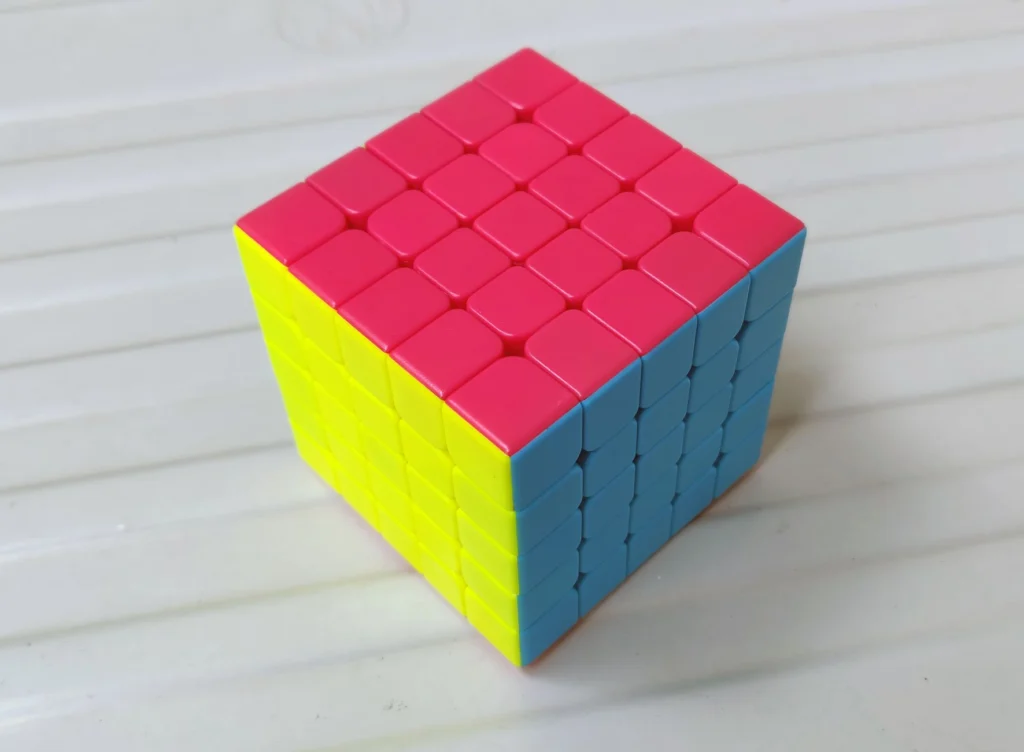
The Rubik’s Cube, invented in 1974, has quietly built one of the more rigorous competitive subcultures in all of hobbyist puzzle-solving. The current world record for a single solve sits under 3.5 seconds — a number that sounds almost fictional until you understand the layered system of memorized algorithms and pattern recognition that makes it possible.
It’s not intuition — it’s a memorized system
Top speedcubers aren’t solving the cube through spatial reasoning in real time; they’re executing memorized sequences, called algorithms, triggered by pattern recognition of the cube’s current state. The most widely used advanced method, CFOP (Cross, F2L, OLL, PLL), requires memorizing well over a hundred distinct algorithms for the final two layers alone, each triggered by recognizing a specific visual pattern in under a second. Competitive solvers also use a technique called “lookahead” — planning several moves beyond the one currently being executed by tracking the cube’s state peripherally while their hands are still completing the prior step, a skill that itself takes years of practice to develop reliably at speed.
The hardware matters more than most people assume
Modern speedcubes bear almost no resemblance to the sticker-and-plastic cube most people had as kids — competition cubes use magnetic positioning systems to snap each layer precisely into alignment, adjustable tension mechanisms, and specialized plastics engineered specifically to reduce friction during fast rotation, all of which measurably affect solve times at the elite level, which is why serious competitors experiment extensively with cube tuning before major events.
A sub-5-second solve isn’t one skill. It’s memorized algorithms, trained pattern recognition, and finger dexterity, all compressed into a window shorter than it takes to read this sentence.
Why the community has stayed so durable
Unlike many niche hobbies that peaked and faded, competitive cubing — organized globally through the World Cube Association, which sanctions competitions across dozens of event categories beyond the standard 3×3 cube — has grown steadily for decades, helped by a low barrier to entry (a competition-grade cube costs a fraction of most hobby equipment) and a genuinely welcoming, highly online community culture that makes the path from casual solver to competitive cuber more accessible than most specialized skill-based hobbies.
If your company or product is mentioned in this article, you're welcome to share it.