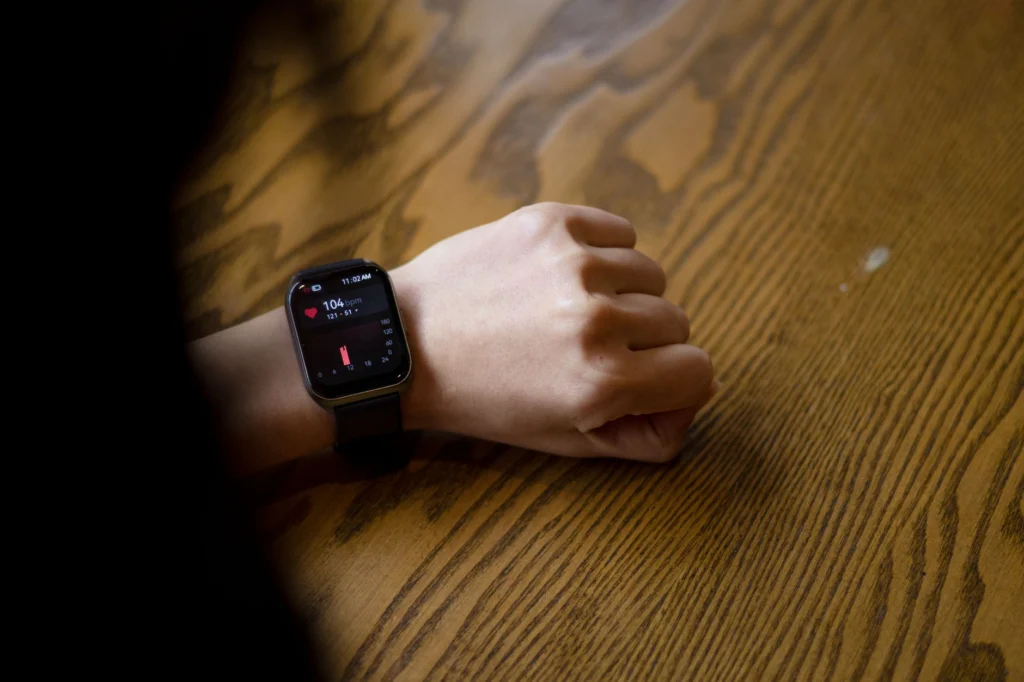
A smartwatch has no direct access to your heart’s electrical activity the way a chest strap or an ECG does — it’s reading your pulse indirectly, through light, from a wrist that’s constantly moving. That it works as well as it does is genuinely impressive; that it’s still measurably less accurate than a chest strap is a fact worth knowing before you trust it during a hard workout.
The actual mechanism: light, not electricity
The technology is called photoplethysmography, or PPG. On the underside of the watch, one or more small LEDs — usually green light, which blood absorbs particularly well — shine continuously into the skin and the capillaries just beneath it. A photodetector next to the LED measures how much of that light bounces back. Here’s the part that makes it work: every time your heart beats, a fresh pulse of blood surges through those capillaries, and blood absorbs more light than the surrounding tissue does. So the amount of reflected light dips very slightly with each heartbeat, in a small but measurable, rhythmic pattern. The watch counts the rate of those dips, and that rate is your heart rate. It’s an optical proxy for a mechanical event, not a direct electrical reading — and that distinction is the root of everything PPG gets wrong.
Where a chest strap actually wins
A chest strap uses electrocardiography — the same underlying principle as a hospital ECG — sensing the actual electrical signal your heart generates to trigger each beat, not a downstream optical side-effect of that beat. In controlled testing, a good chest strap has been measured at around 99.6% accuracy against clinical ECG equipment, which is about as close to a direct measurement as consumer hardware gets. PPG sensors, by contrast, are genuinely and significantly more vulnerable to motion artifacts — every arm swing, wrist flex, or shift in how tightly the watch sits against your skin introduces optical noise that can get misread as a beat, or mask a real one. Skin tone, tattoo ink density, ambient temperature, and even how tightly you’ve fastened the band all measurably affect PPG accuracy too, in ways a chest strap’s direct electrical contact simply isn’t vulnerable to.
Why the industry still bet on PPG anyway
The tradeoff was never really about accuracy — it was about what people would actually wear continuously. A chest strap is more accurate but genuinely uncomfortable for all-day, every-day wear, and most people won’t put one on just to check their resting heart rate on a Tuesday afternoon. PPG’s real advantage is that it’s built into something already on your wrist, enabling continuous, all-day heart rate tracking that a strap-based solution never could at real-world adoption scale. The accuracy gap is the price of that convenience, and it widens specifically during high-intensity, high-motion activity — exactly the scenario where you’d most want a precise number, and exactly where PPG is weakest.
The actual takeaway
Your smartwatch isn’t lying to you, but it isn’t measuring your heart directly either — it’s inferring your pulse from tiny changes in reflected light, filtered through however much your wrist happens to be moving at that exact moment. For resting heart rate and general trend tracking, that’s genuinely reliable. For a hard interval workout where you actually need the real number, a chest strap’s direct electrical measurement is still the more honest tool — the gap between the two isn’t a manufacturing defect, it’s a fundamental difference in what each device is actually sensing.
If your company or product is mentioned in this article, you're welcome to share it.