Search “Formula 1 jobs” and the results are almost entirely about engineering — race engineers, aerodynamicists, internships in Maranello and Brackley. That’s real, and we’ve covered it in depth. But a modern F1 team employs well over 900 people, and a top team’s combined technical and commercial workforce sits north of that once you count everyone from factory floor to hospitality suite. The ten teams on the 2026 grid employ a combined workforce estimated at more than 9,000 people. Most of those jobs are not held by aerodynamicists.
If engineering isn’t your route in — or you want to understand the full map before deciding where to aim — this is the category-by-category breakdown of what F1 teams actually hire for.
Trackside Operations — the jobs that travel to every Grand Prix
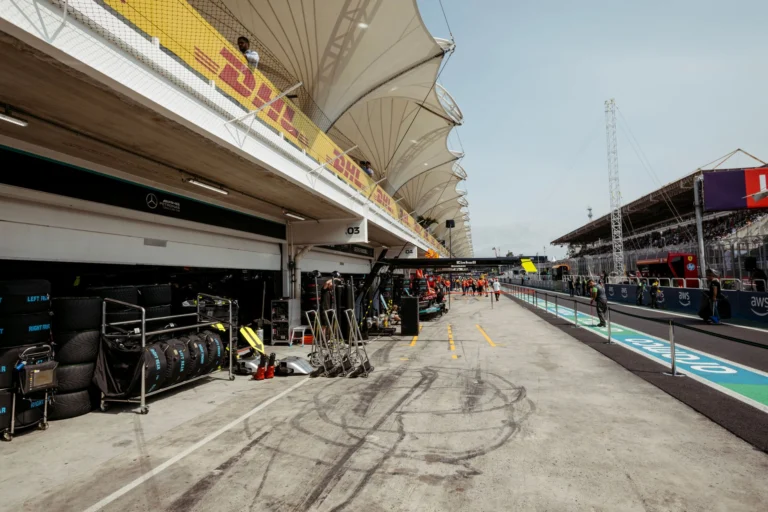
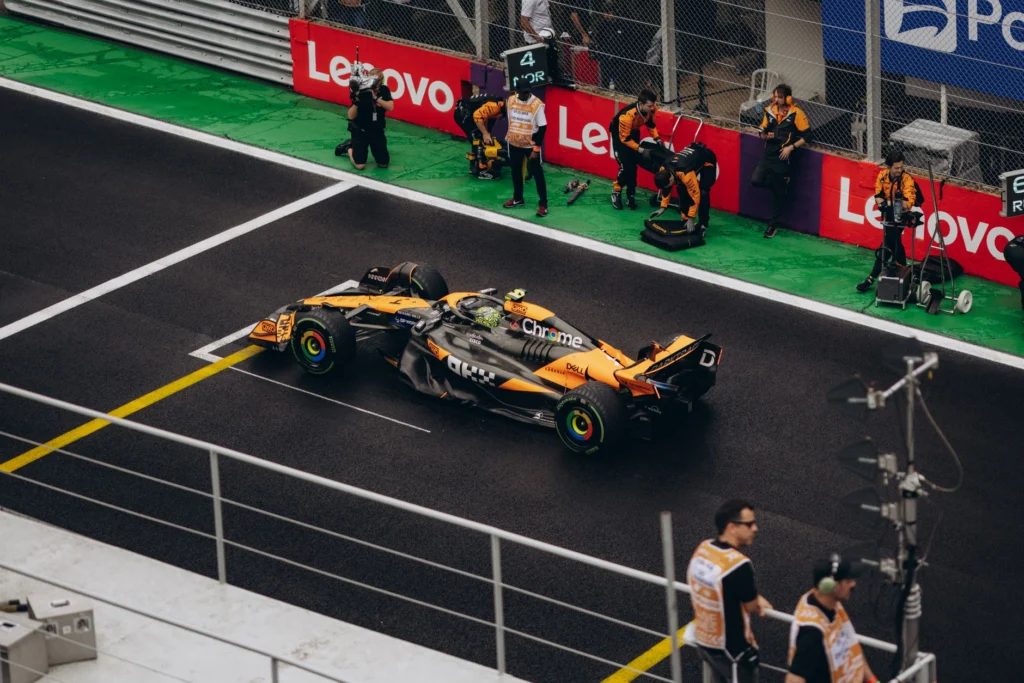
This is the smallest slice of any team’s headcount but the most visible one: the people who fly to every race weekend and run the car and the garage in real time.
- Race engineers, performance engineers and strategy engineers — covered in depth in What an F1 Engineer Actually Gets Paid, and What the Job Involves.
- Race mechanics and pit crew — the people who physically build, maintain and repair the car at the circuit, including the pit-stop crew. This is a hands-on technical trade, not a desk job: mechanics typically come up through motorsport apprenticeships, race-team experience in junior categories, or direct technical training rather than a university engineering degree.
- Tyre and fuel technicians — specialists managing tyre preparation, fuel systems and compliance with the sport’s technical regulations trackside.
- Truckies and logistics crew — the people who physically move a team’s freight, garage equipment and hospitality structures between (and within) continents on an 24-race calendar. This is one of the more overlooked entry points into the paddock.
Factory-Based Engineering — where the car is actually designed
The vast majority of a team’s engineering headcount never sets foot in a garage on a race weekend. This is design, simulation, vehicle dynamics, control systems, electronics and software — the work that determines how fast the car is before it ever leaves the factory. We’ve covered who gets hired into these roles and what the actual career path looks like in Inside F1 Engineering Jobs: Who Actually Gets Hired, and From Where, and how to break in as a student in How to Land an F1 Engineering Internship.
Manufacturing and Design — turning a digital model into a physical car
Between “the engineer designed it” and “the car is on the grid” sits an entire manufacturing operation:
- Composite technicians — laying up and curing the carbon-fibre structures that make up most of an F1 car’s bodywork and chassis.
- CNC machinists and toolmakers — producing the precision metal components a modern F1 car depends on, often to tolerances measured in microns.
- Quality and inspection specialists — verifying that manufactured parts actually meet the design spec before they’re trusted on a car at 300 km/h.
- Industrial and technical designers — translating engineering requirements into manufacturable, regulation-compliant components.
These roles reward hands-on precision trades and manufacturing engineering backgrounds as much as, or more than, a traditional engineering degree — apprenticeships are a genuine route in here, not a fallback option.
Commercial, Marketing and Partnerships — the business that funds the racing
An F1 team’s on-track budget is funded substantially by sponsorship and commercial revenue, and that revenue is generated by a real commercial organization:
- Partnerships and sponsorship management — the people who sell, manage and activate the sponsor deals that fund a large share of a team’s budget.
- Marketing, brand and content teams — running the team’s public identity, social channels, campaigns and fan-facing content.
- Communications and media relations — managing press, driver media commitments and crisis communications during a 24-race season under constant public scrutiny.
- Digital and CRM specialists — increasingly important as teams build direct fan relationships and e-commerce operations that didn’t exist a decade ago.
These are standard marketing, comms and commercial careers that happen to sit inside a motorsport organization — a marketing or business degree and relevant commercial experience matter more here than any engineering background.
Hospitality — running a five-star operation at 24 venues a year
Every team runs its own hospitality suite (“motorhome” or paddock hospitality unit) at every race, hosting sponsors, VIPs and media at a standard comparable to a high-end hotel or restaurant — then packs it up and rebuilds it at the next circuit days later.
- Hospitality managers overseeing the entire guest operation at each Grand Prix.
- Chefs and catering staff delivering restaurant-quality food to sponsors and guests, often for 100+ covers a day, at a different venue every fortnight.
- Guest relations and events staff managing VIP experiences, corporate hospitality packages and sponsor entertainment.
This is genuine hospitality-industry experience translated into the highest-pressure, highest-turnover version of the job that exists — a real route in for people from restaurant, event and luxury-hospitality backgrounds who have zero interest in engineering.
Finance, Legal, HR and IT — the functions every large organization needs
A modern F1 team is, structurally, a mid-sized technology and manufacturing business operating under the FIA’s cost cap — which means it needs the same back-office functions any comparable company does:
- Finance and cost-cap compliance — F1’s budget cap regulations have made financial control and compliance one of the more specialized and closely-watched functions inside every team.
- Legal and regulatory affairs — contracts, IP, sponsorship agreements and technical-regulation compliance.
- HR and talent — running recruitment (including the graduate and apprenticeship schemes referenced throughout this series) for an organization competing globally for scarce technical talent.
- IT and enterprise systems — the infrastructure underneath everything above, plus the growing data and AI functions that now sit alongside traditional engineering software.
Sustainability — the newest standing department on the grid
F1’s push toward its net-zero targets and sustainable-fuel programme has created a genuinely new category of team job: sustainability managers and specialists working on carbon accounting, logistics efficiency, sustainable materials and supply-chain impact — a route in for environmental science, sustainability and supply-chain backgrounds that didn’t exist in this sport a decade ago.
Where to go from here
If your route in is engineering, start with the three articles linked throughout this piece — they cover salary expectations, who actually gets hired, and how to land an internship specifically. If you’re aiming for a non-engineering role, or you’re realizing a team job isn’t your only way into the sport, two more pieces in this series are worth reading next: You Don’t Have to Work for an F1 Team to Work in F1, which covers the suppliers, sponsors and organizations hiring around the sport, and How to Apply for an F1 Job and Actually Get Hired, which covers the practical application process across every category above, not just engineering.
Individual role deep dives
For a closer look at specific F1 jobs, see our role-by-role guides:
- F1 Aerodynamicist: What They Do and How to Become One
- F1 Race Strategist: What They Do and How to Become One
- F1 Vehicle Dynamics Engineer: What They Do and How to Become One
- F1 Mechanic: What They Do and How to Become One
- F1 Marketing and Commercial Careers: What They Do and How to Get In
- F1 Hospitality Careers: What They Do and How to Get In