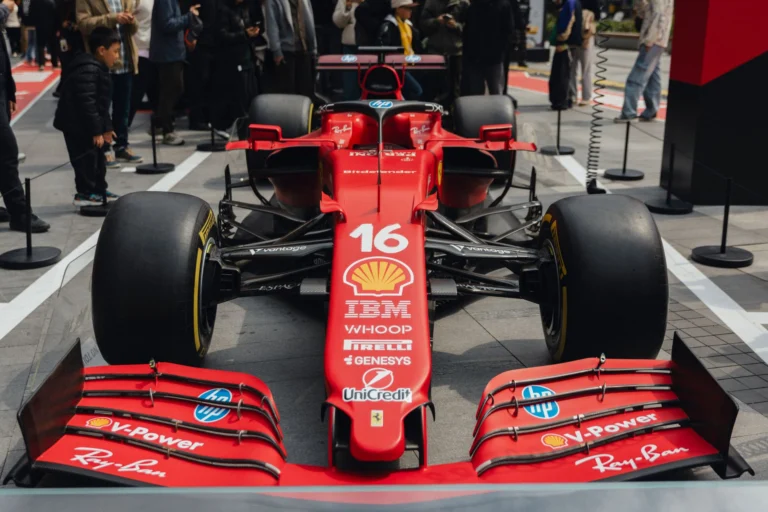
A student applying for Ferrari’s 2026 F1 Engineering Academy had to do more than put “passionate about motorsport” on a CV. Ferrari wanted Master’s graduates or PhDs, typically within 12 months of graduation, from disciplines including aerospace, mechanical, electrical and electronic engineering, materials, controls, software engineering and mathematics. The successful candidates would spend six months in Maranello working on areas such as CFD, vehicle dynamics, suspension design, ERS and power-unit modelling. (careerservice.polimi.it)
That is a useful correction to the way F1 internships are often imagined.
You are not applying to “work around race cars.” You are applying to solve engineering problems inside a company where the deadline can be the next race, the next production batch or the next simulation run.
And there is genuine search demand for this information. Ubersuggest's current US data puts “f1 engineering internship” at 170 monthly searches, with an SEO difficulty score of 28. Monthly volume has moved between 110 and 260 over the past year, so the number is not enormous, but the intent is unusually specific: people searching it are generally looking for a route into F1 engineering rather than generic motorsport information.
The better question, then, is not simply how to get an F1 internship. It is what kind of engineering evidence gets you through the door?
Ferrari’s F1 Engineering Academy is closer to a graduate recruitment pipeline than a normal internship
There is an important naming distinction here.
The Ferrari Driver Academy is Ferrari's driver-development programme. It is designed to identify and develop young racing drivers, not engineering interns. Ferrari's engineering route is the Scuderia Ferrari F1 Engineering Academy. Ferrari says the programme has been running since 2015 and was created to recruit talented engineers into its Formula 1 team. (cdn.ferrari.com)
The 2026 intake makes the structure unusually clear.
Ferrari advertised a six-month internship beginning October 5, 2026. Applicants were expected to be exceptional Master’s graduates or PhDs, generally having graduated within the previous 12 months. The programme targeted aerospace, mechanical, electrical and electronic, materials, controls, software and mathematics backgrounds. (careerservice.polimi.it)
The technical choices were not vague, either. Candidates could indicate preferred areas including:
- AI and data modelling for vehicle-performance optimisation
- CFD and aerodynamic development
- Mechanical design involving suspension, brakes and fuel systems
- ERS and MGU-K design and model optimisation
- Power-unit performance modelling and control
- Vehicle dynamics and tyre science (careerservice.polimi.it)
The selection process included CV and motivation-letter screening, an online aptitude test, HR interviews, technical testing and interviews with engineering managers and mentors in Maranello. The 2026 application deadline was March 30. (careerservice.polimi.it)
That tells you something useful about the candidate Ferrari is actually looking for.
A degree gets you into the pool. A demonstrable technical speciality gives the team a reason to pick you.
McLaren’s route is built around long placements and engineering graduates
McLaren's current early-careers programme is broader than a single F1-specific internship.
Its published timetable lists 12-month Engineering Internships and the Graduate Engineering Programme for September recruitment, alongside other early-career routes. (racingcareers.mclaren.com)
McLaren's F1 technical organisation itself covers a surprisingly wide engineering map: aerodynamics, control systems, design, electronics, performance, reliability, research and technology, and software. The team specifically highlights technical depth, data analysis and simulation, and CAD proficiency among the capabilities it looks for. (racingcareers.mclaren.com)
That matters because an applicant who writes “I want to become an F1 race engineer” is competing for one of the most visible jobs in the sport without necessarily understanding how many other engineering functions sit underneath it.
McLaren's own careers material describes the F1 organisation as a collection of technical specialisms rather than a single engineering job. (racingcareers.mclaren.com)
The practical lesson is straightforward: choose a technical problem first and an F1 team second.
A student who can show a strong suspension model, CFD project, controls system, composite structure or data-analysis pipeline has something an F1 recruiter can evaluate. A student whose main qualification is enthusiasm for Formula 1 does not.
Mercedes shows what an F1 internship can actually look like
Mercedes-AMG PETRONAS provides some of the clearest examples of the work students can be given.
One recent industrial placement was in composite manufacturing at Brackley. The student would work on manufacturing methods for carbon-fibre structures including the chassis, suspension, wings and engine components. The job involved CATIA 3D Experience, plybooks, tooling, laser projection systems, technical drawings and root-cause investigations. (mercedesamgf1.com)
That is not shadowing an engineer.
It is manufacturing engineering.
The placement description says students could take responsibility for components while being coached by experienced engineers. Mercedes also explicitly stated that previous motorsport experience was not required for that role. What mattered was the ability to apply engineering knowledge to practical manufacturing problems. (mercedesamgf1.com)
There are other routes, too. Mercedes' graduate programme divides its technical organisation into Engineering, Technology and Performance, covering the work required to develop and operate a competitive F1 car. (mercedesamgf1.com)
And Mercedes has demonstrated that internships can involve much more than conventional mechanical engineering. Its PETRONAS internship programme has historically brought engineering students into Brackley for extended placements, while more recent talent programmes have included data analytics, technology and sustainability work. (mercedesamgf1.com)
The point is that “F1 engineering” is an umbrella, not a job title.
Your university projects can matter more than an F1-themed CV
Mercedes' own Trackside Engineering Director, Andrew Shovlin, has said the team does not recruit purely on education or qualifications. In discussing industrial placements, he specifically described looking for people who can apply their understanding, communicate effectively and handle pressure and problems constructively. (mercedesamgf1.com)
That gives students a useful way to think about their CV.
Don't ask: How can I make my CV look like an F1 engineer's CV?
Ask: What have I built, modelled, tested or improved that demonstrates engineering judgement?
Formula Student is an obvious route because it gives students a real engineering system with constraints, deadlines and trade-offs. But it is not the only route. A strong university research project, robotics project, UAV, motorsport project, controls system, composite structure or software/data project can demonstrate the same underlying capabilities.
Ferrari's 2026 F1 Engineering Academy specifically mentioned university projects, previous internships, Formula SAE and Shell Eco-Marathon-type experience when describing the experience it wanted candidates to bring. (careerservice.polimi.it)
The common thread is evidence.
If you claim you understand CFD, show the work.
If you claim you understand vehicle dynamics, show the model.
If you claim you can code, show the software.
If you claim you understand composite manufacturing, explain the design-for-manufacture trade-off you actually encountered.
The strongest application usually has a technical story, not ten unrelated skills
An F1 team does not need every student to know everything.
It needs people who can become very good at something useful.
A mechanical engineering student might build a Formula Student suspension and analyse kinematics, tyre behaviour and load cases. An aerospace student might run and validate a CFD study. An electrical engineer might build a motor-control or energy-management model. A computer scientist might develop a data pipeline or vehicle-performance model.
The project does not have to involve a Formula 1 car.
In fact, pretending that a university project is equivalent to F1 engineering is usually less convincing than explaining exactly what the project taught you.
A good portfolio can answer five questions:
- What problem were you solving?
- What assumptions did you make?
- What tools and methods did you use?
- What went wrong or changed during development?
- What measurable result did you achieve?
That is the language engineering teams understand.
You should apply before you feel “F1 ready”
One of the more useful things Mercedes says publicly is that candidates should be open-minded about where they start. Shovlin points out that someone might aspire to become a race engineer but begin somewhere completely different. He also makes the blunt numerical point that there are only 20 cars on the grid, while a large F1 team employs more than 1,000 people. (mercedesamgf1.com)
That is why obsessing over the race-engineer title can be counterproductive.
Aerodynamics, vehicle dynamics, controls, electronics, software, reliability, composites, manufacturing, simulation and performance engineering can all put you inside an F1 organisation.
And once you are inside, your technical reputation matters more than the title you originally imagined.
The timing matters, too. McLaren currently publishes its engineering internship and graduate recruitment window around September, while Ferrari's F1 Engineering Academy operates on a defined annual cycle. Mercedes also runs structured industrial-placement and graduate routes. (racingcareers.mclaren.com)
So don't wait until graduation week to start looking.
Track the teams' careers pages. Watch university careers offices. Build relationships with Formula Student and engineering societies. Keep a version of your CV ready. Know which technical area you want to pitch.
The application itself may only take an hour. Building the evidence that makes the application credible can take two years.
An F1 engineering internship is really an audition for the next job
This is the part that makes these programmes different from a conventional summer placement.
Ferrari's F1 Engineering Academy explicitly describes the six-month placement as a route that can lead to a longer-term role, while Mercedes describes its industrial-placement programme as being designed with progression into future graduate roles in mind. (careerservice.polimi.it)
That changes what you should optimise for.
The objective is not to get a photograph outside the garage.
It is to become the intern who can be trusted with a difficult problem, communicate what happened, learn from a failed approach and return with a better answer.
That is also why the best preparation for an F1 engineering internship looks surprisingly ordinary: rigorous engineering coursework, difficult projects, good documentation, technical software, programming, testing, teamwork and the ability to explain your decisions.
The red car is the destination people notice. The real selection process is deciding whether, when given a problem that matters and a deadline that will not move, you can produce useful engineering.