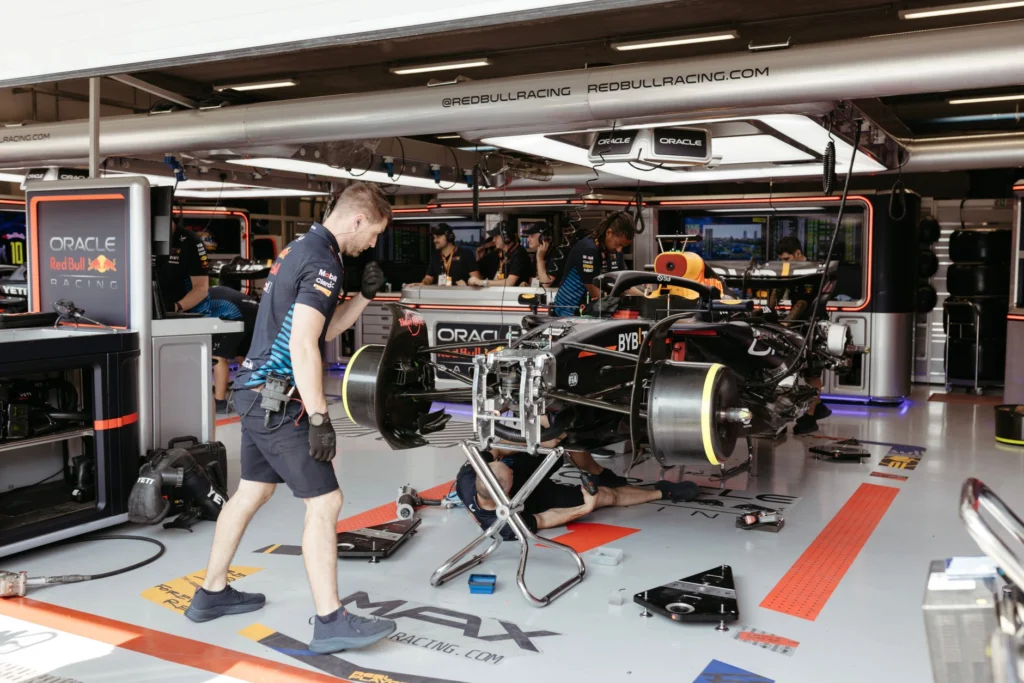
Ten teams compete on the Formula 1 grid. If working in F1 meant only working for one of those ten teams, the number of realistic jobs in the sport would be small and the competition for each one would be brutal beyond reason. It isn’t, and it doesn’t have to be.
Formula 1 is a supply chain, a broadcast product, a governed sport and a commercial entity, and each of those is a real employer with real engineering, technical, commercial and operational jobs — many of them less competitive to enter than a seat at Ferrari or McLaren, and several of them a genuine stepping stone toward a team job later. Here’s who else is actually hiring around the sport.
The tyre supplier: Pirelli
Every car on the grid runs on Pirelli tyres — F1’s sole tyre supplier — which makes Pirelli’s motorsport division one of the more overlooked engineering employers in the sport. Pirelli runs its own graduate route into the business, the two-year “Warming Up” programme for engineering and business graduates, and partners with universities including the University of Milan and Politecnico di Torino on placement opportunities. Tyre compound development, degradation modelling and trackside tyre engineering at Pirelli sit directly alongside the teams’ own vehicle-dynamics work — the two groups are in constant technical dialogue during a race weekend.
The power unit suppliers
Not every team builds its own engine. The power unit suppliers run engineering organizations that are, in some respects, more specialized than a full chassis team’s:
- Mercedes-AMG High Performance Powertrains (HPP) designs and builds the power units used by Mercedes and its customer teams, based at its own Technology Centre in Brixworth. HPP hires across F1 and Advanced Technologies engineering, operations and business-support functions — it’s a genuinely separate recruiting organization from the Mercedes chassis team at Brackley.
- Red Bull Powertrains is developing Red Bull’s own power units in partnership with Ford, and actively recruits engineers, technical specialists and electronics support engineers as it builds out that operation — a rare chance to join a power-unit programme from a comparatively early stage.
- Ferrari and Honda Racing Corporation run the remaining power unit programmes supplying the rest of the grid, each with its own engineering recruitment separate from the chassis side of the business.
For a propulsion, thermodynamics, controls or electronics specialist, a power unit supplier can be a more directly relevant employer than a chassis team — and, because it’s a less obvious target than “Formula 1 team,” often a less saturated one.
The sport’s own governing body: the FIA
Someone has to write, police and enforce the technical and sporting regulations every team on the grid operates under. That’s the FIA — Formula 1’s international governing body — which employs race directors, technical delegates, stewards, scrutineers and safety specialists, alongside standard commercial, legal and administrative functions. These are genuinely different jobs from a team engineer’s: less about extracting lap time, more about technical compliance, safety and the sporting integrity of the championship. It’s also one of the more direct routes for an engineer who wants to stay deeply technical without competing for one of the ten teams’ own headcount.
Formula 1 itself — the commercial rights holder
The organization that owns and operates the championship is a separate employer from every team on the grid. Formula 1’s own corporate recruitment spans sporting systems and race operations, broadcast engineering and production, digital and technology, commercial and marketing, and logistics. Its hiring process is structured differently from a team’s — commonly built around two interview stages including a task-based assessment — and its jobs range from the technical (broadcast systems, timing and data feeds used by every team and broadcaster) to the purely commercial (partnerships, digital products, race promotion).
Broadcast and media partners
F1’s global broadcast is produced through a network of rights-holding broadcasters and production partners in each market — camera operators, broadcast engineers, producers, commentators and technical crews who build the race-weekend TV product millions of people watch. This is a legitimate route into the sport for people from a broadcast, production or sports-media background with no engineering ambitions at all, and one that doesn’t require relocating to a UK-based team factory.
Logistics partners
Moving an entire F1 paddock — garages, hospitality units, freight, equipment — to a different continent roughly every two weeks during the season is a serious logistics operation, run in partnership with global freight and logistics providers rather than by the teams alone. Supply-chain, freight-operations and logistics-planning careers with F1’s logistics partners are a real, specialized route into the sport for people with a supply-chain or operations background rather than a motorsport one.
Component and materials suppliers
Beyond tyres and engines, teams source specialist components — brakes, wheels, composite materials, fasteners, sensors — from suppliers who serve multiple teams at once. Brake and composite specialists in particular run engineering teams focused on extreme-performance materials science, a discipline directly transferable from and to aerospace and other high-performance industries. These suppliers are frequently smaller and less publicly visible than the teams themselves, which can mean a shorter, less competitive hiring process for a genuinely relevant engineering background.
Motorsport engineering consultancies
A layer of specialist engineering consultancies and contract-engineering firms works across multiple F1 teams and adjacent motorsport categories, providing simulation, CFD, composites and design services without being tied to a single constructor. For an engineer who wants breadth across the sport rather than deep specialization inside one team, a consultancy route can offer exposure to more of the technical landscape earlier in a career than a single-team job would.
Adjacent racing series as a real stepping stone
Formula 2, Formula 3, Formula E, the World Endurance Championship and other major series are frequently run by teams, engineers and personnel with direct crossover into F1 — several current F1 engineers and mechanics came up through junior single-seater series or endurance racing rather than starting in F1 itself. Treating a job in F2, F3, WEC or Formula E as a lesser consolation prize is usually the wrong way to think about it: it’s frequently the actual route in, offering real trackside responsibility earlier in a career than an F1 team would hand a junior engineer.
The practical takeaway
If the ten F1 teams feel like a closed door, they’re not the only door. Power unit suppliers, Pirelli, the FIA, Formula 1’s own commercial organization, broadcast partners, logistics providers, component suppliers, engineering consultancies and the junior single-seater and endurance series that feed talent into F1 all represent real, hireable jobs connected to the sport — several of them less competitive to break into than a seat at a top team, and more than a few of them a genuine pipeline toward one. For the full breakdown of what F1 teams themselves hire for, see Formula 1 Jobs: Every Category F1 Teams Actually Hire For, and for how to actually put an application together across any of these employers, see How to Apply for an F1 Job and Actually Get Hired.
If your company or product is mentioned in this article, you're welcome to share it.