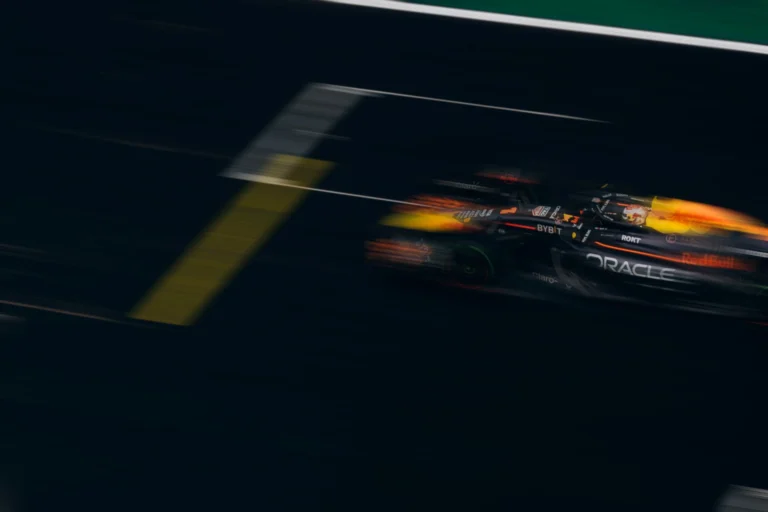
Max Verstappen’s final Dutch Grand Prix ended after one lap. Running seventh, the Red Bull driver dipped a wheel across the white line on the main straight, lost the rear of the car through the final banked corner and hit the outside barrier heavily. The impact scattered debris across Zandvoort and brought out the red flags. Verstappen was unhurt, but his race was over. (formula1.com)
That incident did more than remove the local favourite. It changed the first strategic decision of the afternoon, gave Kimi Antonelli a second chance to attack Lando Norris, and created the race situation in which Norris eventually had to beat Mercedes on tyre performance rather than simply defend his pole position.
The crash did not, by itself, win Norris the race. In fact, the immediate consequence was the opposite: Antonelli used the restart to take the lead.
Verstappen’s crash turned a normal start into a standing restart
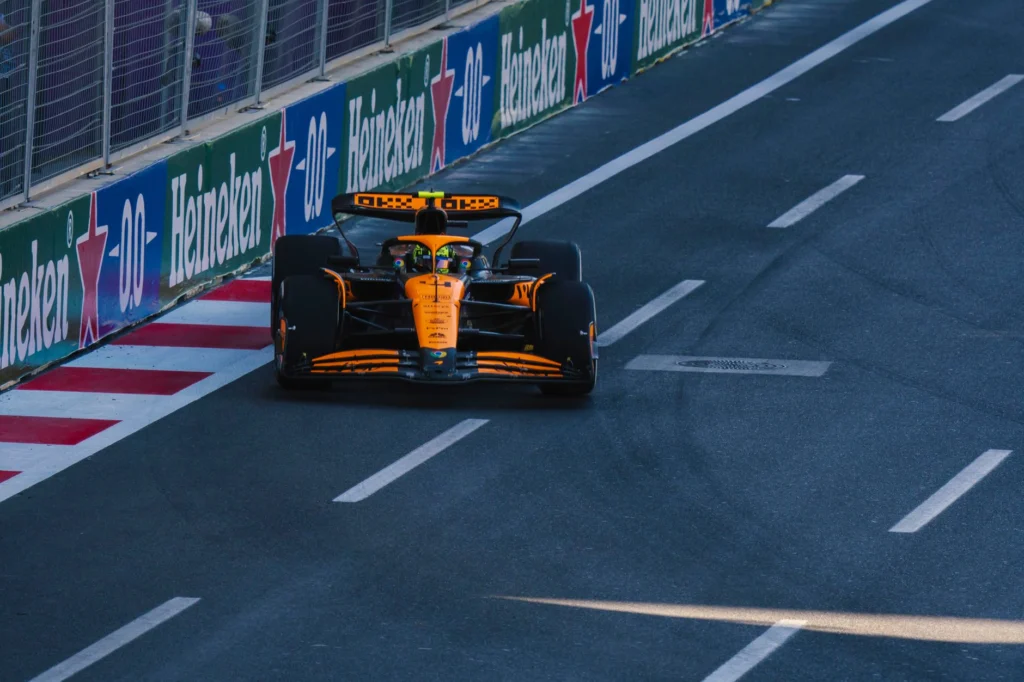
Norris had started from pole with George Russell and Antonelli behind him. Antonelli made the better launch of the two Mercedes drivers and moved into second at Turn 1. Verstappen, starting seventh, was fighting his Red Bull team-mate Liam Lawson before the race changed completely at the end of the opening lap. (formula1.com)
The conditions made the incident particularly significant. The track was still damp in places after pre-race showers, and the field had split its tyre choices. Most of the grid had selected soft tyres for the expected one-stop race. The top four, however, started on mediums, as did Pierre Gasly, Franco Colapinto and Esteban Ocon. Valtteri Bottas and Sergio Perez were the notable runners on hards. (formula1.com)
Verstappen's loss of control came as he exited the final banked section. Formula 1 reported that he dipped a wheel onto the white line before losing the rear. Sky Sports described the car as catching the damp kerb, while Verstappen himself said the impact could have been worse. (formula1.com)
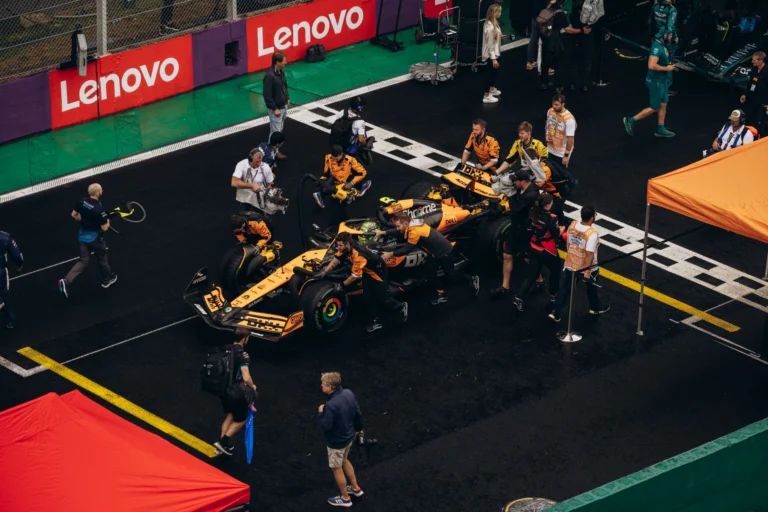
Because the Red Bull was heavily damaged and debris covered the circuit, race control stopped the race. The field returned to the pits, and the restart was held from the grid rather than continuing behind the Safety Car.
That distinction mattered.
Antonelli won the restart Verstappen created
When the race restarted on Lap 5, Antonelli reacted faster than Norris and attacked into Turn 1. The Mercedes driver took the lead, turning what had been a straightforward pole-to-lead scenario for Norris into a chase. (formula1.com)
This was the first major tactical consequence of Verstappen's crash.
Without the red flag, Norris would have continued leading with Antonelli behind him. Instead, the interruption created another launch, and Antonelli made the most of it. The Mercedes driver then established enough of a gap to prevent Norris from immediately using Overtake Mode.
For much of the opening stint, Norris could not force the issue. By Lap 10, Antonelli had extended the advantage to around 1.4 seconds. Norris later reported that he had effectively reached his performance limit, telling his team he was at “pace zero” with nothing else available. (formula1.com)
The restart therefore appeared to have worked in Mercedes' favour.
But Zandvoort's race was going to be decided over much longer tyre runs.
The real swing came when Norris found pace on the hard tyre
Antonelli's lead was not enough to settle the race because the Mercedes and McLaren were approaching the tyre strategy differently.
Norris kept pressure on Antonelli through the first stint. By Lap 30, the gap had fallen to less than a second before Norris suffered a snap that temporarily interrupted the chase. The Ferraris were also becoming increasingly involved in the fight, with Charles Leclerc eventually passing Oscar Piastri for fourth. (formula1.com)
Then Mercedes committed to its first major pit-stop cycle.
Antonelli stopped on Lap 41 for hard tyres and Russell followed. The change brought the Mercedes drivers back into traffic, while Norris remained out longer. (formula1.com)
The difference became clearer in the second half of the race. Sky Sports reported that Norris was significantly stronger after moving onto the hard compound, while Antonelli struggled for confidence and pace on his own hard-tyre stint. Antonelli later acknowledged that the second half had been difficult and said the McLarens were simply too strong on pace. (skysports.com)
This is where the crash's influence needs to be separated from the actual cause of Norris's victory.
The red flag gave Antonelli the lead. It did not give Norris the winning pace. That came later, as McLaren's tyre performance allowed Norris to close the gap and eventually reclaim first place.
The late Virtual Safety Car gave Mercedes one last strategic gamble
The final major tactical complication came with a Virtual Safety Car after Esteban Ocon's Haas stopped on track.
Antonelli was among the drivers who used the opportunity to pit for fresher tyres. Norris and Russell stayed out.
The decision temporarily put Antonelli behind Russell. Mercedes had effectively traded track position for fresher rubber, hoping the tyre advantage would allow Antonelli to recover second place before the finish. (formula1.com)
It worked, but only because Mercedes then made a second decision.
With 16 laps remaining, Antonelli had been running second behind Norris. After the VSC stop, he returned behind Russell, who was now the obstacle between Antonelli and second place. Mercedes ordered Russell to let his team-mate through on Lap 65.
Russell was unhappy with the call, but the logic was straightforward. Antonelli had been ahead before the VSC and had taken a different strategic route. Keeping the cars racing each other risked allowing the Ferraris to attack both Mercedes cars. (formula1.com)
The swap worked. Antonelli finished second, Russell third.
But Norris was already too far ahead.
Verstappen’s absence changed the midfield as much as the podium fight
There was another consequence that is easier to overlook.
Red Bull had only one car left in the race after Verstappen's retirement. Lawson, who had qualified eighth alongside Verstappen on the third row, became the team's sole representative. He eventually finished seventh despite receiving a 10-second penalty for a yellow-flag infringement. (formula1.com)
Verstappen had started only seventh, so it would be an overstatement to assume he would automatically have finished on the podium. The evidence from the race does not support that conclusion. Red Bull's pace had already been disappointing through the weekend, and Verstappen had been eliminated before completing a competitive race stint.
What can be said with certainty is that his retirement removed another car from the strategic equation. Red Bull could no longer influence the leaders through tyre timing, pit-window pressure or track position.
That mattered because the Dutch GP became unusually concentrated around McLaren, Mercedes and Ferrari.
Norris won the race Verstappen's crash helped create, but not the way it first appeared
Norris eventually crossed the line 11.536 seconds ahead of Antonelli. Russell finished third, only narrowly keeping Lewis Hamilton and Charles Leclerc behind him. Piastri was sixth and Lawson seventh. (formula1.com)
The sequence is revealing.
Verstappen's crash caused the red flag.
The red flag created a standing restart.
The restart allowed Antonelli to take the lead.
Antonelli's lead forced Norris into a longer pursuit.
The tyre strategy eventually shifted the advantage back toward McLaren.
Then a late VSC created another strategic split, allowing Antonelli to recover second but leaving Norris comfortably in front.
So the crash changed the race without determining its winner.
That distinction matters because it is easy to look at a dramatic opening-lap retirement and assign too much of the eventual result to it. The evidence from Zandvoort points to something more interesting. Verstappen's accident changed the shape of the race immediately, but Norris still had to execute the strategy and find the pace to take the lead back.
The final Dutch Grand Prix therefore ended with two very different Verstappen stories. His home race disappeared almost instantly, while the race itself continued through a series of tyre and restart decisions that had nothing to do with simply inheriting his position.
For Norris, the important moment was not Verstappen hitting the wall. It was what came after: Antonelli taking the lead, McLaren finding the stronger long-run pace, and Norris eventually turning a race he had temporarily lost into his second consecutive victory. (formula1.com)