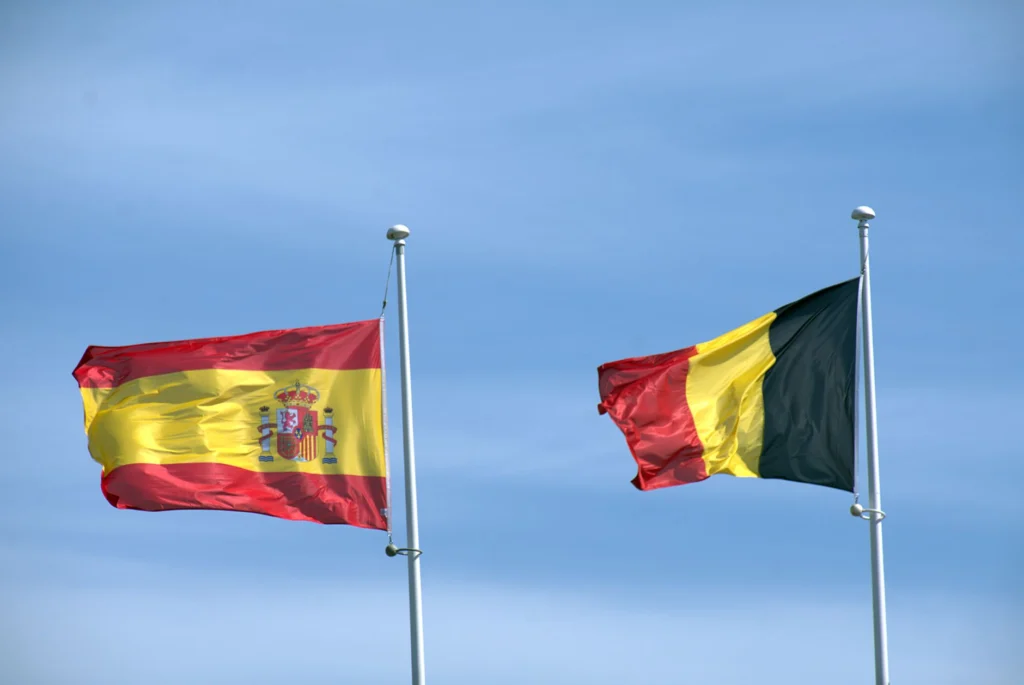
Spain reached the 2026 World Cup semi-finals by beating Belgium 2-1 at SoFi Stadium, but the decisive story was less about sustained dominance than about what happened when Belgium’s resistance finally cracked.
Fabián Ruiz put Spain ahead in the 30th minute after Dani Olmo’s shot was saved by Thibaut Courtois. Charles De Ketelaere equalised 11 minutes later with a header from Timothy Castagne’s cross. Then, with extra time approaching, Mikel Merino came off the bench and scored in the 88th minute after substitute goalkeeper Senne Lammens spilled Pau Cubarsí’s shot. (theanalyst.com)
The tactical shape of the match explains why Belgium could stay alive for so long despite Spain controlling most of the ball. Spain circulated possession, moved its attacking midfielders around Belgium’s defensive block and repeatedly created pressure around the penalty area. Belgium accepted long periods without the ball and looked for moments to attack quickly through Jérémy Doku, Kevin De Bruyne and De Ketelaere.
Spain ultimately had 17 shots to Belgium’s five, with Opta recording 2.08 expected goals for Spain against 0.37 for Belgium. (theanalyst.com)
Spain changed the midfield without changing its basic idea
Luis de la Fuente made one of the most consequential selection decisions before kick-off by starting Fabián Ruiz in place of Pedri. Fabián then repaid the decision by scoring Spain’s opener.
Spain’s starting XI retained Rodri at the base of midfield, with Fabián alongside the attacking line and Dani Olmo, Álex Baena and Lamine Yamal operating behind Mikel Oyarzabal. The official team sheet confirms the lineup and the later changes: Pedri replaced Fabián in the 55th minute, Ferran Torres replaced Baena at the same time, Nico Williams came on for Oyarzabal in the 79th, and Merino replaced Olmo in the 86th. (psg.fr)
That structure gave Spain several ways to move Belgium around.
Rodri could drop deeper to help Spain establish possession, while the full-backs Pedro Porro and Marc Cucurella provided width. Olmo had freedom to move into different attacking pockets rather than remaining fixed in one channel. Yamal supplied another route to goal from the right, where his ability to receive, turn and attack defenders repeatedly forced Belgium to retreat.
The first goal was a good example of that pressure. Porro combined with Yamal before advancing, Olmo received the resulting opportunity and forced Courtois into a save. Fabián reacted first to the rebound and finished. The exact sequence is reported consistently across the match accounts. (theanalyst.com)
Spain did not need to manufacture a completely new attacking system. It needed to keep moving Belgium’s defensive line until an opening appeared.
Belgium’s best tactical answer was to stay compact and counter
Belgium did not attempt to match Spain possession for possession.
Rudi Garcia’s side defended in a compact structure and tried to deny Spain clean access through central areas. The approach made sense given the personnel available. Belgium had already lost Amadou Onana, while captain Youri Tielemans was injured during the warm-up and could not start. Kevin De Bruyne therefore wore the captain’s armband, with Hans Vanaken and Nicolas Raskin providing the central midfield pairing. (theanalyst.com)
That mattered because Belgium’s midfield was not simply trying to win the ball high. It had to survive Spain’s circulation first.
When Belgium did recover possession, the clearest route forward was through Doku’s acceleration and De Bruyne’s passing. The combination produced one of Belgium’s better second-half moments: Doku and De Bruyne exchanged passes before Maxim De Cuyper got behind the Spanish defence and hit the side-netting. (skysports.com)
Belgium’s equaliser also came from a different kind of attack. Castagne delivered from the right and De Ketelaere attacked the cross, getting across Pau Cubarsí to head past Unai Simón in the 41st minute. It was Belgium’s first goal against Spain in the tournament and ended Spain’s run of 649 minutes without conceding. (theanalyst.com)
That goal mattered tactically as much as it did on the scoreboard. Spain had been controlling the game, but Belgium demonstrated that it did not need extended possession to create a high-value chance.
Courtois kept Belgium in the match until his injury changed the equation
The scoreline at half-time understated Spain’s territorial and attacking advantage.
Courtois was repeatedly involved. He saved from Olmo for the first goal, denied Yamal in the second half and later stopped Oyarzabal at his near post. Spain kept producing attempts, but Belgium’s goalkeeper prevented the pressure from becoming a second goal. (theanalyst.com)
Then came the match’s most consequential non-goal event.
Courtois was forced off in the 71st minute with an apparent thigh injury. Senne Lammens replaced him, becoming the first goalkeeper other than Courtois to represent Belgium at a World Cup since Geert De Vlieger in 2002. (theanalyst.com)
It would be wrong to reduce Belgium’s defeat entirely to the injury. Spain had already created the greater volume of chances and remained the stronger attacking side. But the goalkeeper change removed the player who had been helping Belgium absorb that pressure.
Seventeen minutes later, the difference became decisive.
Merino’s introduction turned Spain’s pressure into a late winner
Merino entered for Olmo in the 86th minute. Two minutes later, he scored.
The goal itself was simple. Cubarsí drove a shot toward goal from outside the area. Lammens could not hold it, and Merino reacted quickest to the loose ball and finished from close range. Sky Sports reported that Merino had been on the pitch for only 117 seconds and scored with his second touch. (skysports.com)
The substitution therefore worked in two ways.
First, Merino added fresh legs to Spain’s midfield and attacking pressure at a point when Belgium’s defensive structure was being stretched. Second, his instinct for arriving in the penalty area gave Spain another player capable of attacking the second ball.
That second point is central to the goal. Spain did not need a perfectly constructed passing sequence to win the quarter-final. It needed another shot, another rebound and a player alert enough to attack it.
Merino had already scored a late winner against Portugal in the previous knockout round. Opta recorded that he became only the second Spain player to score winning goals in two World Cup knockout matches as a substitute, and the first Spain player to score two winning goals in the 80th minute or later at the World Cup. (theanalyst.com)
The turning point was not one mistake, but the accumulation of pressure
Lammens’ error supplied the decisive moment, but Spain’s performance had created the conditions for it.
The statistical difference was substantial: 17 shots against five and 2.08 expected goals against 0.37. Spain also held roughly 68% possession, depending on the statistical provider. (theanalyst.com)
Those numbers should not be interpreted as proof that Belgium was overwhelmed for 90 minutes. Belgium had a clear defensive plan, scored against the run of play and generated dangerous counter-attacking situations. But the underlying chance profile supports the conclusion that Spain were the side more likely to produce the next goal.
The match therefore turned on a familiar knockout-football equation: sustained pressure does not guarantee a goal, but it increases the number of moments in which a defensive clearance, save, rebound or individual error can decide the game.
Belgium held that line for almost the entire second half. Courtois’ injury weakened it. Lammens’ spill finally broke it.
Spain’s tactical flexibility mattered more than its possession
Spain’s 2-1 win was not simply another demonstration of possession football.
The more revealing detail was how little Spain needed to abandon its principles when the game became difficult. Rodri continued to control the base of midfield. The full-backs continued to provide width. Yamal remained a threat. The attacking players rotated rather than waiting for Belgium to make the first move.
De la Fuente also used his bench aggressively. Pedri and Ferran Torres arrived at half-time, Nico Williams followed in the final stages, and Merino came on just before the decisive goal. (psg.fr)
That sequence gave Spain different profiles without requiring a wholesale tactical reset.
Belgium, meanwhile, was forced into increasingly reactive substitutions. Romelu Lukaku and Axel Witsel entered in the 60th minute, Jorthy Seys followed a minute later, and Saelemaekers replaced De Bruyne late. (psg.fr)
The result was a quarter-final decided by margins rather than by a tactical demolition.
Spain had the better control of the game. Belgium defended well enough to keep it level. Courtois kept the score down. De Ketelaere exploited one of the few clear openings. Then Merino, Cubarsí and Lammens produced the final sequence.
That is why the 2-1 scoreline is more revealing than it first appears. Spain did not need to overwhelm Belgium. It needed to keep asking the same question until the answer changed.
The answer changed in the 88th minute, and Mikel Merino was standing in the right place.