Lando Norris won the 2026 Dutch Grand Prix by 11.536 seconds over Kimi Antonelli, with George Russell third. That result looks straightforward until the race is reconstructed lap by lap: Mercedes had the faster car early, McLaren found the stronger long-run pace, and Red Bull never got a clean enough sample to show where it really stood. (formula1.com)
That makes Zandvoort a useful test of the three teams, but not a simple championship ranking. Max Verstappen crashed on the opening racing lap, leaving Liam Lawson as Red Bull's only representative. Lawson finished seventh, which says something about the RB22's competitiveness but not enough to put a precise number on its race pace. (formula1.com)
The more revealing comparison was between Norris and the two Mercedes drivers.
Mercedes had the advantage when the race restarted
The Dutch Grand Prix effectively began twice.
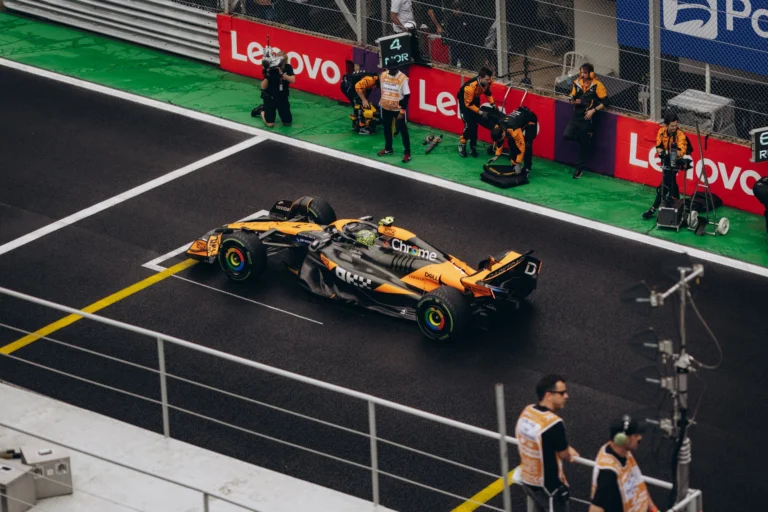
Norris started from pole, with Russell and Antonelli alongside him on the front two rows. When the first start was interrupted by Verstappen's crash, the field returned for another standing start. Antonelli launched better than Norris and took the lead, while Russell was beaten by Oscar Piastri. (formula1.com)
From there, Antonelli established the strongest pace of the opening stint. He pulled roughly 1.4 seconds clear of Norris, enough to keep the McLaren outside the overtake-mode window. By the middle of the race, however, Norris had brought the gap back under a second. (formula1.com)
Mercedes' own post-race account is unusually clear about what happened. Antonelli "had the measure of Norris in the first stint" but subsequently struggled for pace. (formula1.com)
That distinction matters. The Mercedes was not simply beaten from the start. It was competitive enough to control the race initially, but its advantage did not survive into the later phase.
McLaren's advantage appeared as the tyres aged
Norris' eventual victory was built on what happened after the initial Mercedes advantage disappeared.
At Lap 16, Norris reported that he had essentially exhausted his available pace. Yet he stayed close enough to Antonelli to keep the pressure alive. By Lap 30, the gap was back below a second. Ten laps later it had fallen to 0.7 seconds. (formula1.com)
Antonelli then stopped for hard tyres on Lap 41, followed shortly by Russell. Norris remained out longer, and the Mercedes strategy eventually required Antonelli to make another stop under a late Virtual Safety Car. The extra tyre advantage was not enough to recover the lead. (formula1.com)
The critical tactical detail is that Norris did not need the freshest tyres to win. He stayed out during the late VSC while Antonelli stopped, leaving the McLaren on older rubber. Even so, Norris pulled away by more than 11 seconds before the chequered flag. Formula 1's race report explicitly describes him as able to pull away despite having older tyres than his Mercedes rival. (formula1.com)
That is probably the strongest race-pace signal from Zandvoort: once the initial tyre and track-position advantage shifted, McLaren could maintain a much stronger sustained pace than Mercedes expected.
Piastri makes the McLaren picture less comfortable
The second McLaren complicates any claim that Zandvoort was simply a dominant McLaren weekend.
Piastri qualified fourth, only 0.142 seconds behind Norris, and was running ahead of Russell after the restart. But his race deteriorated. A slow pit stop cost him track position, and Ferrari's Lewis Hamilton and Charles Leclerc eventually passed him. Piastri finished sixth, 32.332 seconds behind Norris. (formula1.com)
Formula 1 reported that Piastri himself could not explain the lack of pace and described the result as disappointing. (formula1.com)
That means the Dutch GP does not establish that McLaren had a 30-second race-pace advantage over Mercedes. Piastri's result was affected by the slow stop and the subsequent traffic, while Norris had clean air at the front.
It does establish something narrower and more useful: Norris had the strongest combination of pace, tyre management and track position when the race settled into its long-running phase.
Mercedes was still the more complete team over the weekend
If the question is race pace at Zandvoort alone, McLaren has the stronger case. If the question is overall 2026 competitiveness, Mercedes has the stronger evidence.
Russell won Saturday's Sprint from pole and managed his tyres well enough to control the race. Antonelli also showed strong Sprint pace despite running in traffic. Formula 1's weekend report noted that Mercedes' race pace in the Sprint looked very strong. (formula1.com)
That performance matters because the Sprint provided a cleaner comparison of sustained pace than Sunday's chaotic opening lap. Mercedes could make its tyres last and control the field, while McLaren's Norris began to lose rear grip as his medium tyres deteriorated. (formula1.com)
Mercedes then placed both cars on the Sunday podium.
The championship picture reinforces that consistency. After the Dutch GP, Mercedes leads the constructors' standings with 425 points, compared with 263 for McLaren and 186 for Red Bull Racing. Antonelli leads the drivers' championship with 242 points, while Russell has 183. (formula1.com)
So there are two different answers to "who has the fastest car?"
At this particular circuit and in this particular Grand Prix, Norris had the winning race pace. Across the season, Mercedes has been the more reliable points-producing package.
Red Bull is the difficult one to measure
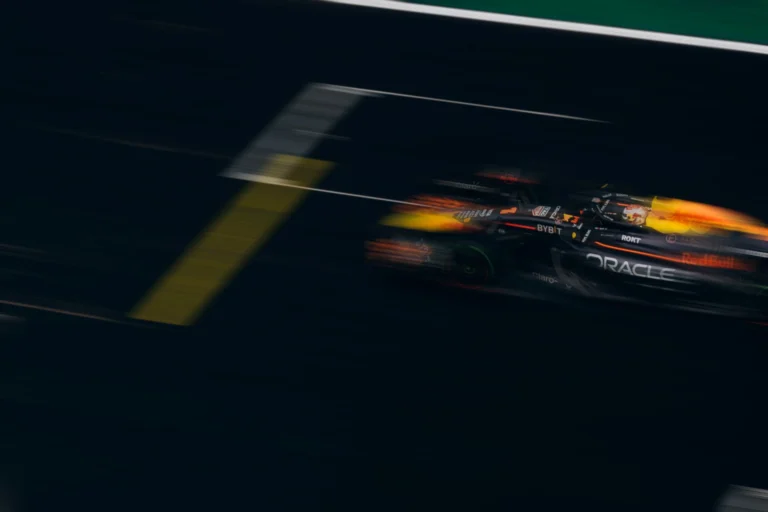
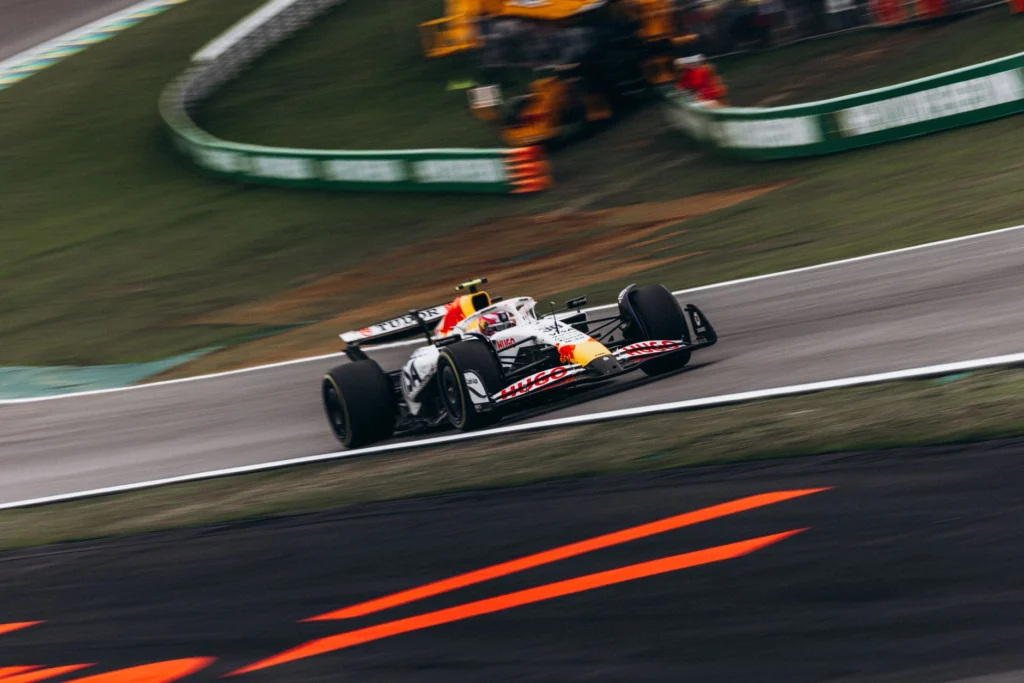
Red Bull's position is much less certain because Verstappen's race ended almost immediately.
The home favourite started seventh after qualifying 0.455 seconds off Norris' pole time. Lawson qualified eighth, only 0.073 seconds behind Verstappen. That suggests the Red Bull was not hopelessly detached from the front on one-lap pace. (formula1.com)
But qualifying pace is not race pace.
Verstappen lost the rear on the main straight on Lap 1 after crossing the white line and hit the wall, triggering the red flag. Lawson survived and eventually finished seventh, but he spent the race well outside the fight for victory. (formula1.com)
There is therefore no honest basis for saying Red Bull was, for example, half a second per lap slower than McLaren at Zandvoort. The race did not provide enough uninterrupted evidence.
The broader season record is also mixed. Red Bull has scored 186 constructors' points through the Dutch GP, well behind both Mercedes and McLaren. But Verstappen had already won the Hungarian Grand Prix, finishing ahead of Antonelli, while Norris won that race. (formula1.com)
Red Bull remains capable of producing a race-winning package at the right circuit. Zandvoort simply did not give it a clean opportunity to demonstrate that.
The qualifying gap was too small to explain the race result
The Dutch GP grid makes the eventual finishing order even more revealing.
Norris took pole in 1:11.163. Russell was 0.102 seconds behind, Antonelli 0.133 seconds behind, and Piastri 0.142 seconds behind. Verstappen was seventh, 0.455 seconds off pole. (formula1.com)
Those are small margins at the front.
The race, however, produced a much larger separation. Norris finished 11.536 seconds ahead of Antonelli and 15.906 seconds ahead of Russell, while Piastri was 32.332 seconds back. (formula1.com)
That gap cannot be explained by qualifying performance alone. Strategy, tyre degradation, traffic, pit-stop execution and track position all mattered.
It is also why a single fastest-lap comparison would be misleading. The meaningful question is not which car could produce the quickest isolated lap, but which car could sustain competitive lap times while managing its tyres and reacting to the changing race.
The clearest 2026 hierarchy is circuit-dependent
Zandvoort points toward McLaren having the best late-race pace of these three teams, Mercedes having the stronger early-race and tyre-management package, and Red Bull remaining the least certain quantity.
That is a narrower conclusion than calling McLaren the fastest team.
The season standings currently argue against that broader claim. Mercedes is 162 points clear of McLaren in the constructors' championship, while Red Bull trails McLaren by 77. (formula1.com)
But the Dutch GP also shows why the standings cannot be treated as a pure speedometer. Norris has now won consecutive Grands Prix, first in Hungary and then at Zandvoort, while Mercedes has continued to collect podiums and championship points. (formula1.com)
The most useful reading of the current three-way comparison is therefore not "McLaren is fastest" or "Mercedes is fastest."
It is that the gap is being decided by where each car can sustain its performance. At Zandvoort, Mercedes owned the opening phase and McLaren owned the decisive later phase. Red Bull never got the uninterrupted race to answer the question.
That is the real race-pace story heading into the next round: Norris has shown that McLaren can convert sustained pace into wins again, while Mercedes still has the season-long consistency advantage. Red Bull needs a clean Grand Prix before its actual position in that fight can be judged with confidence.