Palm trees are the defining symbol of every tropical beach photo — and, botanically speaking, they’re not actually trees at all. Here’s the real science behind the beach icon.
Palm trees aren’t botanically “trees”
A true tree is a woody plant capable of secondary growth in diameter, through a layer called the cambium that adds new growth rings year after year. Palms lack a cambium entirely, which means they genuinely don’t increase in trunk diameter as they age the way oaks or pines do — a palm’s trunk is essentially the same width for its entire life once it’s established.
They’re closer relatives to grass than to oak trees
Palms aren’t true trees botanically — they’re monocots, more closely related to grasses, bamboo, and lilies than to any actual tree species. Their internal structure reflects that relationship directly: the xylem and phloem (the plant’s internal transport tissue) are arranged in scattered bundles throughout the trunk, similar to the strands running through a celery stalk, rather than in the concentric rings found in real wood.
No rings means no easy way to tell a palm’s age
Because palms never form growth rings, there’s no straightforward way to count a palm’s age the way you’d count rings in a cut tree trunk — a real, practical consequence of their non-woody internal structure that surprises most people who assume every tall trunk works the same way underneath.
There are over 2,500 real palm species
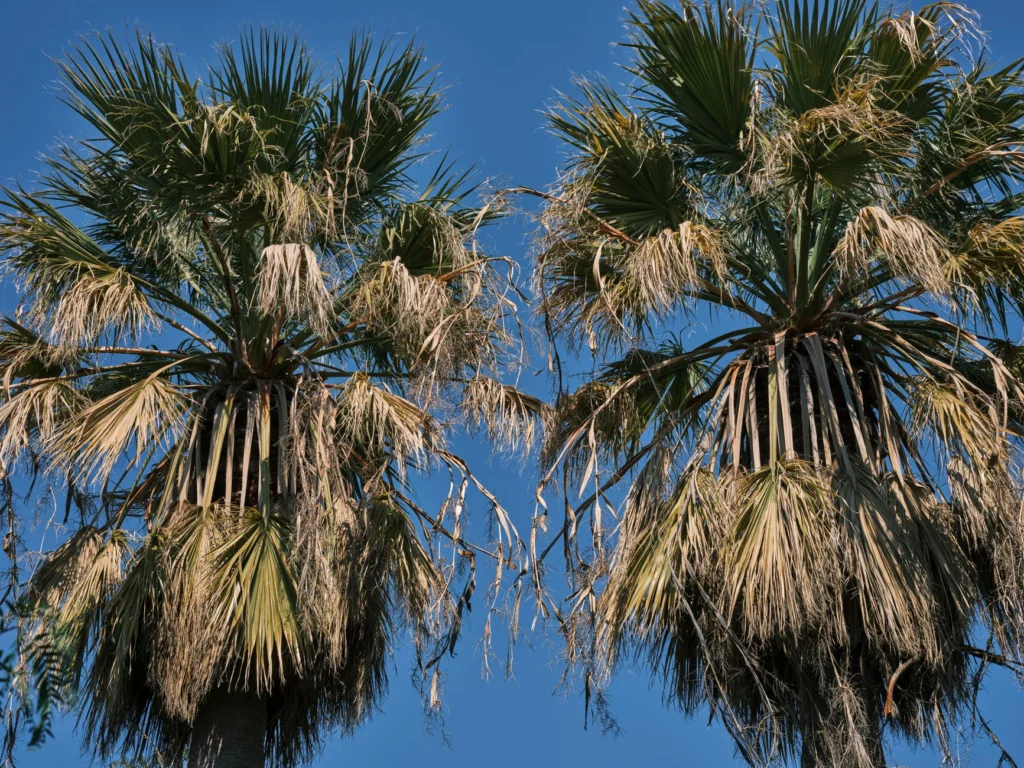
Palms belong to the family Arecaceae, which contains more than 2,500 distinct species. True palms across that family share a consistent set of traits: unbranched, fibrous stems; pinnate or palmate leaves emerging from a single growth point at the top; and flowers arranged in branched clusters — a real, defined botanical identity, not just a general “tropical tree” look.
The single growth point that makes a palm’s survival fragile
Unlike a true tree, which grows new branches and shoots from multiple points across its structure, most palm species grow from a single apical meristem — one growth point at the very top of the trunk, sometimes called the “heart of palm.” That’s a real, structural vulnerability: if that single top growth point is damaged or removed, the entire palm typically cannot regenerate and will die, unlike a true tree that can often survive losing a branch or even significant trunk damage by regrowing from elsewhere. It’s the same reason harvesting “heart of palm” as a food product requires cutting down the entire palm — there’s no way to remove that single growth point without ending the plant’s life.
Why this actually matters beyond trivia
The palm’s lack of a cambium isn’t just a technicality — it directly explains why palms can bend dramatically in hurricane-force winds without snapping the way rigid, ringed hardwoods do, and why they can grow in sandy, unstable coastal soil that would topple a heavier, true tree. The exact botanical feature that disqualifies palms from being “real trees” is the same one that makes them so well-suited to the beaches they’re famous for lining.
Not every “palm-looking” tropical plant is actually a palm
Several genuinely common tropical plants that get casually called palms — including cycads and certain yuccas — aren’t members of the Arecaceae family at all, and belong to entirely separate plant lineages that evolved a similar tall, frond-topped shape through convergent evolution rather than shared ancestry. That’s a real, easy mix-up: the visual template of “tall trunk, crown of long leaves at the top” turns out to be a genuinely effective survival shape that multiple, unrelated plant families independently arrived at, not proof of a shared botanical identity.