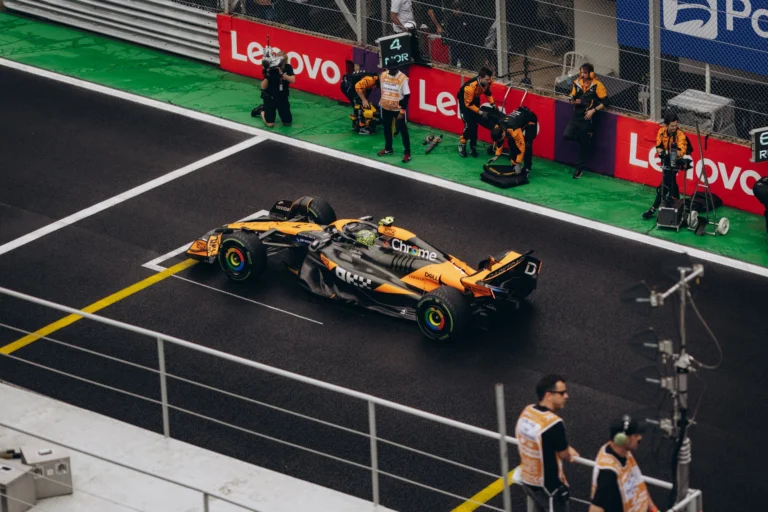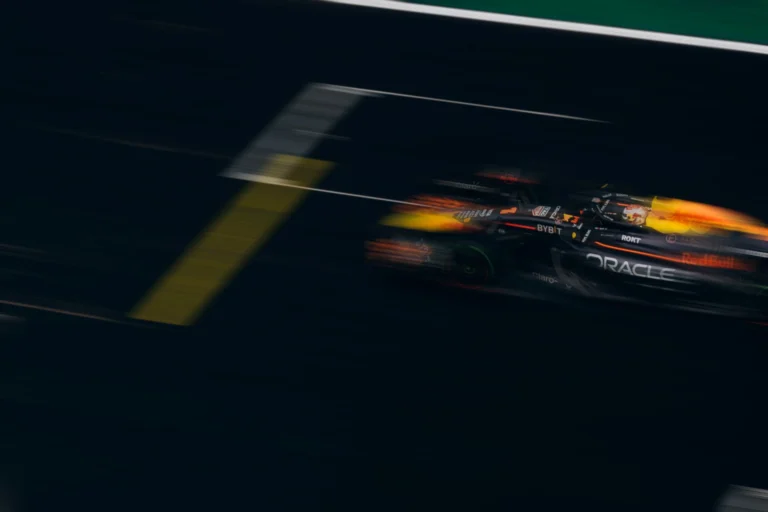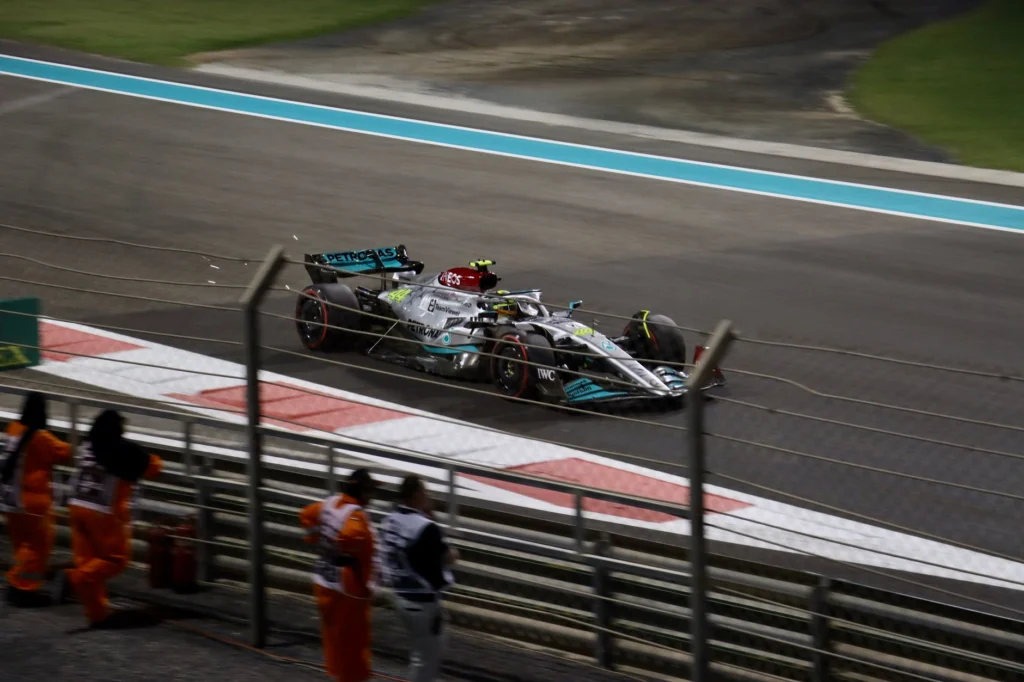
Kimi Antonelli left Zandvoort on Sunday with a second-place finish and a 59-point lead over George Russell and Lewis Hamilton. The result was not a straightforward Mercedes victory. Lando Norris had the faster car over the second half of the Dutch Grand Prix, yet Antonelli still extended his advantage in the championship.
That distinction matters.
Antonelli is no longer a promising Mercedes rookie who happens to be winning races. With six Grand Prix victories from the first 12 rounds, three additional podiums and 242 points, he has become the driver everyone else has to catch. (formula1.com)
The more revealing part of his title campaign is how he has accumulated that advantage. Mercedes has occasionally had the fastest car, but reliability has cost both drivers points. Rivals have also improved. And at Zandvoort, Antonelli's championship position directly influenced Mercedes' tactical decisions.
Antonelli built the lead before Mercedes needed to protect it
The championship case was established during the first half of the season.
Mercedes began 2026 with a one-two finish in Australia, followed by another one-two in China, where Antonelli claimed his maiden Grand Prix victory. He then won in Japan, Miami, Canada, Monaco and Belgium. By the summer break, he had six victories from 11 Grands Prix. (formula1.com)
That run also made him the youngest driver ever to lead an F1 championship when he moved to the top in Japan. (formula1.com)
The interesting part is that Antonelli did not need Mercedes to dominate every weekend to maintain the advantage.
He scored second in Australia, third in Austria and Hungary, and recovered to second at Zandvoort. His non-finishes in Barcelona and Silverstone were the exceptions rather than the pattern. F1's own review of Mercedes' first half identified reliability as one of the team's biggest problems, with the potential points haul reduced by technical failures. (formula1.com)
That gives the championship a useful context. Antonelli's lead is not simply the product of a perfect Mercedes season. It has survived an imperfect one.
The Dutch Grand Prix showed exactly how Mercedes is treating the title fight
Zandvoort provided the clearest example yet of Mercedes making decisions around Antonelli's championship position while still trying to maximize the team's total points.
Norris started from pole, with Russell second and Antonelli third. After Max Verstappen crashed at the end of the opening lap and caused a red flag, Antonelli made an aggressive restart and took the lead from Norris. He then controlled the opening phase of the race. (formula1.com)
But the Mercedes was not the faster car for the entire afternoon.
Once Norris switched onto the hard tyre, his pace improved significantly. Antonelli struggled with confidence in the car during the later stint, and Norris eventually reclaimed the lead. (skysports.com)
Then the tactical situation changed.
With 16 laps remaining, a Virtual Safety Car allowed Antonelli to make what Mercedes described as a "free stop" for fresher tyres. He rejoined behind Russell, while Ferrari's Hamilton and Charles Leclerc were also benefiting from the opportunity to stop. (skysports.com)
Antonelli was on significantly fresher rubber, but Zandvoort is not a circuit where overtaking a teammate can simply be assumed. Mercedes therefore ordered Russell to let Antonelli through.
That decision carried a real cost. Russell was left on older tyres and became vulnerable to Hamilton and Leclerc. Another Virtual Safety Car later in the race helped him defend third, and he eventually finished less than a second ahead of Hamilton. (skysports.com)
The result was Mercedes second and third, rather than potentially allowing both Ferraris onto the podium.
For Antonelli, the immediate benefit was threefold: he took the stronger Mercedes finishing position, extended his championship lead and avoided a pointless intra-team fight. Mercedes' Toto Wolff said the same call would have been made in reverse if Russell had been the driver ahead before the pit stop. (skysports.com)
The important detail is that Antonelli did not actually have the pace to win
It would be easy to read the Dutch Grand Prix as another demonstration of Mercedes' superiority. The race report does not support that conclusion.
Antonelli led after the restart and held the position for much of the first stint, but Norris became substantially faster later in the race. After the pit-stop sequence, the McLaren had the performance advantage and ultimately won by 11 seconds. (skysports.com)
Antonelli himself said the second half was difficult, particularly on the hard tyres, and acknowledged that Mercedes' strategy put Russell in a more exposed position.
That makes the second place more valuable, not less.
Championship campaigns are built from weekends when the car is dominant, but also from weekends when the driver and team recognize that victory is no longer available and protect the best result remaining.
Antonelli did that at Zandvoort.
Mercedes is no longer operating with the same margin it had in spring
The biggest threat to Antonelli is not a sudden collapse in his own form. It is the improving performance of McLaren.
Norris had already won in Hungary before arriving at Zandvoort, following a significant McLaren upgrade. He then won again in the Netherlands. Antonelli's lead remains enormous, but Norris has now demonstrated that McLaren can take victories away from Mercedes on consecutive weekends. (reuters.com)
Antonelli himself acknowledged after Zandvoort that Mercedes no longer had the outright fastest car.
That admission is important because Mercedes' championship advantage was built when its package was more consistently ahead. As competitors close the performance gap, Antonelli will have fewer weekends where simply finishing near the front guarantees a large points haul.
And the 2026 regulations make development especially consequential. Mercedes' own mid-season assessment described the team as having its strongest championship opportunity since 2021, while also pointing to reliability and the narrowing performance gap as reasons the title is far from settled. (formula1.com)
The next problem is already waiting at Monza
Antonelli will arrive at his home Italian Grand Prix with a championship lead of 59 points, but he will not have the usual advantage of starting from wherever he qualifies.
Mercedes has confirmed that an engine change will trigger a significant grid penalty at Monza, with the penalty expected to be at least 10 places. The decision is connected to the team's power-unit allocation after technical problems earlier in the season, including Antonelli's retirement in Barcelona. (formula1.com)
Mercedes deliberately chose Monza because overtaking is comparatively feasible there. In other words, the penalty is not being accepted because the team considers the championship safe. It is being accepted because taking the penalty at a high-speed circuit offers a better chance of recovering the lost positions. (skysports.com)
That could make Monza one of the most revealing races of Antonelli's season.
He has already shown that he can win from the front. The next test is whether he can limit the damage when the circumstances force him to start deep in the field.
Russell remains a genuine threat, but the numbers now favour Antonelli heavily
The Mercedes intra-team battle has not disappeared.
Russell won the Dutch Sprint and reduced his deficit before Sunday's Grand Prix. After finishing third, however, he sits on 183 points, 59 behind Antonelli. Hamilton has the same points total, while Norris is fourth on 159. (skysports.com)
Russell is therefore still mathematically and competitively relevant. He has won races this season, including Australia and Austria, and his Dutch Sprint victory demonstrated that he can still outperform Antonelli on a given weekend. (formula1.com)
But Antonelli has created something Russell cannot easily manufacture: margin.
That margin changes how Mercedes can approach races. At Zandvoort, the team could justify protecting Antonelli's position without sacrificing the second Mercedes from the podium. Russell understood the calculation and later said Antonelli deserved second because he had been ahead before the pit-stop sequence. (skysports.com)
The rivalry is still there. Mercedes simply has more reason to manage it carefully now.
Antonelli's biggest challenge may be maintaining the standard he established
There is one reason not to declare the championship over: Antonelli's recent run has not been flawless.
Before Belgium, he had gone four races without a victory after winning five consecutive Grands Prix. At Zandvoort he also admitted that qualifying mistakes during the Sprint weekend were a useful wake-up call. (reuters.com)
That matters because the remaining season is unlikely to resemble the opening stretch. McLaren has improved. Ferrari remains capable of taking victories, as Hamilton demonstrated in Barcelona. Mercedes has its own reliability concerns, and Antonelli is heading into at least one race with a major grid penalty.
But those are precisely the circumstances in which his current championship position becomes meaningful.
After 12 rounds, Antonelli has 242 points. He has six wins, multiple podiums and a 59-point advantage over the two drivers tied behind him. The latest race did not show an unstoppable Mercedes. It showed something more useful for a championship contender: a driver who can take second when first is no longer realistically available, while his team makes decisions designed to preserve the larger objective.
That is why Kimi Antonelli has moved from prospect to title favourite.
The next question is whether he can survive Monza without giving back a meaningful part of the lead he has spent the season building.