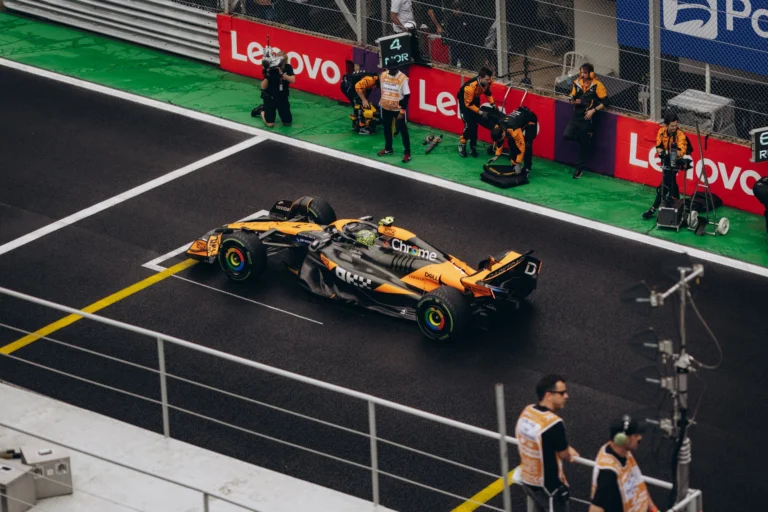
Lando Norris left Zandvoort with his second consecutive Grand Prix victory. Oscar Piastri left in sixth, 32.332 seconds behind his McLaren team-mate. The difference was not simply that Norris had the faster Sunday. Their Dutch Grand Prix weekends exposed two very different sides of McLaren's 2026 driver pairing. (formula1.com)
Norris now has 159 points and sits fourth in the championship, while Piastri has 104. That 55-point gap is striking, particularly because both are driving the same McLaren. But the raw standings hide how differently their seasons have unfolded. (formula1.com)
The 2026 season has already given both drivers reasons to believe they can lead McLaren. It has also exposed weaknesses that are harder to ignore.
Norris has turned a difficult title defence into a late-season charge
Norris entered the summer break with momentum building, and the Hungarian Grand Prix was the first clear sign that his season was changing direction.
At the Hungaroring, Norris won after starting the race strongly and then finding himself behind Piastri. The Australian took the lead when Norris ran slightly wide at Turn 2. McLaren's subsequent strategy eventually separated the two cars, with Piastri making a second stop while Norris stayed out and produced the pace needed to take the victory. Piastri later retired with a gearbox problem. (formula1.com)
That result mattered beyond the 25 points. Norris had finally converted a competitive McLaren into a Grand Prix victory in the second half of the season.
Zandvoort reinforced the point.
Norris qualified on pole with a 1:11.163, only 0.142 seconds ahead of Piastri in fourth. Piastri had looked particularly strong through much of qualifying before Norris produced his final lap as conditions deteriorated. (formula1.com)
The race itself was more revealing.
After Max Verstappen's opening-lap crash caused a red flag, the field returned for a second standing start. Antonelli jumped Norris, while Piastri made an excellent launch and passed George Russell for third. It was one of Piastri's best moments of the race. (formula1.com)
Norris eventually caught Antonelli during the second stint and passed him for the lead. When the late Virtual Safety Car appeared, Antonelli stopped for soft tyres while Norris stayed out. That left Norris on older rubber, but he had enough pace to pull away and win by 11.536 seconds. (formula1.com)
That is the Norris of the last two Grands Prix: fast enough to recover from setbacks and increasingly effective when the race becomes a strategic contest.
Piastri's 2026 record is harder to judge from the championship table
Piastri's 104 points tell only part of the story because his season began badly.
He did not start the Australian Grand Prix and also missed the start in China, although he recovered three points from the Chinese Sprint weekend. He then scored 18 points for second in Japan and 22 for third in Miami. (formula1.com)
His results subsequently became much less consistent. Piastri finished 11th in Canada, fifth in Monaco and Barcelona, fourth in Austria, 11th in Britain and fifth in Belgium. He then retired from the Hungarian Grand Prix before finishing sixth at Zandvoort. (formula1.com)
The pattern is important. Piastri has still produced front-running results, but he has struggled to build the uninterrupted run Norris has managed recently.
And the Dutch Grand Prix was a particularly clean example of why.
Piastri started fourth and immediately moved into third at the restart. He then made his first pit stop one lap after the restart, switching to hard tyres. A slow stop dropped him behind Russell. Later, Ferrari's Charles Leclerc passed him, followed by Lewis Hamilton. Piastri eventually finished sixth. (formula1.com)
Piastri himself described the result as disappointing and said he did not currently have answers for the lack of pace he experienced. That matters because this was not simply a case of being trapped behind a faster car from the opening lap. He had started ahead of the Ferraris and had briefly moved ahead of Russell. (formula1.com)
The Dutch GP showed the difference between their race execution
The most useful comparison is not simply Norris P1 versus Piastri P6.
Norris was also beaten off the line. Antonelli took the lead after the restart and remained ahead for much of the race. Norris then steadily reduced the gap, despite a brief loss of momentum, before making the decisive move for first place. (formula1.com)
Piastri had a similar opportunity to make progress. He passed Russell immediately after the restart, but the slow pit stop erased much of that gain.
From there, his race deteriorated.
The two McLarens therefore experienced opposite strategic trajectories. Norris turned pressure from behind into a race-winning position. Piastri turned an early podium position into sixth.
That does not make the entire difference a driver error. The pit-stop delay was a McLaren operational problem, and Piastri's later pace was clearly not what he expected. The official McLaren race report explicitly identified the slow stop as the event that undermined his race. (formula1.com)
But the contrast still matters when assessing the drivers.
Norris currently has the stronger ability to convert McLaren's pace into points
There is a straightforward argument for Norris in 2026: when McLaren gives him a realistic opportunity to win, he is increasingly converting it.
He won Hungary and then won Zandvoort. Those were back-to-back victories after the summer break, and they moved him to 159 points. (formula1.com)
Piastri, by contrast, has only 104 points after the same 12 Grands Prix. His season contains obvious mitigating factors, including his early non-starts and the gearbox failure in Hungary. But championship scoring ultimately rewards completed weekends, and Norris has accumulated 55 more points. (formula1.com)
There is also a useful distinction in their current competitive profiles.
Norris has become particularly dangerous when a race develops into a contest of tyre management, positioning and timing. His Zandvoort victory was not secured from lights to flag. He lost the lead twice in the strategic sense: first to Antonelli at the restart and later to the changing pit-stop sequence. He still ended up controlling the finish.
Piastri's strongest weekends have often featured flashes of the same speed, but he has not consistently converted those moments into the same points haul.
Piastri still has evidence that the gap is not simply about outright speed
The championship table should not be interpreted as proof that Norris is 55 points faster than Piastri.
Qualifying at Zandvoort is a good counterexample. Norris took pole, but Piastri was fourth and only 0.142 seconds slower. More importantly, Formula 1's official report noted that Piastri had looked like the fastest driver on track for much of the session before Norris produced his final lap. (formula1.com)
The Sprint weekend also showed that McLaren's performance window was competitive rather than dominant. George Russell won the Sprint, with Charles Leclerc second and Norris third. (formula1.com)
That makes the drivers' ability to extract performance from the car increasingly important.
Piastri has shown he can do it. His second place in Japan, third in Miami and fourth in Austria are not the results of a driver merely circulating behind his team-mate. (formula1.com)
The issue is consistency.
A driver can be extremely fast over a lap or a stint and still lose a championship because too many weekends contain a missed opportunity, reliability failure, difficult qualifying session or strategic setback.
That is where Norris currently has the advantage.
McLaren's real problem is not choosing a number one driver yet
There is no evidence from the Dutch Grand Prix that McLaren needs to impose a rigid hierarchy between its drivers.
Norris is the clear championship leader within the team, but his 159 points still leave him 83 points behind Kimi Antonelli, who leads the championship with 242. George Russell and Lewis Hamilton are both ahead of Norris as well, on 183 points. (formula1.com)
Piastri is further back, but the season is not finished.
For McLaren, the immediate priority is therefore maximising both cars rather than turning the internal battle into a political one. The Dutch Grand Prix actually showed why. Norris needed every strategic advantage he could find to beat Mercedes, while Piastri was capable of running third before his race unravelled.
A healthy Piastri finishing closer to the front would have made McLaren's Sunday considerably stronger.
That is the central difference between the two drivers at this stage of 2026. Norris is currently the better converter: better at turning a promising weekend into a major championship result. Piastri remains capable of matching him in isolated phases, but his season has contained too many interruptions and lost opportunities.
The next question is whether that gap is permanent or simply the shape of a season that has not yet finished.
Norris has already answered that question once since the summer break. Two victories in a row have put his title defence back into the conversation.
Piastri's answer will have to come on the track.