The current Rubik’s Cube single-solve world record sits under 3.5 seconds. The first official World Championship in 1982 was won with a time over 22 seconds, and the puzzle’s inventor himself reportedly took roughly a month to solve it the first time in 1974. Understanding how that gap actually closed reveals more about method innovation and organized competition than about raw human reflexes improving.
Who invented the cube, and why it was designed to be solvable at all
Erno Rubik, a Hungarian professor of architecture and design, invented the cube in 1974 as a teaching tool to help his students understand three-dimensional spatial relationships and structural movement, not as a puzzle or toy. He has said publicly that he didn’t know how to solve his own invention for roughly a month after building the first working prototype, a genuinely useful data point on just how unintuitive the puzzle is without a known method, even for the person who designed its mechanism. The cube was licensed internationally and became a global phenomenon by the early 1980s, selling well over 100 million units within its first few years on the market.
The organization that actually governs competitive times
The World Cube Association, founded in 2004, is the internationally recognized governing body for competitive cubing, responsible for certifying official competitions, standardizing timing equipment, and maintaining the verified world record database. Before the WCA existed, claimed records varied in credibility depending on how they were measured and witnessed. The WCA’s standardization, using a specialized timing device called a StackMat timer that starts and stops based on hand contact rather than manual stopwatch reaction time, is a big part of why post-2004 records carry more verifiable precision than earlier claimed times.
The method changes that actually explain the collapse in times
Early solvers, including 1982 World Champion Minh Thai, generally used layer-by-layer methods that solved the cube in a fixed, intuitive sequence without much algorithmic optimization. The modern standard method used by nearly every top competitive solver today is CFOP, an acronym for Cross, F2L (First Two Layers), OLL (Orientation of the Last Layer), and PLL (Permutation of the Last Layer), developed and refined through the 1980s and 1990s by several contributors, most notably Jessica Fridrich, whose name is why the method is also commonly called the Fridrich Method. CFOP works by memorizing a large set of specific algorithms, sequences of moves, for recognized cube patterns, rather than solving intuitively step by step. Top competitive solvers today typically know well over 100 distinct algorithms for the OLL and PLL stages alone, each one triggered by instantly recognizing a specific visual pattern on the cube’s last layer, allowing the solver to execute the correct sequence from memory rather than working out the solution in real time. That shift, from intuitive layer-by-layer solving to pattern recognition plus memorized algorithm execution, is the single biggest factor separating a 22-second 1982 solve from a modern sub-5-second one.
The gap between a 22-second 1982 solve and a modern sub-5-second solve isn’t primarily about faster fingers. It’s the difference between solving the cube by working it out and solving it by instantly recognizing a pattern and executing a memorized sequence for it.
Hardware changed too, and the numbers are specific
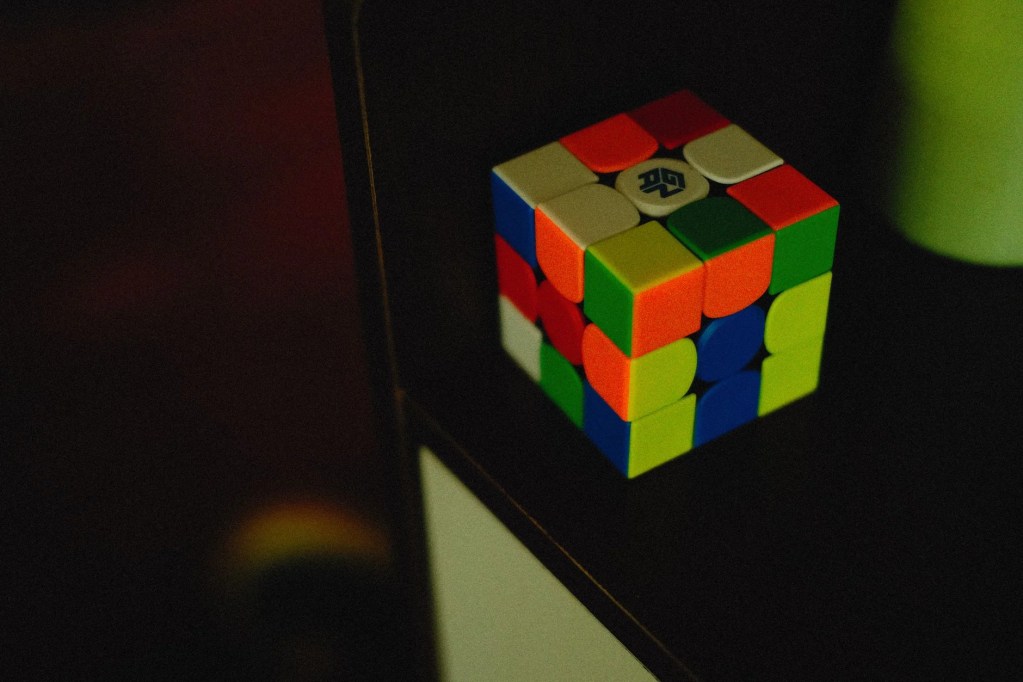
Cube hardware itself has been engineered dramatically since the original 1974 design. Modern competition-grade cubes use magnetic positioning systems, magnets embedded at each piece’s corners and edges that snap the cube into aligned positions, along with precision-engineered internal mechanisms that reduce friction and allow extremely fast, controlled rotation without the pieces catching or locking up mid-turn, a common problem with older, non-optimized cubes. Manufacturers like GAN and MoYu now produce cubes specifically tuned for competitive speed, with adjustable tension and spring systems that let individual solvers fine-tune the cube’s turning resistance to their personal preference, an equipment-level optimization layer that simply didn’t exist in the puzzle’s first decade.
The current record, and how it was actually measured
Yusheng Du set the current single-solve world record of 3.47 seconds at a WCA-sanctioned competition in China in 2018, a time that has stood since despite the sport’s continued growth and increasing competitive depth. WCA rules require an official “scramble,” a randomized starting position generated by certified software, so no solver can memorize or practice the exact configuration in advance, and require independent judges to verify each recorded time. That verification standard is part of why the 3.47-second record is treated as a genuinely reliable benchmark rather than a claimed, unverified time.
Why average solve time matters more than the single record
WCA competitions score most events using an average of five solves, dropping the fastest and slowest times and averaging the remaining three, specifically because a single exceptional solve can happen partly through luck of the scramble, some random starting positions are genuinely easier to solve quickly than others, while a strong average time demonstrates consistent skill across varied conditions. Top competitors like Max Park, one of the sport’s most dominant recent competitors, are often more notable for their sustained sub-5-second averages across many events than for any single record time, which is the metric serious competitive cubers actually treat as the better skill indicator.
Common misconceptions about competitive cubing
A frequent misconception is that competitive solvers are simply moving their hands faster than casual solvers. The larger factor is drastically reduced thinking time, since a competitive solver has pre-planned much of the solution during the brief inspection period allowed before the timer starts, rather than working out each step live during the solve itself. Another common misunderstanding is that a single Rubik’s Cube method exists. In practice, competitive solvers use several distinct methods depending on the specific event, CFOP dominates the standard 3×3 event, but other methods like Roux and ZZ have real competitive followings for solvers who find them better suited to their own move efficiency and thinking style.
Frequently asked questions
What is the current official Rubik’s Cube world record?
3.47 seconds, set by Yusheng Du at a WCA-sanctioned competition in China in 2018.
What method do most competitive speedcubers actually use?
CFOP (Cross, F2L, OLL, PLL), also called the Fridrich Method, is the standard method used by nearly all top competitive solvers, relying on memorized algorithms rather than intuitive step-by-step solving.
Did the cube’s own inventor know how to solve it right away?
No. Erno Rubik has said it took him roughly a month to solve his own invention for the first time in 1974.
Why do competitions use an average of five solves instead of just one time?
A single fast solve can partly reflect a lucky, easier scramble, while an average across five solves, dropping the best and worst, better reflects consistent competitive skill.
For more on the training and technique behind other precision hobbies, see inside the world of competitive speedcubing, where sub-5-second solves are real and what chess grandmasters actually do differently from strong amateurs. More coverage like this lives in our Speed Cubing archive and the broader Niche Skills & Hobbies desk.