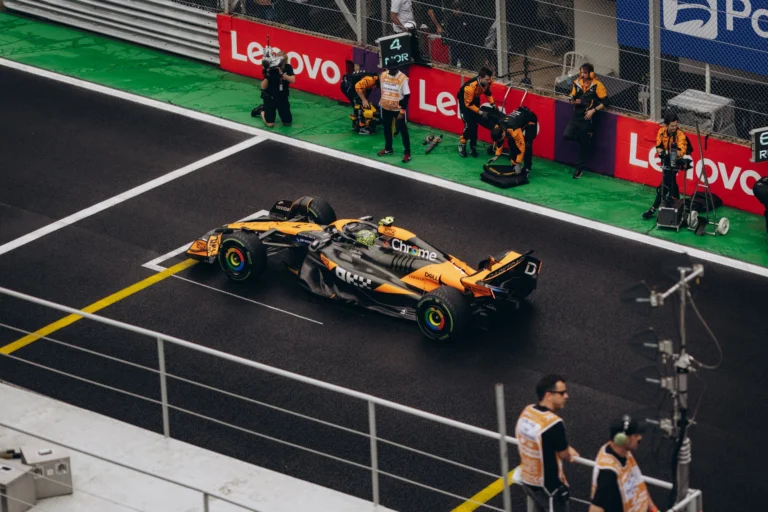
Lando Norris did not win the 2026 Dutch Grand Prix with a classic undercut. He won it by making Mercedes blink first.
That distinction matters because the decisive strategy call at Zandvoort looked, at first, like the kind of pit-stop exchange that usually rewards the car stopping earlier. Instead, McLaren left Norris out while Kimi Antonelli and George Russell committed to another stop, giving Norris the tyre offset he needed to turn a difficult race into a victory.
The final result was Norris ahead of Antonelli by 11.536 seconds, with Russell third. (formula1.com)
So if the question is why the “undercut” worked at Zandvoort, the first answer is that the premise needs correcting: the crucial move was an overcut, supported by the threat of an undercut earlier in the race.
Mercedes had already shown McLaren why track position mattered
Zandvoort was never an easy circuit for overtaking. Pirelli's pre-race assessment described the one-stop as the quickest strategy on paper, with the expected Medium-to-Hard sequence running roughly from Lap 27-33. It also warned that limited overtaking opportunities could make a pit stop particularly costly. (formula1.com)
That shaped the opening phase.
The race itself was complicated before strategy really settled. Rain had arrived before the start, but the track was sufficiently dry for slick tyres. Norris began on the Medium, as did Antonelli and Russell, while much of the field chose the Soft. Max Verstappen's Lap 1 crash then caused a red flag and a standing restart. (formula1.com)
At that restart, Antonelli jumped Norris into Turn 1 and established the lead.
For the next part of the race, Norris could not simply drive past him. By Lap 10, Antonelli had stretched the advantage to 1.4 seconds, enough to keep Norris outside the effective overtaking window. By Lap 16, Norris was already telling McLaren that his tyres had little left. (formula1.com)
That was the first strategic problem.
If Norris stopped too early, he risked giving Mercedes the advantage of track position. If he stayed out too long, he risked losing the pace needed to attack later.
The first stop changed the race without deciding it
Russell was the first of the leading Mercedes cars to make a significant move, stopping on Lap 16 for Hard tyres after coming under pressure from Ferrari. Piastri stopped one lap later, although a slow McLaren pit stop dropped him behind Russell. (formula1.com)
Antonelli and Norris eventually stopped together on Lap 22, both taking Hards.
That part was not the decisive undercut. In fact, both drivers came away from the first stop still separated by strategy and pace rather than a major positional swing. Norris soon began reducing the gap, getting it below a second by Lap 30.
The important discovery was what happened on the Hard tyre.
Norris's McLaren was substantially more comfortable over the longer stint. Mercedes had the lead, but the lead was no longer giving Antonelli control of the race. By Lap 40, Norris was only 0.7 seconds behind. (formula1.com)
That put Mercedes into a familiar F1 dilemma: pit first and risk giving the rival fresher tyres, or stay out and risk being attacked anyway.
Mercedes chose to stop Antonelli on Lap 41.
The real strategic gamble came when Norris stayed out
Antonelli stopped on Lap 41 for another set of Hards. Russell followed. Norris stayed out.
That is where the race moved away from the classic undercut model.
An undercut works because a driver stops first, gets onto fresh tyres, and uses the additional grip to produce faster laps while the rival remains on older rubber. If the timing is right, the driver who stopped first emerges ahead once the second car finally pits.
Norris did the opposite.
He remained on his existing Hard tyres while Mercedes committed to its second stop. The McLaren therefore kept track position and extended the stint. When Norris eventually stopped on Lap 48, he returned to the circuit just over five seconds behind Antonelli. (formula1.com)
Seven laps of difference had created the important asset: fresh tyres without surrendering the race entirely to Mercedes.
Norris immediately exploited them.
The gap fell from just over five seconds to 1.4 seconds within three laps. Antonelli was now defending a position against a driver with a significant tyre-age advantage, and Zandvoort gave him few easy ways to escape.
This is why describing the move simply as an “undercut” misses what McLaren actually achieved.
Norris used the overcut to manufacture the passing opportunity
By Lap 52, Norris was close enough to attack. Antonelli was also dealing with rear-tyre difficulties and was using Overtake Mode while running within a second of Lewis Hamilton, who was still ahead on an alternative strategy. (formula1.com)
Norris did not wait for a theoretical perfect opportunity.
He went around the outside into Turn 1 and passed Antonelli.
The move was followed almost immediately by another: Norris cleared Hamilton and took the effective race lead. He had turned a five-second deficit after his pit stop into the lead in only a handful of laps. (formula1.com)
Norris later explained the logic himself, saying he knew he would not get many chances and that every lap spent behind the Mercedes reduced his opportunity. (skysports.com)
That is the part of the strategy worth remembering. McLaren did not merely create a tyre advantage. It created a short window in which Norris had enough tyre performance to attack before the advantage disappeared.
The Virtual Safety Car could have undone McLaren's work
Then came the complication.
Esteban Ocon stopped his Haas on track, triggering a Virtual Safety Car. Mercedes immediately had an opportunity to change the strategic picture because Antonelli could make a relatively cheap pit stop under reduced racing conditions.
He did exactly that.
Antonelli switched to Soft tyres and rejoined in third, behind Russell. Norris stayed out. By the time the VSC ended, the McLaren was still leading, with Russell between Norris and the freshly shod Antonelli. (formula1.com)
This was the moment when McLaren's strategy could have become a mistake.
Norris himself asked whether the team needed to pit, but the VSC was already ending. There was no longer time to react. (formula1.com)
Instead, Norris had a 10-second advantage over Antonelli by the closing stages.
Mercedes then had to protect the result it could still score. Russell was ordered to let Antonelli through on Lap 65, because Antonelli had much fresher tyres and Mercedes did not want its two cars fighting while Ferrari's Hamilton and Leclerc were closing. (skysports.com)
Russell finished third anyway, holding Hamilton to less than a second at the flag. (formula1.com)
Why the “undercut” label is useful, even though it is technically wrong
There was still an undercut element in the broader strategic battle.
Mercedes knew Norris was the faster car on the Hard tyre. Stopping Antonelli first was an attempt to use fresh tyres and protect against the McLaren's pace. In that sense, Mercedes was responding to the threat that Norris might otherwise stay out and gain an advantage.
But the decisive exchange was the opposite of an undercut.
Mercedes stopped first. McLaren stayed out. Norris then stopped later and used his fresher tyres to close the gap rapidly.
That is an overcut, not an undercut.
And Zandvoort made the distinction particularly significant because fresh tyres do not automatically produce an overtaking opportunity at a circuit where passing is difficult. McLaren needed both tyre performance and enough track position to get Norris within striking distance.
It got both.
Mercedes did not lose because it stopped first; it lost because McLaren had the faster second-stint car
It would be too simplistic to say Mercedes made a bad call by stopping Antonelli on Lap 41.
Antonelli had already spent much of the race struggling to match Norris once both cars moved onto the Hard compound. Mercedes also had Ferrari traffic to consider and could not assume that staying out would preserve the lead indefinitely.
More importantly, the final result was not decided solely by pit-wall timing.
Norris had the pace to make the strategy work.
McLaren's own post-race account said the team had been struggling on the Soft tyre but that Norris's car came alive on the Hards. Mercedes trackside engineering director Andrew Shovlin similarly acknowledged that McLaren had superior pace and that Mercedes needed to pit ahead of Norris to protect its position. (formula1.com)
That is the more useful reading of Zandvoort.
The pit wall did not manufacture a victory from nowhere. It recognised that Norris had a stronger tyre phase, preserved his track position, and gave him a window in which that pace advantage could actually be converted into an overtake.
The result was Norris's second consecutive Grand Prix victory and Mercedes' double podium. The championship leader still finished second, but Zandvoort demonstrated how quickly a race can turn when a driver has the tyre performance to make an overcut more powerful than the conventional undercut response. (formula1.com)
At Zandvoort, the decisive question was never simply who stopped first. It was who could make the last strategically meaningful tyre advantage count before the circuit ran out of overtaking opportunities. Norris did.