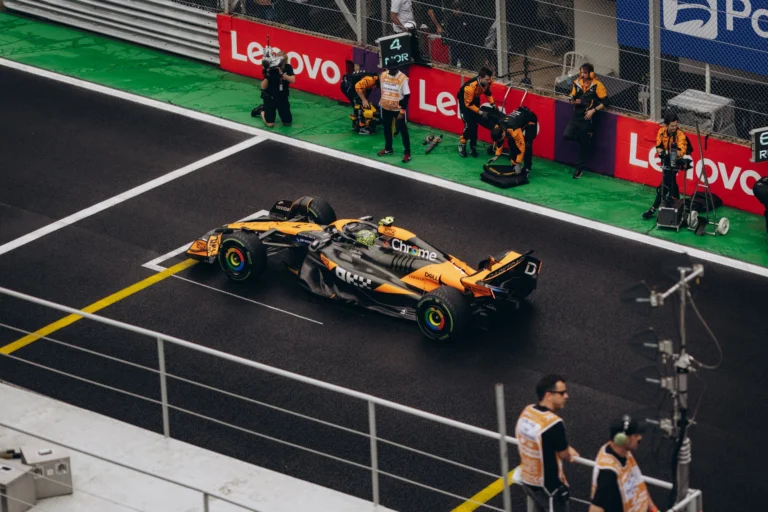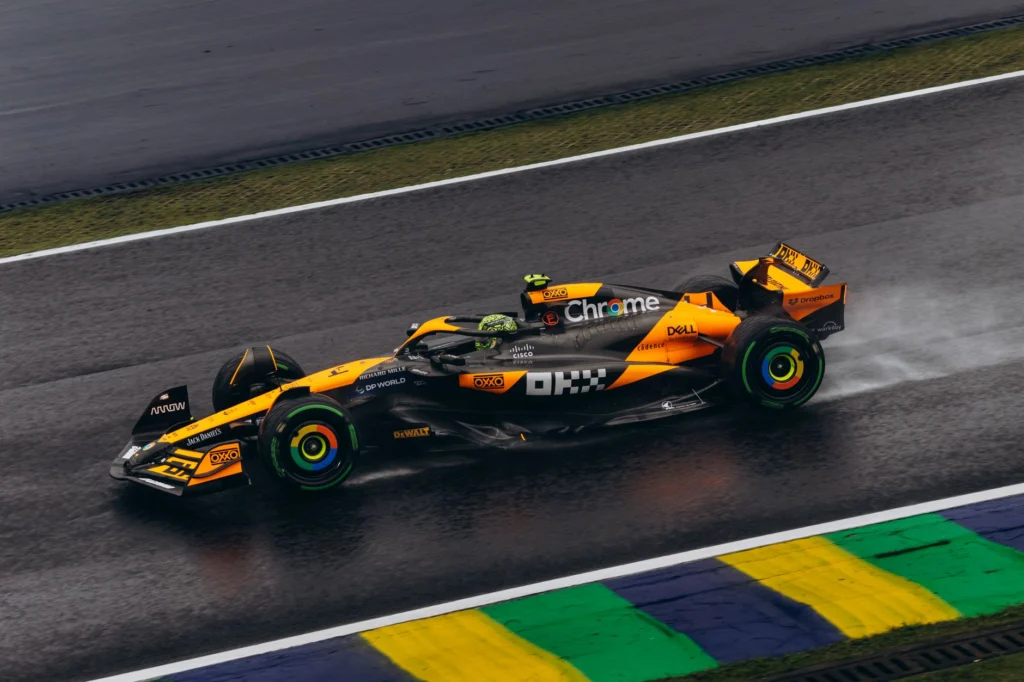
Lando Norris won the 2026 Dutch Grand Prix by 11.536 seconds, but the race was not built around the one-stop strategy Pirelli had expected before Sunday. Rain before the start changed the track, tyre degradation increased after the restart, and a late Virtual Safety Car created another strategic fork.
By the chequered flag, all three dry compounds had been used across the field, with teams running markedly different combinations. Pirelli said almost ten distinct strategies emerged after the first red flag, and the one-stop plan that had looked quickest on Saturday was effectively discarded once the race conditions became clear. (formula1.com)
That makes the Dutch Grand Prix less a story about one perfect tyre call than about how quickly teams had to abandon their original assumptions.
The one-stop strategy looked like the obvious answer on Saturday
Before the weather intervened, Pirelli's race model was relatively straightforward.
Zandvoort had the C2 hard, C3 medium and C4 soft available. The expected quickest strategy was a medium-hard one-stop, with the first stint lasting roughly 27 to 33 laps. Starting on the soft and switching to the hard around laps 26 to 32 was estimated to be about a second slower. Two-stop strategies were considered competitive in clean air, but Zandvoort's limited overtaking opportunities made the extra pit stop a significant liability. (formula1.com)
That last point mattered. Zandvoort is narrow, has relatively few overtaking opportunities and places substantial energy demands on the tyres. Its banked corners generate high vertical and lateral loads, while the track can lose grip as sand blows in from the nearby coast. (formula1.com)
The strategic calculation was therefore familiar: preserve the tyres, avoid an unnecessary stop and protect track position.
Sunday made that calculation obsolete.
Rain changed the tyre equation before the race even started
Heavy rain arrived before the Grand Prix, leaving damp patches around the circuit and creating uncertainty about the opening laps.
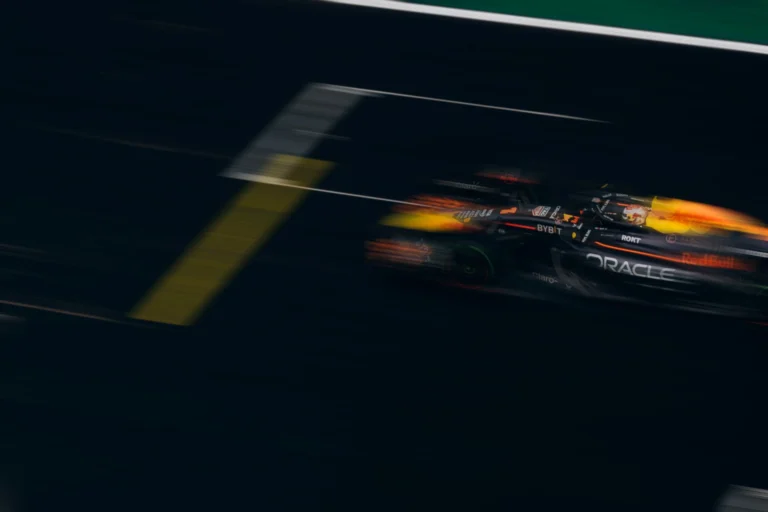
The grid nevertheless settled largely on slicks. The eventual split was significant: much of the field chose the soft, while the leading group of Norris, Russell, Antonelli, Piastri and others took mediums. Verstappen's race ended before the tyre strategy could matter when he lost the rear of his Red Bull on the damp circuit and crashed on the opening lap. (formula1.com)
The red flag then reset the strategic problem.
Norris changed to the soft for the restart. Mercedes kept Antonelli and Russell on mediums, while Piastri moved onto the hard. The race was no longer simply about executing the strategy selected on the original grid. Teams could react to what they had learned from the first lap and the changing track. (formula1.com)
Antonelli immediately gained the advantage, passing Norris at the restart and building a lead.
But the tyres were already telling teams something their pre-race models had not.
The restart exposed the flaw in the one-stop plan
Pirelli's post-race assessment was unusually direct: degradation, which had appeared relatively limited during Saturday's running, became significant after the rain.
The problem was not simply heat. The rain had left the circuit more slippery, increasing wear as the tyres worked against a less predictable surface. Pirelli said teams quickly realised after the restart that a one-stop strategy would not keep them competitive. (formula1.com)
That explains why the leading cars began making their first planned stops earlier than the original one-stop window might suggest.
Russell stopped on Lap 16 for hard tyres. Piastri followed a lap later, also taking hards, although a slow pit stop dropped him behind Russell. Antonelli and Norris then stopped on Lap 22, both switching to the hard compound. Leclerc took mediums during his first stop, while Hamilton remained out longer before eventually taking hards on Lap 26. (formula1.com)
The race had moved from a simple medium-to-hard calculation to a question of which tyre could maintain performance on a degraded surface while minimising the cost of traffic and pit-lane time.
Norris won by being patient with the second phase of the race
Norris's eventual victory was not secured by simply having the fastest car.
After Antonelli's early advantage, Norris spent much of the race trying to keep the Mercedes within reach. His first stop on Lap 22 put him onto the hard tyre, but he later made another stop on Lap 48.
That second stop was crucial.
Norris returned to the track behind Antonelli, but the gap was only a little over five seconds. He rapidly closed it, reaching the Mercedes' rear by Lap 52. Two laps later, Norris passed Antonelli at Turn 1 and then overtook Hamilton to take the lead. (formula1.com)
The tyre advantage was now visible in the result. Norris had accepted the additional stop in exchange for fresher rubber at the moment when track position could be converted into pace.
That is the distinction between a theoretical fastest strategy and the fastest strategy under actual race conditions.
Hamilton's Ferrari strategy showed how expensive indecision could become
Ferrari provided the clearest example of how tyre strategy could be compromised by traffic and timing.
Hamilton ran a different plan from Leclerc and spent a significant portion of the race on tyres that Ferrari hoped would carry him deeper into the race. Leclerc was held back before his own stop, eventually pitting on Lap 44 for hard tyres. Hamilton was unhappy with the delay and complained over team radio. (formula1.com)
Ferrari's problem was not simply that the chosen strategy was wrong. Team principal Fred Vasseur argued afterward that the team deliberately kept its plans less explicit to avoid revealing its intentions to rivals. He also acknowledged that the team had to adapt because the performance difference between compounds was difficult to read during the race.
Hamilton ultimately finished fourth, with Leclerc fifth. George Russell held third, only 1.352 seconds ahead of Hamilton at the finish. (formula1.com)
At Zandvoort, that small margin made every compromised lap matter.
Mercedes took the biggest strategic gamble during the late VSC
The final major tyre decision arrived when Esteban Ocon's Haas stopped on track and triggered a Virtual Safety Car.
Antonelli was running second but had a choice: remain on his existing tyres and protect track position, or pit for a fresh set and accept that he would emerge behind Russell.
Mercedes chose the latter.
Antonelli stopped for soft tyres. Russell and Norris stayed out, leaving Antonelli third behind them. The decision initially looked dangerous because the fresher-tyred Mercedes had surrendered second place.
Mercedes then reversed its running order.
On Lap 65, Russell was told to allow Antonelli through, putting the championship leader back into second while Russell defended third against the Ferraris. (formula1.com)
The gamble worked, but only because the soft tyre delivered enough late-race performance to make the stop worthwhile. Pirelli specifically highlighted Antonelli's late soft-tyre stint, along with those of both Ferrari drivers, as an example of how the softer compound could recover positions when used in the right circumstances. (formula1.com)
Antonelli finished second and Russell third.
The Dutch Grand Prix was decided by changing the assumptions, not following them
Before the weekend, the strategic picture was supposed to favour a medium-to-hard one-stop race. By Sunday evening, the winning logic was very different.
The rain altered the track surface. The red flag gave teams another chance to change compounds. Higher-than-expected degradation made the one-stop plan uncompetitive. The narrow Zandvoort layout then made every pit stop a trade between tyre performance and track position. Finally, the late VSC created an opportunity for Antonelli and Ferrari to use fresh soft tyres when most of the field had already committed to harder rubber.
Norris adapted best. His race included the soft at the restart, hard tyres through the middle phase and another stop late enough to give him the pace needed to attack Antonelli. He then stayed out during the VSC while Antonelli stopped, preserving the lead rather than copying Mercedes' gamble. (formula1.com)
The final result reflected that sequence: Norris first, Antonelli second, Russell third, Hamilton fourth and Leclerc fifth. (formula1.com)
Pirelli's own description is probably the most useful way to understand what happened. The company said all three compounds proved effective under specific conditions, and that teams had to identify which tyre best matched the strengths of their individual cars as those conditions changed. (formula1.com)
At Zandvoort, the tyre strategy was never really a fixed plan. It became a series of decisions made after the track had already invalidated the previous one. That was why the final Dutch Grand Prix produced almost ten different approaches, and why the race ultimately belonged to the driver and team that adapted fastest.
:::