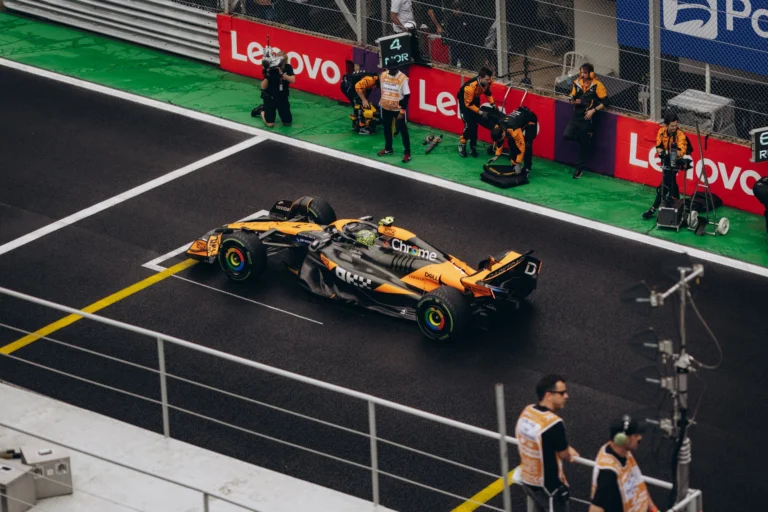
Lando Norris won the Dutch Grand Prix from Kimi Antonelli by 11.536 seconds, but the biggest championship story at Zandvoort was not the victory. It was how little the victory changed.
Antonelli remains firmly in control of the 2026 Formula 1 championship. After 12 rounds, the Mercedes driver has 242 points, 83 clear of Norris on 159. George Russell and Lewis Hamilton are tied on 183, while Charles Leclerc sits fifth on 155. (formula1.com)
That makes Norris's second consecutive victory significant, but not transformative. The Dutch GP showed that McLaren can still beat Mercedes over a race distance. It also showed that Antonelli can lose a win without losing control of the championship.
The more interesting question now is whether Norris has found the kind of late-season momentum that can make an 83-point deficit uncomfortable.
Norris won because McLaren changed the race twice
The tactical story at Zandvoort was more complicated than the final result suggests.
Rain before the start left parts of the circuit damp, but the race itself was run on slick tyres. Most of the field started on the soft compound, while the top four qualifiers, including Norris, Russell and Antonelli, chose mediums. Cadillac's Valtteri Bottas and Sergio Perez started on hards. (formula1.com)
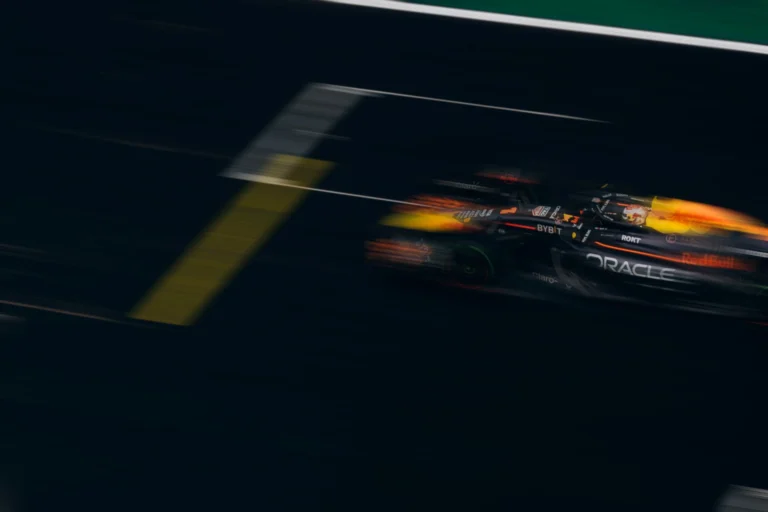
Then Max Verstappen crashed on the opening lap.
Verstappen lost the rear of his Red Bull after putting a wheel over the white line and hit the wall heavily. The incident brought out the red flag and effectively reset the race. Verstappen, who had started seventh at his final home Grand Prix, was out before completing a racing lap. (formula1.com)
At the restart, Norris switched to softs while Antonelli and Russell remained on mediums. Antonelli immediately used the advantage of the medium tyre to take the lead.
That mattered because Zandvoort is not a circuit where simply being faster guarantees an easy pass. Antonelli stretched his advantage over Norris to around 1.4 seconds, enough to keep Norris outside Overtake Mode range.
The first conventional pit cycle arrived around Lap 22. Antonelli and Norris both stopped for hards, while Russell stopped earlier. Later, Norris made a second stop on Lap 48, giving him substantially fresher tyres for the closing phase. (formula1.com)
That second stop was the decisive strategic move.
Norris returned to the track more than five seconds behind Antonelli, but the tyre advantage quickly erased the gap. By Lap 52 he was close enough to attack, and when Antonelli was dealing with rear-tyre struggles, Norris passed him for the lead before also overtaking Lewis Hamilton.
The result was not simply a case of the fastest car winning from pole. McLaren's willingness to use a second stop gave Norris the tyre performance he needed to convert pace into track position.
Mercedes still had the better championship weekend
There is an easy temptation to look at the Dutch GP as a McLaren victory over Mercedes.
The championship numbers say otherwise.
Antonelli finished second and collected 18 points. Russell finished third for another 15. Mercedes therefore put both cars on the podium, while Norris scored 25. (formula1.com)
That means Norris gained only seven points on Antonelli in the Grand Prix itself.
The gap between them is now 83 points.
That is a meaningful deficit, particularly because Antonelli has been consistently productive throughout the season. His 2026 record includes victories in China, Japan, Miami, Canada, Monaco and Belgium, while he also finished second in Australia and the Netherlands. (formula1.com)
More importantly for Mercedes, Russell's third place means the championship leader has a teammate sitting 59 points behind him.
That creates a different problem from the one McLaren faced earlier in the season. Mercedes does not have to rely on one driver to carry its title campaign. It has two drivers occupying second and third in the standings.
The constructors' table makes the advantage even clearer: Mercedes leads with 425 points, Ferrari has 338, McLaren 263 and Red Bull 186. (skysports.com)
For McLaren to turn Norris's comeback into a championship challenge, it needs more than victories. It needs Mercedes to stop scoring heavily with both cars.
Russell's position is stronger than the podium suggests
Russell left Zandvoort with the same points total as Hamilton, 183, but their championship trajectories are different.
Russell won the Dutch Sprint on Saturday and then finished third in Sunday's Grand Prix. (formula1.com)
That makes the Dutch weekend another reminder that Russell is still a factor in the championship, even if the 59-point gap to Antonelli is already substantial.
The Mercedes team also had to manage its internal situation carefully late in the race.
When the Virtual Safety Car was triggered by Esteban Ocon's stopped Haas, Antonelli pitted for soft tyres while Russell and Norris stayed out. Antonelli rejoined behind Russell, but Mercedes later instructed Russell to swap positions with his teammate on Lap 65. (formula1.com)
Russell was understandably unhappy with the call, but Mercedes was protecting the championship leader. Antonelli had fresher tyres and was therefore the driver Mercedes wanted ahead in the closing laps.
The team finished with second and third anyway.
That is a useful distinction. Mercedes did not need to sacrifice a podium to protect Antonelli. It simply adjusted the order of its cars.
Ferrari showed pace, but not enough control
Ferrari's result was respectable and frustrating at the same time.
Hamilton finished fourth and Leclerc fifth, only 0.503 seconds apart. (formula1.com)
The Ferrari drivers also demonstrated genuine race pace. Leclerc's fastest lap of 1:14.230 was the quickest of the race, ahead of Piastri, Norris and Hamilton. (formula1.com)
But fastest-lap pace did not translate into a podium.
Ferrari spent much of the race fighting Mercedes and McLaren rather than controlling the strategy. Leclerc eventually passed Piastri and Hamilton followed, but both Ferraris remained behind Russell.
Hamilton later said Ferrari's strategy discussions cost him a chance at the podium. ESPN reported that he was nevertheless positive about the team's progress. (espn.com)
That leaves Ferrari in an awkward championship position. Hamilton and Russell are level on 183 points, but Ferrari has two drivers separated by only 28 points and still trails Mercedes by 87 points in the constructors' standings.
The pace is there. The conversion is not yet.
Verstappen's title challenge took another direct hit
Verstappen's retirement is the simplest championship calculation of the weekend.
He scored zero points at his home race.
The Dutch GP standings leave him sixth in the championship on 112 points, 130 behind Antonelli. (formula1.com)
That does not make a comeback mathematically impossible. But it changes the practical question.
Before Zandvoort, Verstappen needed to turn his remaining opportunities into a sustained run of major points. At Zandvoort, he instead lost an entire Grand Prix before the race had properly developed.
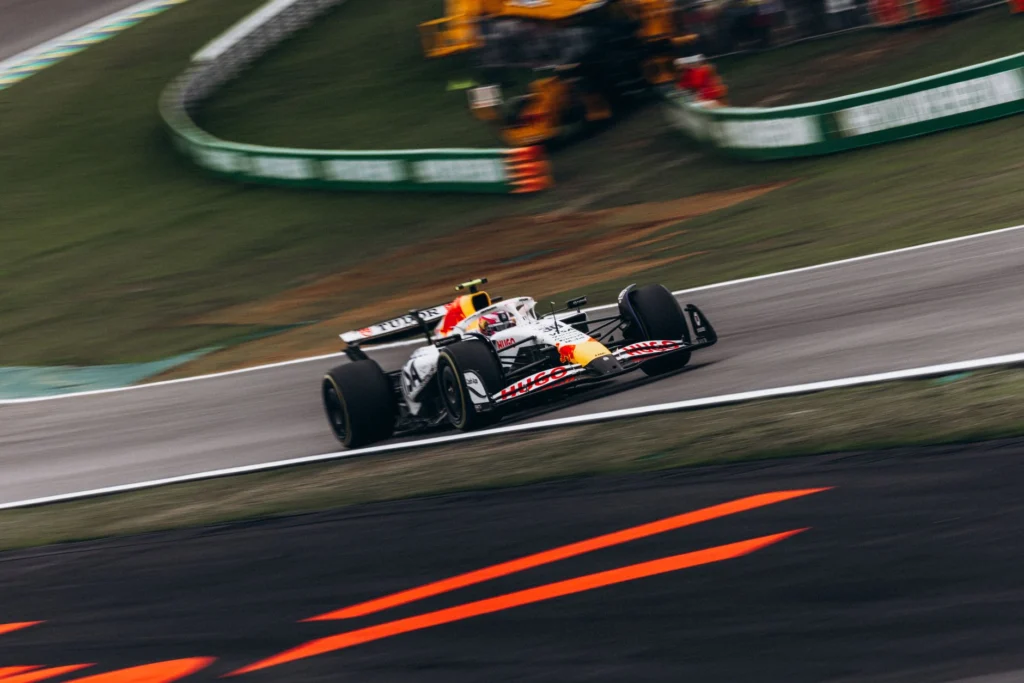
The other problem is Red Bull's current position. Liam Lawson finished seventh as the team's only classified points scorer after Verstappen's crash. Red Bull sits fourth in the constructors' championship on 186 points, well behind Mercedes, Ferrari and McLaren. (formula1.com)
Verstappen therefore needs both a personal points surge and a significant improvement in Red Bull's competitive position.
Norris has momentum, but he needs something Mercedes has not given him
Norris's last two Grands Prix have produced exactly the kind of results a championship challenger needs: victory in Hungary followed by victory in the Netherlands. His Dutch win was also his second at Zandvoort, after his 2024 victory. (formula1.com)
The problem is the size of the gap.
Norris is not chasing a driver who has suddenly stopped scoring. Antonelli finished second in the Netherlands and extended his championship lead to 83 points. (skysports.com)
That is why the next phase of 2026 will be less about whether Norris can win races and more about whether Mercedes can be denied points.
If Norris keeps winning while Antonelli finishes second, Norris gains only seven points per Grand Prix. At that rate, an 83-point deficit takes a very long time to disappear.
Retirements, poor finishes, strategy failures and intra-team consequences would change that arithmetic quickly. But those are variables, not a strategy.
For now, the Dutch GP has produced a more interesting championship rather than a closer one.
McLaren has rediscovered winning form. Ferrari is close enough to interfere. Russell remains a credible Mercedes challenger. Verstappen has suffered another major setback.
And at the centre of all of it is Antonelli, still 83 points clear.
The championship battle changed at Zandvoort because Norris finally looks capable of applying pressure. It did not change because Mercedes lost control.
That distinction is likely to define the rest of the 2026 season.