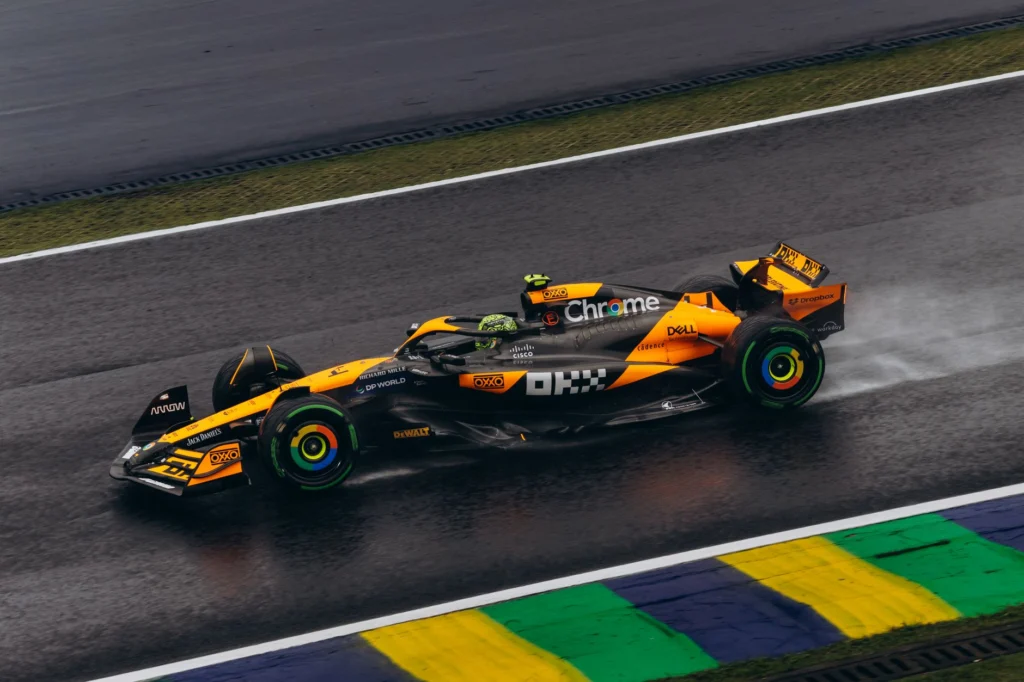
The 2026 Formula 1 cars do something their predecessors could not: they change their aerodynamic configuration during the lap. On designated straights, the front and rear wing elements open into Straight Mode to reduce drag. Through corners, they return to their closed configuration to restore downforce.
That sounds as if the traditional argument over high- and low-downforce setups has disappeared. It has not. Straight Mode replaced the old, simpler DRS system outright, rather than just adding to it.
The new system changes the compromise rather than eliminating it. Teams still have to decide how much aerodynamic load to build into the car, how the chassis behaves in slow and fast corners, how much drag is acceptable outside the active-aero zones, and how the car's balance works across an entire lap.
The first half of the 2026 season has already produced useful examples. Canada rewarded a car that could exploit repeated long straights. Monaco effectively removed Straight Mode altogether. Hungary, with its sequence of corners and relatively short straights, pushed teams back toward a high-downforce philosophy. (formula1.com)
Active Aero has changed the setup question, not removed it
The basic 2026 aerodynamic philosophy is straightforward.
The front and rear wings have movable elements. In Corner Mode, those elements remain closed to produce the downforce required for braking and cornering. In Straight Mode, they open and flatten, reducing both drag and downforce so the car can accelerate to a higher terminal speed. Unlike the old DRS system, Straight Mode is not an overtaking aid restricted to a following driver. It is part of the car's normal aerodynamic operation on designated sections of the circuit. (formula1.com)
That distinction matters when engineers choose a setup.
A team no longer has to compromise the entire lap simply because a rear wing needs to be efficient on a straight. The active system handles part of that compromise automatically. But the fixed aerodynamic characteristics of the car still matter whenever Straight Mode is unavailable, and the amount of load available in Corner Mode remains critical.
There is another reason the setup problem remains significant: the 2026 cars generate substantially less aerodynamic load than the previous generation. The FIA's original technical description anticipated a reduction in downforce and drag, while Formula 1's later explanation described the cars as having flatter floors rather than the large ground-effect tunnels used from 2022 through 2025. (formula1.com)
That makes mechanical grip, aerodynamic balance and confidence in slower corners particularly important at circuits where top speed is not the dominant performance metric.
Canada showed why low drag still matters
The Circuit Gilles-Villeneuve is almost a demonstration circuit for the benefits of the new aerodynamic system.
Canada has four designated Straight Mode zones: the start-finish straight, the section between Turns 7 and 8, the run between Turns 9 and 10, and the final section between Turns 11 and 13. The car can therefore repeatedly switch between its low-drag and cornering configurations during a lap. (formula1.com)
That changes what engineers are looking for.
The circuit contains heavy braking zones and relatively slow corners, so the car still needs enough downforce to remain stable under braking and through the chicanes. But the long runs between those corners make drag particularly expensive.
In the old aerodynamic regime, lowering wing levels for Montreal could gain substantial straight-line speed but risk making the car nervous through the corners. In 2026, Straight Mode provides a much more controlled way of reducing drag.
The result is not that every team simply runs low downforce. It is that the performance penalty for carrying more aerodynamic load through the corners can be smaller than it would have been without active aero.
That is one of the central changes in 2026: aerodynamic setup is increasingly about how effectively a car uses the transitions between modes, rather than simply where its rear-wing setting sits on a conventional low-to-high-downforce scale.
Monaco exposed the other side of the equation
Monaco is almost the opposite case.
For safety reasons, Active Aero was disabled for the 2026 Monaco Grand Prix. The cars were effectively locked in maximum-downforce Corner Mode because the circuit contains so few suitable high-speed sections and so many tight, narrow corners. (formula1.com)
That immediately made the aerodynamic compromise much more conventional.
Teams could not open the wings to recover speed on the straights. Any additional drag generated by a higher-downforce configuration remained a penalty, but the value of the extra load in Monaco's slow corners was much greater.
The teams responded accordingly. Mercedes, Red Bull and McLaren all introduced unusual rear-wing winglets for the weekend, taking advantage of the space normally occupied by the Straight Mode actuator. Because the system was not being used, engineers could exploit that area to generate additional downforce without having to worry about the extra drag it would normally create on a Straight Mode section. (formula1.com)
The cars themselves showed why circuit-specific aerodynamic work still matters in 2026. Ferrari also brought changes aimed at Monaco's unusual demands, including front-suspension revisions for the circuit's tight corners and aerodynamic changes to its floor and diffuser. (formula1.com)
The race result reinforced the importance of getting that package right. Kimi Antonelli qualified on pole and won from the front, while Lewis Hamilton finished second and Pierre Gasly third. (formula1.com)
Monaco therefore provides the clearest counterexample to the idea that active aero makes aerodynamic setup less important. When Straight Mode disappears, the conventional value of downforce returns immediately.
Hungary sits closer to the high-downforce end
The Hungaroring presents a different version of the same problem.
The circuit strings together several corners with relatively short straights, and Formula 1's own circuit description says teams use Monaco-levels of downforce there. A well-sorted chassis is generally more valuable than outright horsepower because there are fewer opportunities to cash in on top speed. (formula1.com)
The 2026 race illustrated that dynamic.
Lando Norris won from pole, with Max Verstappen second and Kimi Antonelli third. Norris did not simply disappear from the field because McLaren had an overwhelmingly faster car everywhere. His race developed through track position, tyre management and the team's pit-stop decisions. Oscar Piastri initially passed Norris at Turn 2 and led much of the first half, while Norris was unable to make a conventional on-track pass despite having pace in hand. (formula1.com)
That is relevant to aerodynamics because Hungary rewards the parts of lap time generated before and after the straight. A car needs enough load to carry speed through the corners and maintain stability when the next acceleration zone arrives.
Active Aero still helps on the straights, but there are fewer opportunities for that advantage to dominate the lap.
The race also showed how quickly a setup advantage can become strategic rather than purely aerodynamic. Norris stayed out while Piastri made his second stop, then produced strong laps on older tyres. Piastri subsequently lost time in traffic and after contact with Carlos Sainz, allowing Norris to gain the position after his own stop. (formula1.com)
Aerodynamics did not decide that race by itself. But the circuit's basic demands shaped the performance window in which those strategic decisions mattered.
The same rear wing can mean different things at different tracks
This is where the 2026 regulations become particularly interesting.
A rear wing is not simply a "high-downforce" or "low-downforce" component anymore. Its performance has to be understood alongside the active mechanism, the front wing, the floor, the diffuser and the circuit's Straight Mode zones.
At a track such as Canada, a team can accept more Corner Mode load because the car will periodically open its wings and shed drag. At Monaco, that mechanism is unavailable, so every extra aerodynamic device has to be judged against its permanent drag penalty. At Hungary, the relatively short straights make additional cornering performance more valuable again. (formula1.com)
This also explains why visually unusual wing solutions can appear from one race to the next without indicating that a team has fundamentally changed its car.
Mercedes' Barcelona rear wing, for example, featured small centreline winglets designed to increase downforce and drag at a ratio the team considered attractive for that event. (formula1.com)
That wording is revealing. Engineers are not chasing maximum downforce in isolation. They are chasing the most useful relationship between downforce and drag for a particular circuit.
2026 makes circuit characteristics more visible in the data
The new cars should make comparisons between circuits particularly interesting because the aerodynamic modes expose where lap time is being gained.
At a high-speed track with several Straight Mode zones, teams can compare how much time their cars gain while the wings are open against how much they lose through the corners. At a slow circuit such as Monaco, that separation becomes much smaller because the active system is removed.
The consequence is that a team's strengths can move around the calendar more dramatically.
A car with excellent straight-line efficiency may look particularly strong in Canada. The same car can lose that advantage in Monaco, where the race is dominated by low-speed grip, traction, braking stability and driver confidence. Hungary sits somewhere in between, but much closer to Monaco's cornering demands than Canada's repeated high-speed runs.
That is why a championship cannot sensibly be judged from one circuit's aerodynamic picture.
The 2026 rules have made the cars more adaptable during a lap, but they have not made them universally adaptable from one circuit to another. The circuit still dictates what performance is worth paying for.
And that is the real aerodynamic story of 2026: active aero has not made setup irrelevant. It has made the distinction between a good setup and a bad one more dependent on where the car is being driven.
If your company or product is mentioned in this article, you're welcome to share it.