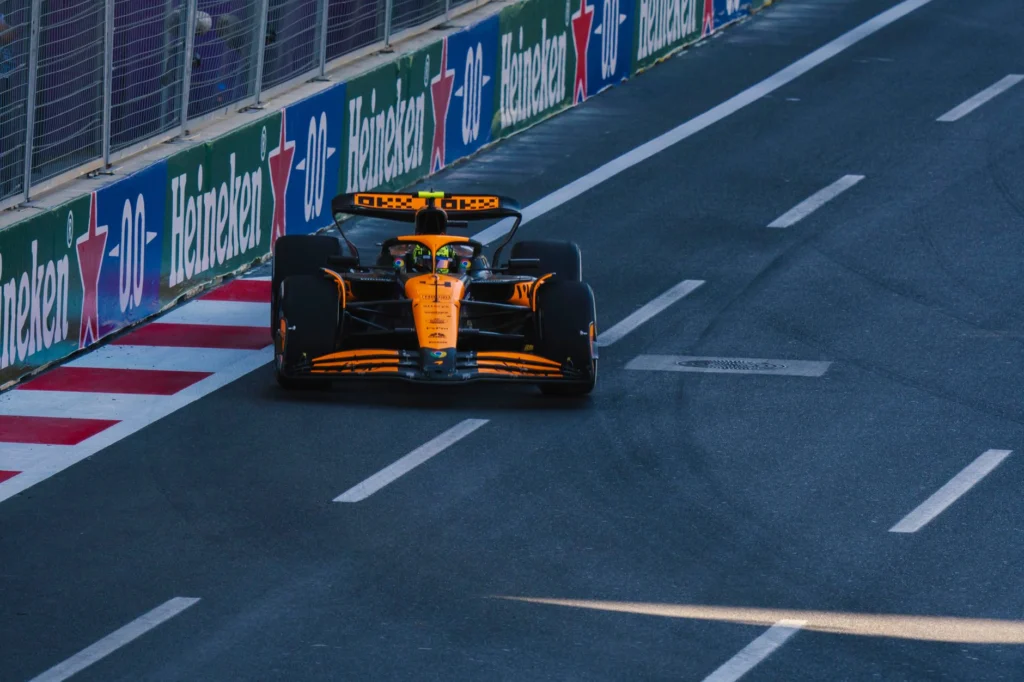
DRS — the Drag Reduction System — is one of the most-discussed pieces of Formula 1 technology and also one of the most simply engineered: a single flap on the rear wing that opens on command, and closes automatically the moment the driver brakes. The mechanism is simple. The rule governing when it can be used is the part broadcast commentary usually skips.
In Formula 1, what is DRS?
In Formula 1, DRS stands for Drag Reduction System — a driver-activated flap built into the rear wing that a car can open on a straight to cut aerodynamic drag and gain extra top speed, specifically to help a car close in on and pass the car ahead of it. It was introduced in 2011 as F1’s answer to a specific problem: modern F1 cars are so aerodynamically dependent that a car following closely behind another loses a large share of its own downforce in the leading car’s turbulent wake, which made overtaking on pure pace alone extremely difficult even for a genuinely faster car. DRS didn’t fix that underlying wake problem directly — it gave the chasing car a rule-gated speed tool to offset it.
What actually happens when DRS opens
An F1 rear wing generates downforce by deflecting air upward as it passes over it, which pushes the car down onto the track — but that same deflection creates aerodynamic drag, which costs straight-line speed. DRS works by opening a flap in the upper element of the rear wing, letting air pass through largely undisturbed instead of being deflected. Downforce drops sharply, drag drops with it, and the car picks up several kilometers per hour of extra top speed for as long as the flap stays open — typically worth somewhere in the range of ten to twenty kilometers per hour depending on the specific car and circuit.
The rule that actually governs when it’s usable
DRS isn’t available whenever a driver wants extra speed. It can only be activated within specific “DRS zones” defined at each circuit, and only when a driver is within one second of the car ahead at a designated detection point earlier on the track — a rule specifically designed to help a chasing car close the final gap for an overtake, not to hand out free speed generally. During the race’s opening laps and immediately after a safety car restart, DRS is disabled entirely, specifically because the artificial speed boost would be dangerous in a tightly bunched field where cars don’t yet have clean racing space around them.
How many DRS zones does a circuit actually have?
Most circuits run one or two DRS zones per lap, but the number is set individually for each track based on how difficult overtaking naturally is there — slower, tighter circuits generally get more zones to compensate. Singapore’s street circuit has been run with as many as four DRS zones in a single lap, reflecting how genuinely hard it is to pass there without help. At the other end, a circuit with long, naturally fast straights and easier overtaking opportunities might run with just one zone, since the track itself already does more of the work.
DRS isn’t a performance boost available to whoever’s fastest. It’s a rule-gated tool available specifically to whoever’s close enough to attempt an overtake — which is precisely why it’s controversial: it’s deliberately not a level playing field in the moment it activates.
Why the debate around it hasn’t settled
Critics have argued for over a decade that DRS produces overtakes that look more like a rule-granted pass than a genuinely earned one, particularly on circuits with a single long straight where a DRS-enabled car can simply drive past with minimal risk. Defenders point out that DRS use still requires the chasing driver to actually get within the one-second window through genuine pace and tire management first — DRS closes the final gap, it doesn’t create the opportunity from nothing. The 2022 aerodynamic overhaul, built substantially around ground effect specifically to reduce wake turbulence, was in part an attempt to make DRS less necessary going forward, not to replace it outright — evidence that the sport itself still treated DRS as a workaround for a deeper aerodynamic problem, not a permanent design philosophy.
DRS is actually being retired for the 2026 season
This is the part worth knowing if you’re reading this in the 2026 season specifically: F1’s new regulations replace traditional DRS entirely with a system called Overtake Mode. Instead of a rear-wing flap gated to fixed track zones, a car within one second of the car ahead at a designated point can activate extra deployable electrical power — an additional battery boost — for the following lap, which it can use strategically across the whole lap rather than only in a fixed zone. Unlike DRS, Overtake Mode can also be used defensively, adding a tactical layer the old system never had, and it works alongside new fully movable front and rear wings that switch between high- and low-downforce settings depending on whether a car is cornering or on a straight. The underlying goal — helping a trailing car close a gap enough to actually attempt a pass — hasn’t changed. The mechanism delivering it has moved from a simple mechanical wing flap to a more strategic, energy-based system that gives drivers more choices about when to use their advantage.
To see this transition actually play out in a real race, read our breakdown of the 2026 Dutch GP: How DRS Disappeared and Overtaking Became an Energy Game.
For the other half of F1 aerodynamics — the part that helps a car corner rather than overtake — see how Formula 1 ground effect actually works.
Frequently Asked Questions
What does DRS stand for in F1?
DRS stands for Drag Reduction System — a driver-activated flap in the rear wing that reduces aerodynamic drag to help a chasing car overtake.
What is DRS in F1, in one sentence?
It is a rule-gated rear-wing flap that a driver can open in designated zones, but only when within one second of the car ahead, to gain extra straight-line speed for an overtake attempt.
Is DRS still used in F1?
Not from the 2026 season onward. F1 replaced traditional DRS with a system called Overtake Mode, which uses an extra deployable battery boost instead of a rear-wing flap.
Why is DRS controversial?
Critics argue it can produce passes that look rule-granted rather than earned, especially on tracks with one long straight, since the trailing car gains a speed advantage the car ahead does not have access to.
If your company or product is mentioned in this article, you're welcome to share it.