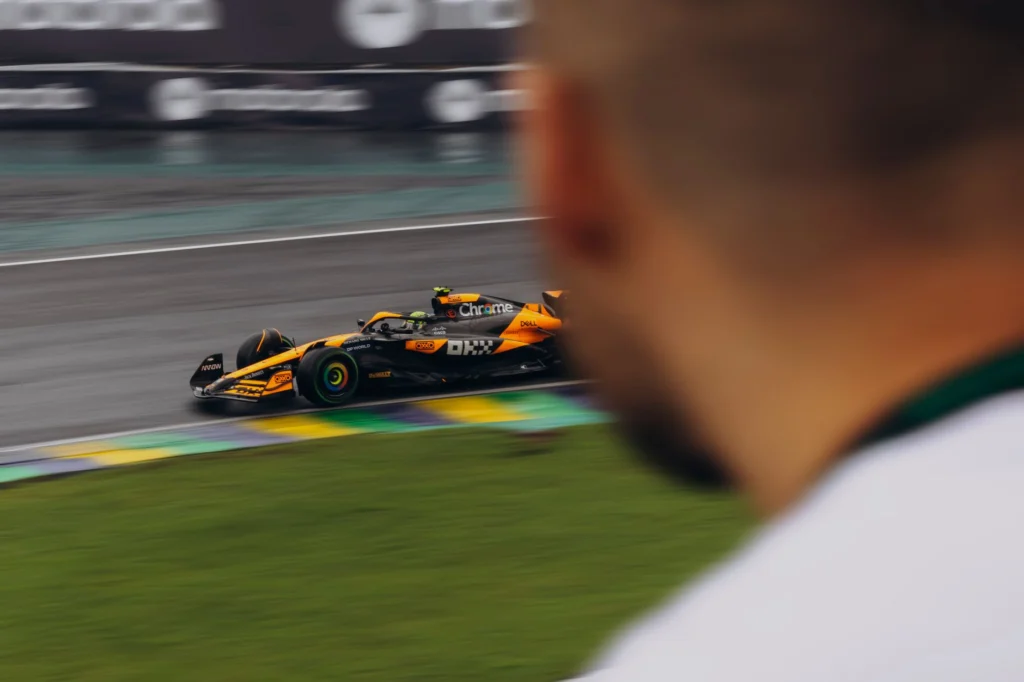
At Zandvoort, Lando Norris spent the first 21 laps trying to solve a problem Kimi Antonelli had created. The Mercedes had taken the lead at the restart, and Norris could not get close enough to attack.
Then the tyres changed, and so did the race.
Norris moved onto hard tyres at the first round of stops, while Antonelli also switched to the hards. But the McLaren found considerably more pace over the long run. Norris eventually reclaimed the lead and finished 11.536 seconds ahead of Antonelli, with George Russell another 4.370 seconds back in third. (skysports.com)
That result captures something increasingly clear about the three drivers after 12 Grands Prix of the 2026 season: Antonelli has been the most consistent race winner, Norris currently has the strongest sustained race pace, and Russell remains the most reliable Mercedes counterweight to both.
The championship table makes the hierarchy look simple. It is not.
Norris has become much harder to beat once the race settles into a rhythm
Norris's season began with flashes rather than sustained control. He finished fifth in Australia, fifth in Japan and second in Miami, where Antonelli beat him by only 3.264 seconds. (formula1.com)
The bigger change has come after the summer break.
Norris won Hungary and then followed it with another victory at Zandvoort. The Dutch GP was particularly revealing because he did not win simply by controlling the race from pole.
He lost the lead twice.
Antonelli jumped him at the restart after Max Verstappen's first-lap crash triggered the red flag. Mercedes' car was then strong enough to keep Norris at arm's length for much of the first stint. Formula 1's race report records Antonelli building a lead of around 1.4 seconds, enough to keep Norris outside Overtake Mode range. (formula1.com)
But Norris' response was not a single qualifying-style burst. He gradually brought the gap back.
Both drivers stopped on Lap 21 and took hard tyres. From there, the balance changed dramatically. Sky Sports described Norris as "far quicker" on that stint, while Mercedes itself acknowledged that Antonelli had the measure of Norris early but struggled for pace later. (skysports.com)
That distinction matters. Race pace is not simply the fastest lap a driver can produce. It is the ability to sustain competitive lap times while managing tyres, fuel, traffic and the car's balance over a stint.
On that evidence, Norris currently has the strongest case of the three.
Antonelli's advantage is that he keeps winning races even when the car is imperfect
Antonelli's championship lead is not built on one type of performance.
He has won seven of the first 12 Grands Prix and leads the championship with 242 points. Russell has 183 and Norris 159. (formula1.com)
His victories have also come in different circumstances.
In Canada, Antonelli fought Russell directly for the lead before Russell's power-unit problem ended the Mercedes duel. The official race report says the pair swapped positions and that Antonelli appeared slightly faster, while Russell was somewhat tidier. (formula1.com)
In Austria, Russell won, but Antonelli finished third only 1.986 seconds behind him. Norris was seventh, more than 21 seconds behind the winner. (formula1.com)
And at Zandvoort, Antonelli's two starts were arguably his biggest asset. He passed Russell at the initial start and then Norris at the restart. Later, when the hard tyre stopped giving him enough confidence or pace, he could no longer hold the McLaren behind him. Antonelli himself said the starts had effectively "saved" his race. (formula1.com)
That is a different kind of race strength from Norris'.
Antonelli does not always need the fastest car over the entire distance. He has repeatedly put himself in the right position early, extracted enough performance from the Mercedes and converted opportunities when they appeared.
That is why the points gap remains so large despite Norris' recent improvement.
Russell's race pace is closer to Antonelli's than the championship table suggests
Russell's 2026 record is easy to underestimate because he has not matched Antonelli's win count.
He has two Grand Prix victories, six podiums and four poles, according to Formula 1's official driver statistics. He also sits second in the championship on 183 points, level with Lewis Hamilton. (formula1.com)
His strongest evidence comes when Mercedes has a car capable of running at the front.
In Australia, Russell won with Antonelli second, only 2.974 seconds behind after 58 laps. In China, Antonelli won and Russell finished second, 5.515 seconds behind. (formula1.com)
The Austrian GP is even more useful because it exposed Mercedes' race management and tyre behaviour. Russell led for much of the race, then discussed surface overheating over the radio as Mercedes considered whether a one-stop strategy was viable. He eventually stopped on Lap 20 and still won, holding off Verstappen by 1.611 seconds. Antonelli finished third, 1.986 seconds behind. (formula1.com)
Russell's problem is less about raw speed than converting every strong weekend into the maximum result.
The Dutch GP showed that again. He won Saturday's Sprint from pole, then qualified second for Sunday's Grand Prix, only 0.102 seconds behind Norris. (formula1.com)
But the Grand Prix itself was different. Russell lost positions at the start and restart, fell behind Piastri, then spent part of the race fighting Ferrari's Charles Leclerc and Hamilton. His later strategy recovered the position, but by then Norris had established a lead Mercedes could not challenge. (formula1.com)
The qualifying and Sprint evidence says Russell's underlying speed is still there. The Sunday race shows how much harder it is to turn that speed into sustained control.
The Dutch GP exposed the three drivers' different approaches to the same Mercedes problem
The most interesting comparison is not simply Norris 1st, Antonelli 2nd, Russell 3rd.
It is what happened underneath those positions.
Antonelli led for much of the first half but lost performance on the hard tyre.
Russell struggled earlier, then recovered through strategy and tyre freshness.
Norris was the driver who ultimately maintained the strongest pace once the race moved into its decisive phase.
The late Virtual Safety Car made the comparison even more complicated. Mercedes stopped Antonelli for fresh soft tyres, putting him behind Russell. The team subsequently ordered Russell to let his teammate through because Antonelli had the newer tyres and, in Russell's own assessment, would have overtaken him anyway. (skysports.com)
That was not a conventional "faster driver beats slower driver" situation. It was a tyre-age and strategic-positioning decision.
Antonelli had the faster tool at that moment, but Norris was already too far ahead to catch.
That is the key tactical distinction. The driver with the best pace over a particular stint is not automatically the driver with the best race pace overall.
Miami showed the same pattern before Norris' recent improvement
Miami provides a useful earlier benchmark because all three finished and there was no Mercedes retirement obscuring the comparison.
Antonelli won. Norris was second, 3.264 seconds behind, while Russell finished fourth, 43.051 seconds behind the winner. (formula1.com)
The result suggested Antonelli and Norris were already operating in a different performance group from Russell that day.
But the season has not followed that ranking consistently.
Russell later won Austria. Norris won Hungary. Antonelli continued accumulating victories. The three cars have therefore traded the advantage depending on circuit, setup and tyre behaviour rather than following one fixed order.
That makes a simple season-long "who is fastest?" ranking misleading.
The championship still favours Antonelli because race pace is only one part of the equation
After the Dutch GP, Antonelli leads Russell by 59 points and Norris by 83. Norris has now won consecutive Grands Prix, but the gap remains substantial. (skysports.com)
The reason is straightforward: Antonelli has converted more weekends.
His 242 points include seven Grand Prix victories. Norris has three wins, while Russell has two. (formula1.com)
So if the question is who currently has the best race pace?, Norris has the strongest recent evidence, especially over the second half of a tyre stint at Zandvoort.
If the question is who has been the most effective racer across the season?, Antonelli has the much stronger case.
And if the question is who can challenge either of them when Mercedes has the right setup?, Russell remains very much in that conversation.
The next test is Monza, where the characteristics change again and the 2026 season moves into its second half. (formula1.com)
Zandvoort did not settle the Norris-Antonelli-Russell question. It made the distinction sharper.
Norris is currently the driver Mercedes needs to catch over a full stint. Antonelli is still the driver everyone needs to catch in the championship. Russell, meanwhile, has shown enough outright speed to make the gap between those two statements uncomfortable for both of them.
New to the term? See what DRS actually does to an F1 car.
If your company or product is mentioned in this article, you're welcome to share it.