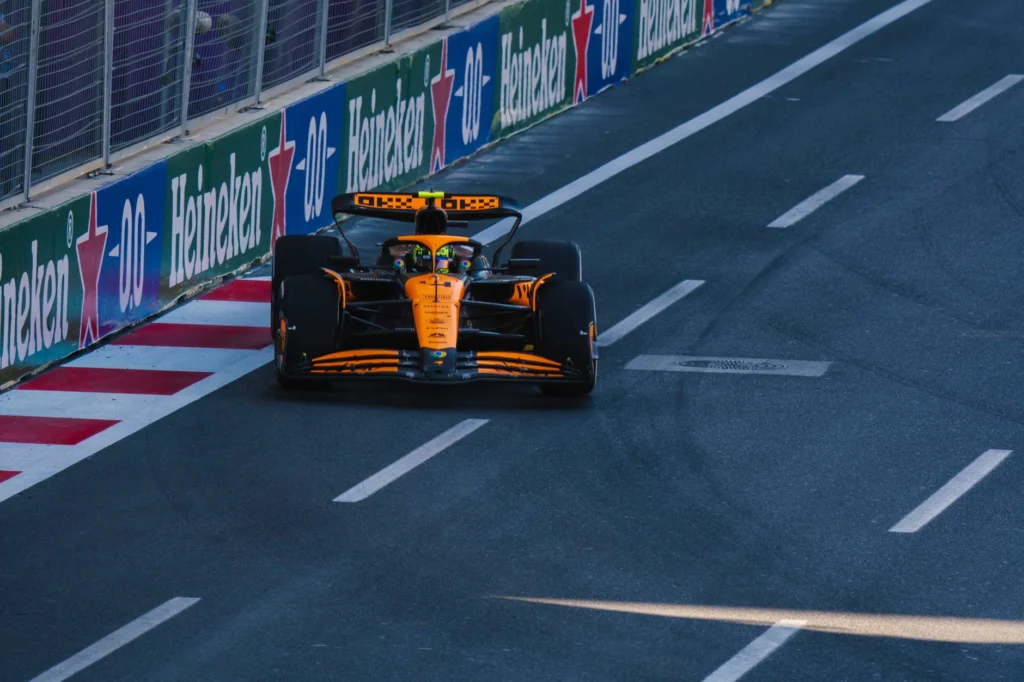
Lando Norris won the 2026 Dutch Grand Prix by doing something that looked increasingly difficult after the restart: staying close to Kimi Antonelli long enough for McLaren’s tyre strategy to become an advantage.
Antonelli took the lead from Norris at the second standing start and Mercedes initially looked in control. Norris could not attack immediately. His soft tyres were struggling, while Antonelli’s Mercedes had enough pace to build a gap of around 1.4 seconds and keep Norris outside overtaking range.
The race changed when McLaren committed to the hard tyre and Norris gradually found the pace Mercedes could not maintain. By the time the decisive second round of stops arrived, Norris had enough tyre performance to turn a strategic deficit into a race-winning opportunity.
He eventually finished 11.536 seconds ahead of Antonelli. George Russell completed the Mercedes double podium in third. (formula1.com)
Mercedes had the faster start, but McLaren had the better second phase
The opening laps did not suggest a Norris victory.
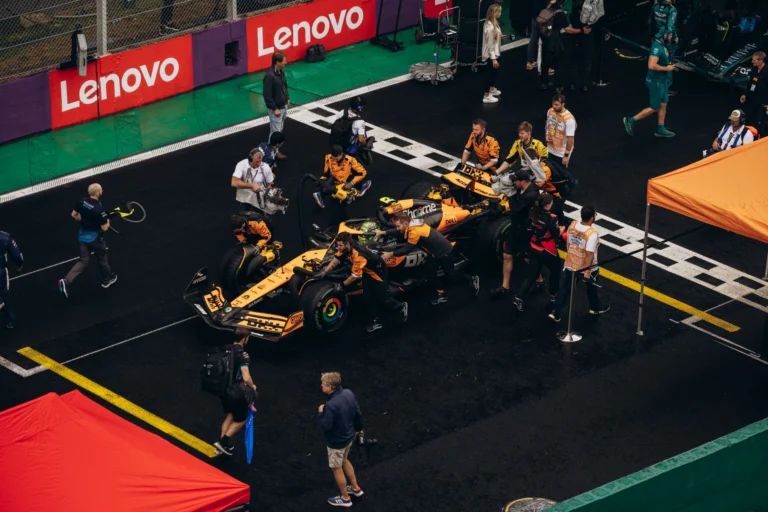
Norris started from pole, with Russell and Antonelli alongside him at the front of the grid. Antonelli made the better launch and moved ahead of Russell before the race was stopped by Max Verstappen's crash on the opening lap.
At the restart, Antonelli went again. He took the lead from Norris and was able to control the gap sufficiently to prevent Norris from using his overtaking tools effectively.
That mattered because Zandvoort is not a circuit where simply being faster guarantees an easy pass. The narrow layout and limited overtaking opportunities make track position unusually valuable.
Norris also made his situation harder by starting the restarted race on soft tyres, while both Mercedes cars were on mediums. Oscar Piastri, meanwhile, had switched to hards. (formula1.com)
The early tyre choice therefore produced a straightforward tactical problem for McLaren: Norris needed to survive the soft-tyre phase without losing too much ground.
He did.
The hard tyre changed Norris's race
Norris's own assessment after the race explains why the strategy eventually worked. He said he had struggled badly with the soft tyre during the first half of the race, but that the McLaren "came alive" once the hard tyre was fitted. (formula1.com)
The timing of the first stops was important.
Russell stopped on Lap 16 for hards. Piastri followed on Lap 17, although a slow McLaren stop dropped him behind Russell. Antonelli and Norris both stopped on Lap 22 and took the hard compound. (formula1.com)
That put Norris into a different race.
By Lap 30, he had brought the gap to Antonelli below one second. A few laps later he briefly lost some momentum after a snap, but the underlying advantage remained. By Lap 40, the gap was back down to 0.7 seconds.
Mercedes had not suddenly become slow. The problem was that Norris had found a more useful tyre window.
That distinction matters. McLaren did not win because it produced a spectacularly clever pit-wall gamble from the beginning. The decisive advantage came from managing the race until the car was operating on the compound where Norris had the pace to attack.
Norris's second stop was the call that put him in position to win
The second sequence of stops created the critical strategic split.
Antonelli and Russell stopped around Lap 41 for another set of hards. Norris stayed out.
Norris continued until Lap 48 before making his second stop. When he returned, he was in third, roughly five seconds behind Antonelli. But he had a significant tyre-age advantage.
The gap disappeared quickly.
Three laps after the stop, Norris was only 1.4 seconds behind Antonelli. By Lap 52, he was close enough to attack, while Antonelli was reporting rear-tyre problems.
There was another complication. Antonelli was fighting Lewis Hamilton for position and could use Overtake Mode while within a second of the Ferrari. That gave Mercedes some defensive protection.
It did not last.
Norris attacked at Turn 1 and went past Antonelli. He then passed Hamilton shortly afterward to take the race lead. (formula1.com)
This is the central tactical point of the race: McLaren used Norris's second stop to give him the tyre performance required to recover track position, rather than trying to protect the position he had lost at the restart.
Mercedes had to choose between attacking Norris and protecting the podium
Once Norris was ahead, Mercedes still had an opportunity to make something of the race.
The Virtual Safety Car caused by Esteban Ocon's stopped Haas created that opportunity.
Mercedes brought Antonelli in for fresh soft tyres. Norris stayed out.
That decision is easy to describe as a missed opportunity for McLaren because Antonelli finished the race on much newer tyres. But the outcome shows why staying out was the correct call for Norris: he had enough track advantage to survive the closing laps.
Antonelli rejoined behind Russell, meaning Mercedes had effectively inverted its two cars. The Italian then closed on his teammate rapidly.
Mercedes eventually ordered Russell to let Antonelli through on Lap 65. Russell complied, and Antonelli took second. (skysports.com)
The alternative was not obviously better. Had Russell pitted under the VSC, Mercedes said he would have dropped behind Hamilton. Keeping Russell out protected the second Mercedes car from Ferrari while giving Antonelli the fresher tyres.
Mercedes therefore maximised its points from the situation, even if it could no longer challenge Norris.
McLaren's strategy worked because Norris could execute the overtakes
Strategy in Formula 1 is often described as though the pit wall determines the result by itself. Zandvoort showed the limitation of that idea.
McLaren could put Norris on the right tyre at the right moment, but Norris still had to make the pass.
His move on Antonelli was especially important because Mercedes had already demonstrated that it could defend effectively. Antonelli had held Norris behind him for much of the first stint and had enough pace to prevent an easy undercut.
Once Norris had the tyre advantage, he attacked Turn 1 decisively.
Norris later described the outside-line commitment at Turn 1 as the move that won the race. (formula1.com)
That assessment is consistent with the sequence of the race. The hard tyre gave him the pace; the second stop gave him the tyre-age advantage; the overtake converted that advantage into track position.
The strategy and the driving were inseparable.
Piastri shows why McLaren's strategy was not automatically superior
The other McLaren provides a useful counterexample.
Oscar Piastri started fourth and moved ahead of Russell at the restart. But his race deteriorated after a slow pit stop dropped him behind the Mercedes.
Piastri subsequently struggled for grip and was passed by both Ferraris. He finished sixth, 32.332 seconds behind Norris. (skysports.com)
That gap is not evidence that McLaren had a perfect weekend operationally. Quite the opposite.
The team made a costly slow stop with Piastri, while Norris's strategy succeeded because the timing, tyre performance and execution aligned. McLaren itself therefore supplied the clearest warning against treating the victory as a simple case of superior pit-wall strategy.
Mercedes was fast enough to win, but not consistent enough to control the whole race
Antonelli's second place should not be mistaken for a strategic collapse.
Mercedes had the stronger opening phase. Antonelli led after the restart, controlled Norris for a substantial portion of the race and ultimately finished only 11.536 seconds behind the winner. Russell added third. (formula1.com)
But the balance shifted once Norris found his hard-tyre pace.
Mercedes then had to react to a McLaren that was faster on the second stint. Its later VSC stop gave Antonelli fresh softs, but it also sacrificed track position and left him behind Russell.
That was enough to recover second place, not enough to recover the win.
Mercedes team principal Toto Wolff defended the decision-making, while Antonelli acknowledged that the car simply did not have enough pace to beat Norris after the McLaren driver regained the lead. (formula1.com)
The Dutch GP was won before the final VSC
The final VSC made the closing order look more complicated than it really was.
By the time it appeared, Norris had already done the decisive work. He had survived the difficult soft-tyre phase, extracted strong pace from the hards, stopped later than Antonelli in the second cycle, closed the gap and passed both Antonelli and Hamilton.
The VSC gave Mercedes a final opportunity to change the tyre equation, but it did not create the opportunity to win.
Norris's margin at the flag, 11.536 seconds, is the clearest measure of that. (skysports.com)
The 2026 Dutch Grand Prix therefore was not a case of McLaren simply undercutting Mercedes. It was more subtle. Mercedes controlled the first strategic phase through track position and early pace. McLaren waited for the tyre advantage to become meaningful, then used Norris's pace to take the position back on track.
At Zandvoort, that was enough.