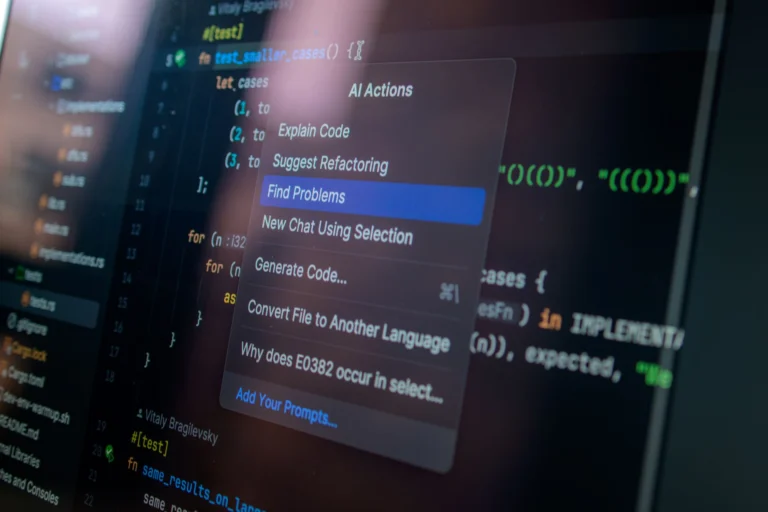
The obvious question keeps coming up: if Claude, ChatGPT, and Gemini can write a meta description, suggest keywords, and even draft an entire article, why would a company still need to hire an SEO expert? The honest answer, after building Talmyn’s entire SEO operation directly on top of these tools for months, is that the question gets the actual bottleneck backward. The tools were never the hard part. Knowing what to point them at, when, and why, is.
What AI tools are actually good at, without exaggeration
Modern AI models are genuinely excellent at specific, bounded SEO tasks: drafting a keyword-informed article at speed, generating meta descriptions and title variations, summarizing a competitor’s content structure, or spotting a pattern in a large export of data once you know what to ask it to look for. None of that is in question. What AI tools are not good at, at least not without a human directing the process, is deciding which of a site’s hundred existing pages most urgently needs attention today, recognizing that a technical audit’s findings might be a stale crawl artifact rather than a real bug, or noticing that two articles are quietly cannibalizing each other’s search ranking because nobody was watching for the pattern. Those are judgment calls built on context the AI doesn’t have until a person supplies it, repeatedly, correctly.
The actual operation behind Talmyn, not the marketing version
I’m Alif Vasaya, Talmyn’s founder, and I run its SEO function directly through Claude, day to day, rather than delegating it to a traditional agency or a large in-house team. The workflow isn’t “ask an AI to do SEO.” It’s a set of specific, repeatable systems built and refined over months: a direct Google Search Console API connection that pulls live indexing status, click and impression data, and crawl behavior on demand, rather than waiting on manual monthly exports; a tracked Ubersuggest project that surfaces real keyword volume and ranking-position data for every page on the site, refreshed and re-pulled whenever a decision needs current numbers instead of stale ones; and a direct connection into the WordPress backend itself, so a diagnosed problem, a broken internal link, a missing category description, a duplicate-content cluster splitting ranking signal between two articles, gets fixed the same session it’s found, not queued into a ticket someone gets to eventually.
The tools didn’t replace the SEO decision-making. They removed the multi-day lag between finding a problem and fixing it, which is a different thing entirely, and it’s the difference that actually compounds.
A specific, real example of what this looks like in practice
When Talmyn migrated hosting providers, the site quietly picked up a wide range of real technical problems, corrupted character encoding across dozens of pages, a stale static file shadowing a dynamic one it was supposed to route around, category pages with broken em dashes rendering as literal question marks, and over a hundred subcategory pages that had never had a real description written for them at all. None of that surfaced from a single dashboard alert. It surfaced from a working method: pull real Search Console data, cross-reference it against the site’s actual sitemap and content, verify every finding against the live site with a direct request rather than trusting a report at face value, and fix root causes instead of symptoms. A related-posts widget quietly linking to old, redirected URLs looked, on the surface, like 84 separate broken links. The actual cause was one flawed function feeding every related-content block on the site. Finding that took cross-referencing several different data sources and reading the actual template code, not running a scan and reading a summary.
Why this still requires a person driving it, not just better prompts
The reason a company can’t simply hand an AI model a login and walk away comes down to three specific gaps that current models don’t close on their own. First, prioritization: an AI model has no inherent sense of which of a hundred flagged issues is actually costing the business traffic today versus which is cosmetic, that requires someone who understands the specific business’s goals well enough to rank the list correctly. Second, verification: AI-generated audits and AI-drafted content both need a second pass checking claims against reality, since a model can present a plausible-sounding but wrong diagnosis with exactly the same confident tone as a correct one, and the only way to catch that gap is a person who checks the actual page, the actual data, the actual code. Third, continuity: SEO isn’t a single project with an end date. It’s an ongoing operating rhythm, categories that need periodic content refreshes, a backlog of pages Google has crawled but not indexed that needs sustained attention, keyword opportunities that shift month to month, and that rhythm needs someone actively running it week over week, not a tool that sits idle until someone remembers to open it.
What actually changed for the SEO role, specifically
The honest shift isn’t that SEO expertise became unnecessary. It’s that the job description changed. A traditional SEO specialist a decade ago spent a meaningful share of their time on manual, repetitive execution: writing meta descriptions one by one, manually checking crawl reports, building spreadsheets of keyword data by hand. AI tools genuinely absorbed that layer of the job. What’s left, and what’s actually harder to hire for, is the layer above it: someone who can read a Search Console export and know within minutes which finding is real and which is noise, someone who can direct an AI tool with enough specificity that its output is usable on the first pass instead of the fifth, and someone who treats an AI-generated claim the same way a good editor treats a first draft, useful, often mostly right, and never published without being checked.
Common misconceptions about AI-driven SEO
A frequent misconception is that using AI tools for SEO means less oversight is needed, when the opposite is closer to true. Faster output means more content and more changes moving through the pipeline, which means more that needs checking, not less. Another common misunderstanding is that a general-purpose AI assistant alone can replace dedicated SEO tools like Search Console or a keyword-tracking platform. The AI model is the layer that interprets and acts on the data. It still needs the data itself, pulled from real, authoritative sources, to have anything worth interpreting.
Frequently asked questions
Can AI tools replace an SEO expert entirely?
Not currently. AI tools execute specific tasks well, but prioritizing what to fix, verifying AI-generated claims against reality, and running SEO as an ongoing operation still require a person directing the process.
What’s actually different about doing SEO with AI tools versus traditional methods?
The main shift is speed between diagnosis and fix. Direct API access to real data plus an AI model that can act on it quickly removes the lag that used to sit between finding a problem and resolving it.
Does AI-generated SEO content need to be fact-checked?
Yes, consistently. AI-generated findings and drafts can be confidently wrong, and treating every output as a first draft that needs verification against real data and the live site is the difference between catching an error and publishing one.
What SEO tasks has AI actually automated well?
Repetitive, bounded execution work: drafting meta descriptions and title variations, summarizing large data exports, generating keyword-informed content drafts, and spotting patterns once a person knows what to ask it to look for.
For more on how Talmyn approaches AI-assisted, human-verified reporting sitewide, see our AI & Automation Policy. For the internal linking and technical diagnostics work described here, see the Tech & AI Evolution desk.
If your company or product is mentioned in this article, you're welcome to share it.