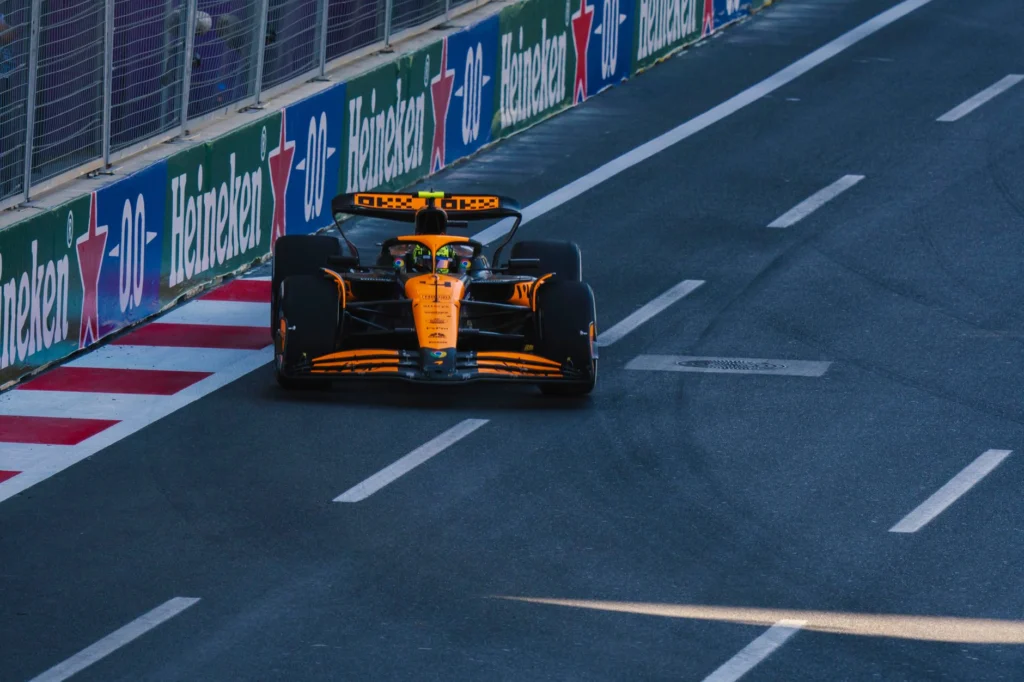
Kimi Antonelli left Zandvoort with 242 points and a 59-point championship lead, but the Dutch Grand Prix also exposed the weakness in that advantage: Mercedes no longer has the field to itself.
Lando Norris won from pole, beating Antonelli by 11.536 seconds after taking the lead back late in the race. George Russell finished third for Mercedes, while Lewis Hamilton brought his Ferrari home fourth. Russell and Hamilton are now tied on 183 points, with Russell second on the countback. Norris sits fourth on 159, 83 points behind Antonelli. (formula1.com)
There are still 12 Grands Prix on the original 24-round calendar? No. After Zandvoort, 12 rounds have been completed, leaving 12 Grands Prix still to run, beginning with Monza on September 4-6. The remaining calendar also includes Madrid, Baku, Singapore, Austin, Mexico City, São Paulo, Las Vegas, Qatar and Abu Dhabi, among others. (formula1.com)
That makes the championship less straightforward than the points table suggests. Antonelli has the cushion. Norris currently has the momentum. Russell has the Mercedes machinery and is tied for second. Hamilton has Ferrari's improving performance and the experience to exploit a long season.
Antonelli has the points advantage, but Mercedes' dominance is no longer absolute
Antonelli's lead is built on an extraordinary first half of the season.
He has won six Grands Prix: China, Japan, Miami, Canada, Monaco and Belgium. Mercedes has won eight of the first 12 races, with Russell taking victories in Australia and Austria. (formula1.com)
The early-season picture therefore made the title look almost like a Mercedes internal affair. Antonelli accumulated points relentlessly while his rivals suffered retirements and inconsistent weekends.
But the advantage has narrowed in performance terms.
McLaren has now won the last two Grands Prix. Norris won Hungary before winning at Zandvoort, and the Dutch victory was not simply the result of a chaotic race. Norris had enough pace to recover from losing the lead to Antonelli after the restart and then build a winning margin. (formula1.com)
Antonelli himself has acknowledged the shift, saying Mercedes no longer has the fastest car. Reuters reported that he believes McLaren has made significant gains since its Hungary upgrade. (reuters.com)
That distinction matters. A 59-point lead is substantial. A 59-point lead with a car that is no longer clearly fastest is a different championship proposition.
Norris has the strongest recent argument, and Zandvoort showed why
Norris' title challenge looked much less convincing earlier in the season.
He had retirements in Canada and Monaco, a non-start in China that still yielded five points, and several weekends where McLaren could not consistently match Mercedes. (formula1.com)
His recent form is different.
At Zandvoort, Norris started from pole but lost the lead when Antonelli passed him at the standing restart following Max Verstappen's first-lap crash and the resulting red flag. Antonelli then controlled the first phase of the resumed race.
The tactical turning point came later.
Norris was stronger after moving onto the hard tyre, while Antonelli's first stint left him vulnerable. Mercedes eventually pitted Antonelli for fresh tyres under a Virtual Safety Car with 16 laps remaining. That gave him a theoretical opportunity to chase Norris, but it also dropped him behind Russell. (skysports.com)
Mercedes then instructed Russell to let Antonelli through.
That decision was logical from the championship team's perspective. Antonelli was the driver carrying the larger points lead, and fresher tyres gave him the only plausible route to victory. But the move also demonstrated how much Mercedes' race had changed: Antonelli was no longer controlling the race from the front. He was being repositioned behind his team-mate and sent after Norris.
Norris ultimately stayed clear and won by more than 11 seconds. (formula1.com)
The significance is not that one victory suddenly makes Norris the favourite. It is that McLaren now appears capable of beating Mercedes on outright race pace, tyre management and strategic flexibility.
An 83-point deficit is still enormous. But Norris has 31 points from Zandvoort because the Sprint win and Grand Prix victory both counted, and he now has consecutive Grand Prix wins. The championship has become mathematically difficult for him, not irrelevant.
Russell is closer to Antonelli than the standings initially suggest
Russell's case is more complicated because his title challenge is being fought inside the strongest team in the championship.
He has 183 points, exactly the same as Hamilton, and moved ahead of the Ferrari driver on countback after Zandvoort. (racingnews365.com)
His 2026 Grand Prix wins came in Australia and Austria, while he has also been highly productive in Sprint weekends. At Zandvoort he won the Sprint from pole, his third Sprint victory of the season. (reuters.com)
The problem is Antonelli's consistency.
Russell can match him over individual weekends, and sometimes beat him outright. But Antonelli has accumulated a much larger total because he has converted more of Mercedes' best opportunities into wins and podiums.
Belgium was particularly costly for Russell. He retired after early contact with Hamilton, while Antonelli won the race. (formula1.com)
Zandvoort provided another example of the political and sporting tension inside Mercedes. Russell was running third when the team told him to give up the position to Antonelli. He complied, then had to defend third place from Hamilton for the remainder of the race. (skysports.com)
That is the fundamental issue for Russell. He does not need a faster Mercedes than Antonelli. He needs to consistently outscore him in the same machinery while avoiding the kind of incidents that turn a competitive weekend into a zero.
At 59 points behind, that remains possible. But it requires a sustained reversal of the intra-team points balance.
Hamilton's title challenge depends on Ferrari becoming a regular winner
Hamilton is tied with Russell on 183 points, but his route to the championship is different.
His first Ferrari Grand Prix victory came in Barcelona, where he beat Russell and Norris. Ferrari's strategy was aggressive: Hamilton started on soft tyres and the team ultimately used a three-stop strategy, benefiting from a Virtual Safety Car that provided a free stop. He then built enough of a margin to win comfortably. (formula1.com)
That race demonstrated that Hamilton's title hopes do not require Ferrari to dominate every circuit. They require Ferrari to give him enough competitive weekends to convert opportunities.
His Monaco result was another important marker. Hamilton finished second behind Antonelli, showing Ferrari could fight Mercedes on a circuit where track position and tyre management heavily influence the outcome. (formula1.com)
But Hamilton has only one Grand Prix win compared with Antonelli's six, and Ferrari has not yet demonstrated Mercedes-level consistency across the season. The team is expected to introduce an engine upgrade at Monza, according to recent reporting, which could change the competitive picture again. (theguardian.com)
Hamilton's advantage is that 12 races remain. His disadvantage is the arithmetic: he needs to erase 59 points just to draw level with Antonelli, while also dealing with Norris and Russell.
The Dutch Grand Prix may be more important for McLaren than for the points table
The final order at Zandvoort was Norris, Antonelli, Russell and Hamilton. On paper, that looks like another Mercedes-heavy podium.
The race itself tells a different story.
Norris lost the lead and recovered it through pace and tyre strategy. Antonelli was forced into a late tactical response. Russell was ordered to move aside. Hamilton then pressured Russell all the way to the finish, eventually ending only 0.849 seconds behind him. (formula1.com)
Mercedes still scored heavily. The team leads the constructors' championship with 425 points after 12 Grands Prix and has eight wins. (formula1.com)
But McLaren's development curve is now the bigger question.
If Norris can regularly qualify near the front and reproduce the hard-tyre performance seen at Zandvoort, Antonelli's 59-point advantage will come under pressure without Norris needing to win every remaining race.
That is why the next few races matter disproportionately.
Monza should tell us whether Antonelli's cushion is actually safe
The next race is Monza, followed immediately by Madrid. Those races will provide a useful contrast to Zandvoort and should reveal whether McLaren's recent advantage travels across different circuit characteristics. (formula1.com)
Ferrari will also arrive at its home race with considerable attention on its development programme, while Mercedes must manage a championship fight involving both of its drivers.
Antonelli remains the clear favourite on the evidence of the points table. He has 242 points, six wins and the largest margin over every rival. Nothing about the Dutch result changes that.
But the title is no longer simply Antonelli's to lose.
Russell is tied with Hamilton on 183 and has the same Mercedes machinery as the championship leader. Hamilton is only 59 points back and has already shown that Ferrari can produce a winning strategy. Norris is 83 points behind, but he has won the last two Grands Prix and just defeated Antonelli directly after losing the lead.
The most revealing number may therefore be the gap between first and fourth: 83 points with 12 Grands Prix still remaining.
Antonelli has built the lead. The other three now have to take it apart, one weekend at a time.
:::
If your company or product is mentioned in this article, you're welcome to share it.