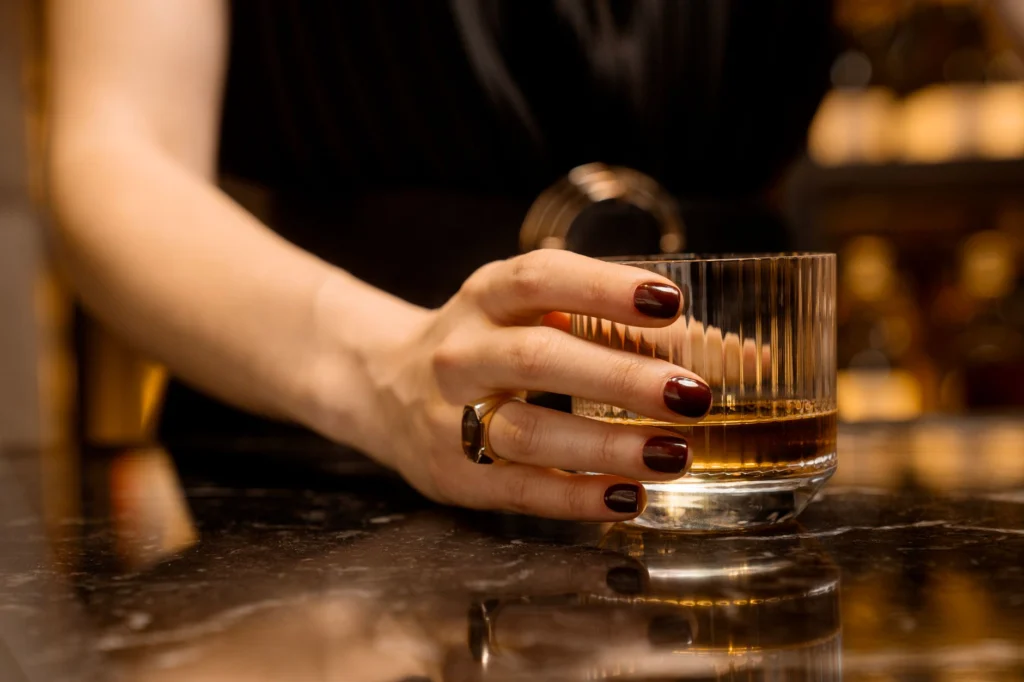
What Makes Red Wine Nails Work
Red wine nails sit between a classic red and a deep burgundy. The color is dark enough to look polished, but it still shows red and berry tones instead of reading as black. That balance makes it wearable in an office, at dinner, or with cold-weather clothes. It is not one shade. Merlot leans true red with berry undertones, cabernet runs darker and more crimson, burgundy has a clear purple cast, and blackberry is nearly black-red. Cool undertones usually suit burgundy and blackberry; warm undertones often suit merlot and cabernet with a little brown or brick in the base.
Choosing Your Shade
Look at the polish against your skin in daylight, not under store lighting. A shade that looks rich on the shelf can turn harsh if it is too blue for your skin, or muddy if it is too brown. If you want a safer first red wine, choose a merlot with visible red rather than a nearly black burgundy. If you already wear dark polish, cabernet and blackberry give more contrast. Sheer red wine shades exist, but most of the effect comes from opacity, so plan on two or three thin coats unless the bottle is explicitly a one-coat formula.
At-Home Application
A red wine manicure shows ridges, cuticle flooding, and chips more than a nude polish does. The prep matters as much as the color.
1. Prep the nail
Remove old polish, wash and dry your hands, and push back cuticles with an orange stick or cuticle pusher. Do not cut cuticles unless they are torn; cutting can leave the nail edge irritated. Shape the nail with a file in one direction. Almond, squoval, and short rounded shapes all work with dark red. Lightly buff ridges with a fine-grit buffer, then wipe the nail with polish remover to remove dust and oil.
2. Use a base coat
Deep red pigments can stain bare nails, especially if the polish stays on for more than a week. Apply one thin base coat and let it dry. A ridge-filling base coat helps if your nails have visible texture.
3. Apply thin color coats
Load the brush lightly and paint a thin coat down the center of the nail, then along each side. Cap the free edge by brushing a small amount of polish across the tip. Let the first coat dry for two minutes, then apply a second thin coat. If the color is still patchy, add a third thin coat rather than a thick one. Thick coats pool at the cuticle, wrinkle when they dry, and take much longer to set.
4. Top coat and clean up
Apply a glossy or matte top coat once the color is dry to the touch. Cap the free edge again. Clean up any polish on the skin with a small angled brush dipped in remover. Wait at least 20 minutes before using your hands for anything rough.
Finishes and Details
A solid red wine nail is already a strong look. Add detail only where it will show.
- Matte top coat: This softens the shine and makes dark red look velvety. It also shows hand cream marks, so keep cuticles moisturized but not greasy.
- Subtle shimmer: A fine shimmer top coat adds light without looking like craft glitter. Skip chunky glitter if you want the manicure to stay formal.
- Accent nail: Paint one ring finger in a lighter merlot or add a single thin gold stripe. Fine linework can disappear against dark polish, so keep the design simple.
- Red wine French: Use a nude base with a deep red tip for a cleaner look, or a deep red base with a nude tip for more contrast. The nude-base version is easier to maintain.
- Minimalist art: One small gold dot near the cuticle or a thin black line on one nail is enough. Too many details compete with the color.
How It Wears
Dark red polish reads as deliberate and formal. On short nails it looks neat; on almond nails it looks sharper. Because the contrast against skin is high, chips are more visible than they are with nude polish. A fresh top coat every two to three days helps. Keep cuticle oil and hand cream nearby, wear gloves for dishes and cleaning, and avoid using your nails to open cans or scrape labels. Remove the polish after seven to ten days, especially if you used a base coat that is not stain-blocking, and give nails a short break before the next dark color.
Bottom Line
Red wine nails are less about a single trend and more about picking the right depth for your skin tone and applying it neatly. A merlot is the easiest entry point, burgundy suits cooler undertones, and cabernet or blackberry works when you want a darker finish. Two thin color coats, a base coat, and a top coat will do more for the result than an expensive bottle alone.
If your company or product is mentioned in this article, you're welcome to share it.