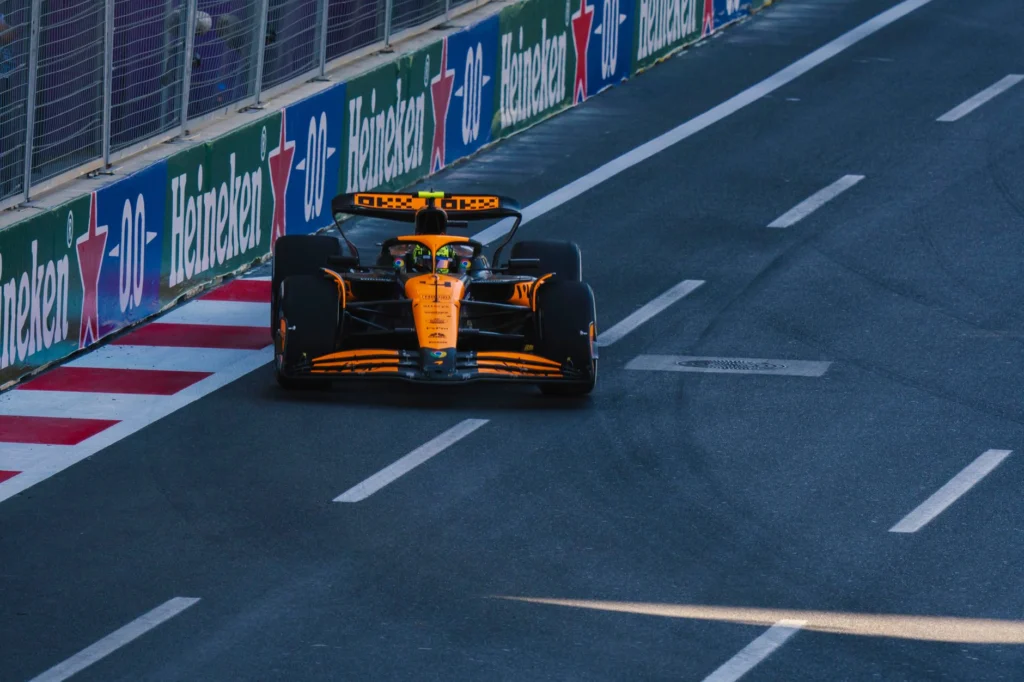
Lando Norris lost the lead to Kimi Antonelli twice at Zandvoort, yet McLaren still had the faster race car when it mattered. The evidence was clearest after the first pit cycle: once Norris and Antonelli switched to hard tyres, the McLaren began closing on the Mercedes at a rate the Mercedes could not sustain. (formula1.com)
That makes the 2026 Dutch Grand Prix less interesting as a simple result sheet than as a comparison of two cars that behaved very differently over a stint. Mercedes had the better opening phase. McLaren had the stronger long-run pace and, crucially, the tyre performance to turn that advantage into a win.
Mercedes had the advantage at the first restart
The race began with Norris on pole, but the first start was effectively erased after Max Verstappen crashed at the end of Lap 1 and triggered a red flag.
For the restart, the strategic picture changed. Norris switched to soft tyres, while Antonelli and George Russell stayed on mediums. Oscar Piastri, meanwhile, took the harder option. (formula1.com)
Antonelli made the crucial move immediately. He launched better than Norris and went around the inside at Turn 1 to take the lead.
The Mercedes driver then established a gap of around 1.4 seconds by Lap 10, enough to keep Norris outside the one-second window required for Overtake Mode. Norris could follow, but he could not attack effectively. (formula1.com)
That is the first important distinction between the cars. On the initial medium-tyre phase, Mercedes had enough pace and tyre control to dictate the race from the front.
Norris even admitted on Lap 16 that his tyres were effectively spent, telling his engineer: “I’m pace zero – I’ve got nothing else.” (formula1.com)
If the race had remained a straightforward one-stop contest from there, Mercedes would have had a very strong argument for being the better race package.
But the tyre change exposed something else.
The hard tyre changed the balance between McLaren and Mercedes
Antonelli and Norris both stopped around Lap 22 and fitted hard tyres. That is where the race began moving decisively toward McLaren.
Sky Sports reported that the dynamic “swung dramatically” after the switch, with Norris clearly faster than Antonelli. (skysports.com)
The timing is important. Mercedes did not suddenly become slow in isolation. Rather, McLaren appeared to extract substantially more performance from the hard tyre over the stint.
Norris had already reduced Antonelli's advantage to under a second by Lap 30. By Lap 40, the gap was down to 0.7 seconds. (formula1.com)
That progression matters more than the eventual 11.536-second finishing margin. The final gap was influenced by the later Virtual Safety Car, pit stops and Mercedes' decision-making. The more revealing comparison is what happened when both cars were running in broadly comparable race conditions.
Norris could repeatedly erase Antonelli's lead.
Mercedes, by contrast, was increasingly concerned about its rear-tyre performance. By Lap 52, Antonelli was reporting rear-tyre struggles as Norris closed rapidly. (formula1.com)
So the better description of the car comparison is not that McLaren was faster everywhere. It was more effective over the evolving race stint.
McLaren's biggest advantage was the ability to attack late in the stint
The second major strategic phase began when Mercedes stopped Antonelli again on Lap 41.
Russell followed into the pits, while Norris remained out. Norris eventually made his second stop on Lap 48, seven laps after Antonelli. (formula1.com)
That created a potentially decisive tyre-age difference.
Norris emerged roughly five seconds behind Antonelli, but the gap disappeared quickly. Mercedes' problem was compounded by Hamilton, who had not yet made his second stop and was therefore occupying the road ahead of Antonelli.
By Lap 52, Norris was close enough to attack. Antonelli had Overtake Mode available because he was within a second of Hamilton, but that did not prevent Norris from getting through. (formula1.com)
Norris went around the outside as Antonelli approached Hamilton and then passed Hamilton himself later in the lap.
The move was not simply a product of tyre age. Norris later explained that he recognised the opportunity and adjusted his brake balance before committing to the braking zone. But the opportunity existed because McLaren had the pace to arrive at that point in the first place. (skysports.com)
This is where McLaren's race pace was superior: Norris could stay competitive through the earlier stint and then exploit the hard tyre when Mercedes' performance began to fade.
Mercedes had the better opening stint, but McLaren had the stronger race window
There is a temptation to look at the result and conclude that McLaren simply had the faster car all afternoon. The race does not support that.
Antonelli controlled the opening phase after the restart. He built a lead, kept Norris outside effective Overtake Mode range and appeared comfortable while the first stint developed. (formula1.com)
The McLaren advantage emerged later.
That distinction also helps explain why Piastri's sixth-place finish is useful evidence rather than a contradiction. Piastri started fourth, passed Russell at the restart and initially moved clear of the Mercedes. But his race deteriorated after a slow pit stop and subsequent loss of pace.
He pitted one lap after Russell and returned behind the Mercedes. Later, Ferrari's Charles Leclerc and Lewis Hamilton both passed him, leaving Piastri sixth. (formula1.com)
F1's official post-race report also notes that Piastri had a slow stop and subsequently slipped backwards. (formula1.com)
That means the McLaren-versus-Mercedes comparison cannot be reduced to finishing positions. Norris extracted a much stronger result from the McLaren than Piastri did, while Mercedes put both cars on the podium.
Still, Norris' pace relative to Antonelli is the cleaner comparison because the two spent much of the race directly fighting each other.
Mercedes' late two-stop gamble did not produce enough pace
The late Virtual Safety Car caused by Esteban Ocon's stationary Haas created another strategic opening.
Antonelli stopped again for soft tyres while Norris stayed out. Mercedes effectively traded track position for tyre freshness. Antonelli rejoined behind Russell, with the expectation that the newer tyres might allow him to recover the lost ground. (formula1.com)
The calculation did not work.
Antonelli eventually passed Russell after Mercedes ordered the team-mates to swap positions, but Norris was already around 10 seconds ahead with the race entering its final phase. Even with tyres nine laps fresher than Norris' according to Sky Sports, Antonelli could not mount a serious challenge for the win. (skysports.com)
That is probably the strongest evidence of the underlying pace difference.
Mercedes had put Antonelli on a theoretically favourable late-race tyre strategy. He had newer rubber and a clear championship incentive to attack. Yet the gap to Norris remained substantial.
The final margin was 11.536 seconds. (formula1.com)
That does not mean Norris was 11.5 seconds faster than Antonelli in pure lap time. The race contained different tyre ages, pit cycles, traffic and Virtual Safety Cars. But it does show that Mercedes' late strategic response could not overcome the performance McLaren had built into the final stint.
So which car had the better race pace?
McLaren. But not by the margin the final result alone suggests.
Mercedes was arguably the stronger car during the opening phase after the restart. Antonelli controlled Norris and had enough pace to keep him from attacking.
McLaren's advantage emerged as the tyres aged. Norris was substantially more effective on the hard compound, closed the gap repeatedly and eventually passed Antonelli before the final sequence of stops.
The contrast is particularly clear because Norris did not win simply by inheriting track position. He had to recover from losing the lead, manage a difficult first stint and then use the McLaren's stronger pace over the later phase to put himself into position for the decisive pass.
The result was a McLaren victory by 11.536 seconds, with Antonelli second and Russell third. (formula1.com)
Mercedes nevertheless demonstrated that its car was close enough to control substantial portions of the race. Its double podium, combined with Russell's Sprint victory on Saturday, shows that Zandvoort was not a weekend in which Mercedes suddenly lacked performance. (formula1.com)
The more revealing conclusion is narrower: Mercedes had the better car at the beginning of the race, but McLaren had the better race window.
At Zandvoort, that difference decided the Grand Prix.
If your company or product is mentioned in this article, you're welcome to share it.