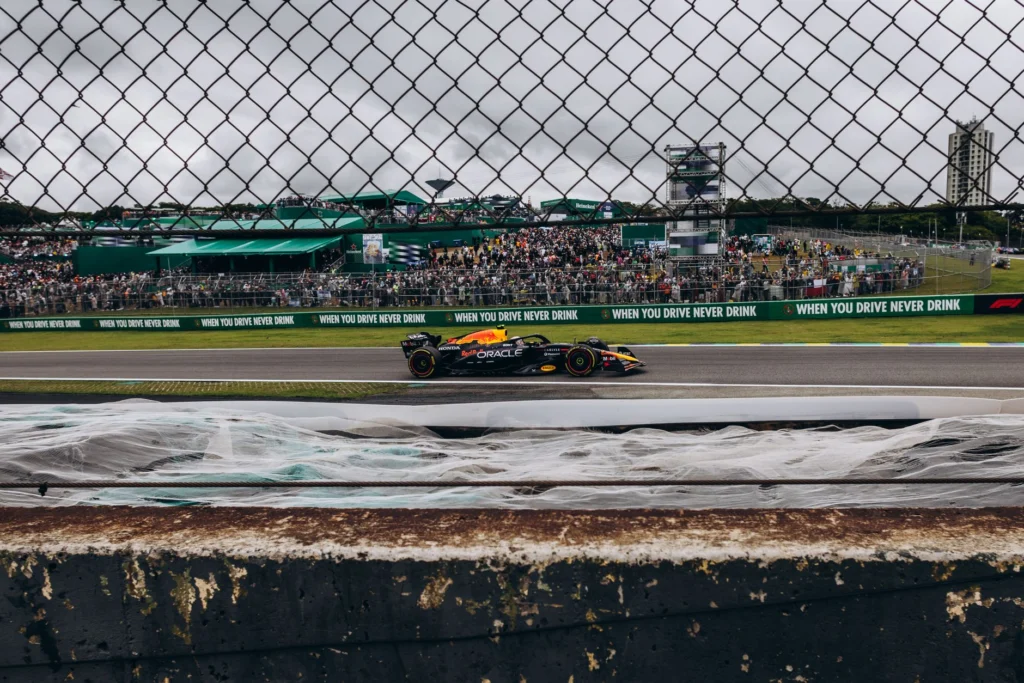
Max Verstappen left the Dutch Grand Prix with no points, his Red Bull in the wall after a single racing lap. He had started only seventh at Zandvoort, behind both Mercedes, both McLarens and both Ferraris, before losing the rear of the RB22 on the main straight and crashing out.
The result left Verstappen sixth in the 2026 Drivers' Championship on 112 points, 130 behind Mercedes leader Kimi Antonelli. Red Bull is fourth in the Constructors' Championship at the end of the Dutch Grand Prix weekend. (formula1.com)
That is the simplest measure of how far the reigning champion's team has fallen. But the season has not been one long failure. Red Bull has produced podiums, strong upgrades and some excellent strategic recoveries. The more revealing story is why Verstappen so often needs to extract an unusually large amount from a car that was supposed to carry him into another title fight.
The RB22 has repeatedly been difficult for Verstappen to trust
The clearest problem appeared early in the season.
At the Chinese Grand Prix, Verstappen described the Red Bull as having no balance and being extremely difficult to drive. He said he could not lean on the car and that every lap felt like survival. Those comments were not about a small setup compromise; they described a driver struggling to establish a predictable reference from one lap to the next. (skysports.com)
That matters particularly for Verstappen because his driving style depends heavily on confidence in the front and rear response. A car can be fast on a timing sheet while still being difficult to exploit if its behaviour changes with fuel load, tyre condition or aerodynamic configuration.
The problem persisted in different forms. In Barcelona, Verstappen finished fourth and called the race "lonely", while admitting Red Bull needed to work harder. In Hungary, he struggled to find a good balance and spun during qualifying, eventually describing the car as "completely broken" after ending the session sixth. (formula1.com)
The evidence points to a car that has not consistently given its driver a stable operating window.
Red Bull's biggest improvement came only after a major Austria upgrade
The season changed somewhat at the Austrian Grand Prix.
Red Bull introduced a substantial upgrade package at the Red Bull Ring, and Verstappen immediately became a genuine contender. He started fifth after a qualifying crash, climbed through the field and eventually finished second, just 1.6 seconds behind George Russell. (formula1.com)
That weekend is important because it shows the underlying problem is not simply that Verstappen has suddenly lost performance.
The upgraded RB22 could fight near the front.
But even that race exposed another weakness. Red Bull left Verstappen out when Russell made his final stop, despite the undercut being powerful at the circuit. Verstappen emerged from his own stop roughly 10 seconds behind and did not have enough laps to challenge Russell for the win. (formula1.com)
It was not a catastrophic strategy error. Verstappen still finished second. But in a championship where Mercedes and Ferrari were capable of converting small advantages into victories, these marginal decisions mattered.
The rear wing saga showed how fragile Red Bull's gains could be
The strangest technical episode of the summer involved Red Bull's rotating rear wing.
The team had introduced its own version of the aerodynamic concept sometimes nicknamed the "Macarena" wing after Ferrari's solution. It had been used from Miami onward, but Verstappen subsequently crashed in qualifying in Austria and then spun out of the British Grand Prix.
Red Bull reviewed the component and removed it before the Belgian Grand Prix, reverting to an older rear-wing specification. (formula1.com)
That does not mean the wing alone caused Red Bull's wider 2026 problems. The available evidence does not support such a simple explanation. But the sequence illustrates how narrow the team's performance window had become: an aerodynamic development intended to create an advantage ended up being shelved after two Verstappen incidents.
At Spa, the older specification did not prevent Verstappen from qualifying second. In fact, Red Bull executed an unusually effective tow strategy, with Isack Hadjar helping Verstappen through Q3. Verstappen then finished third in the race. (formula1.com)
The problem came during the race itself.
Verstappen pitted before the leading runners, but a Virtual Safety Car shortly afterwards compromised the benefit of the fresh tyres. Charles Leclerc then gained time with a cheaper pit stop, leaving Verstappen unable to recover the lost track position. (formula1.com)
Again, Red Bull had enough pace for a podium. It did not have enough margin to make strategic setbacks disappear.
Hungary showed what Verstappen can still do when Red Bull gets the details right
The Hungarian Grand Prix was almost the opposite case.
Verstappen qualified only sixth after struggling with the car, yet finished second. He gained positions at the start, fought Lewis Hamilton through the race and made a decisive pass after his first pit stop.
More importantly, Red Bull's strategy adapted well. The team initially followed McLaren's medium-to-hard approach, then put Verstappen onto soft tyres for the final stint. When a late Virtual Safety Car appeared, Red Bull chose not to stop again. Verstappen carried the older tyres to the finish and secured second. (formula1.com)
This was not simply Verstappen dragging a bad car onto the podium. The race report specifically credits the team's strategic reactions, while Verstappen's own performance turned those decisions into a result.
It is also why the 2026 season should not be described as a collapse caused by one problem. Red Bull has shown that the RB22 can work, and that its pit wall can still make excellent calls.
The problem is that those weekends have been exceptions rather than the baseline.
Zandvoort brought the season's most visible failure, but not its most revealing one
Verstappen's Dutch Grand Prix retirement was spectacular, but it was not the strongest evidence that Red Bull has gone wrong.
He had already struggled to qualify the car into the front six. Verstappen started seventh, with Liam Lawson eighth. In the Sprint, Verstappen had also finished sixth, 10.529 seconds behind winner George Russell. (formula1.com)
The Grand Prix itself lasted less than a lap for Verstappen. After running wheel-to-wheel with Lawson, he dipped a wheel across the white line on the main straight, lost the rear and hit the wall. The impact brought out the red flag. (formula1.com)
There was no strategy decision to blame for that retirement. It was a driver error in a car that had already been struggling to put Verstappen where he expected to be on the grid.
That distinction matters.
A bad pit call can be corrected. A failed component can be redesigned. But when a driver is operating a difficult car at the limit, the consequences of a small mistake become much larger.
Red Bull has improved, but the championship gap tells the real story
Verstappen's 112 points include three podiums in the most recent run of races before Zandvoort: second in Austria, third in Belgium and second in Hungary. His other 2026 race finishes include sixth in Australia, eighth in Japan, fifth in Miami, third in Canada and fourth in Barcelona, alongside retirements in China, Monaco, Britain and now the Netherlands. (formula1.com)
That record explains the championship deficit better than any single crash.
The victories have not come. The podiums have required either an unusually strong Verstappen performance, excellent strategic execution, or both. Meanwhile, Mercedes has built a substantial advantage at the top of the standings, with Antonelli on 242 points and Russell on 183 after Zandvoort. (formula1.com)
Red Bull therefore faces a different problem from the one it had during Verstappen's championship run.
It is no longer enough to give Verstappen a car that is occasionally capable of winning. The team needs a car that is predictable across circuits, tyres and conditions, and it needs to do that without repeatedly forcing Verstappen to compensate for weaknesses himself.
The Austria upgrade suggested Red Bull was moving in that direction. Belgium and Hungary reinforced the idea. Zandvoort interrupted it badly.
And that is probably the fairest reading of Verstappen's 2026 season so far. The driver has not suddenly become incapable of fighting at the front. Red Bull has simply spent too much of the year asking its best driver to solve problems that a championship-winning car should prevent in the first place.
If your company or product is mentioned in this article, you're welcome to share it.