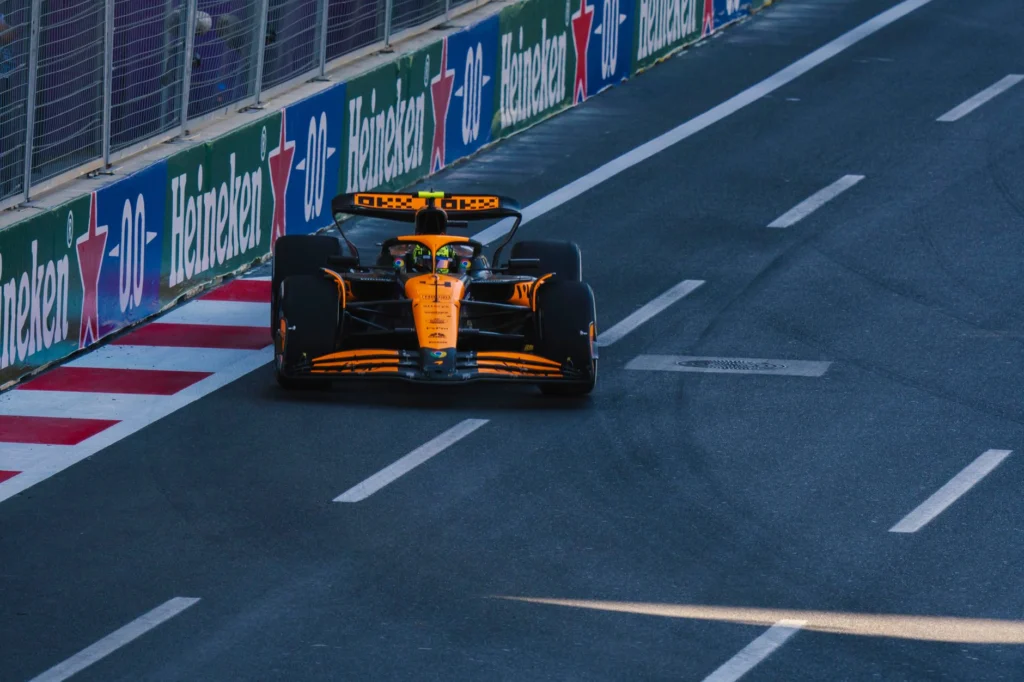
Lando Norris won the final Dutch Grand Prix at Zandvoort by recovering from an early strategic disadvantage, not by controlling the race from pole. After losing the lead to Kimi Antonelli at the second standing start, Norris spent much of the opening phase looking like the slower car. The race changed when McLaren put him onto the hard tyre and gave him enough pace to pressure Mercedes into reacting.
Norris eventually passed Antonelli on Lap 54 and stayed out when a Virtual Safety Car arrived two laps later. Mercedes put Antonelli onto fresh softs, but the extra grip was not enough to overcome the track position deficit. Norris crossed the line 11.536 seconds clear of Antonelli, with George Russell third. (formula1.com)
Norris's biggest advantage was created after he lost the lead
The opening sequence made the McLaren's eventual victory look far from certain.
Norris started from pole, with Russell alongside him and Antonelli third. At the original start he retained first place, but Max Verstappen's Lap 1 crash brought out the red flag. When the race restarted, Antonelli made the better launch and took the lead from Norris.
There was another complication before that restart. Norris changed from his original medium tyres to softs, while Antonelli and Russell remained on mediums. Oscar Piastri, meanwhile, switched to hards. The choice left Norris with the softer compound but did not immediately produce the performance McLaren wanted. (formula1.com)
Norris later described the first half of the race as particularly difficult. The soft tyre did not give him the balance or pace he needed, and he initially believed victory might be out of reach.
That makes the next decision more significant: McLaren changed the tyre rather than simply asking Norris to extract more from a package that was not working.
The hard tyre changed Norris's race
The turning point came when Norris moved onto the hard compound.
Norris's own account is unusually clear about what happened. He said the car "came alive" once the hard tyres were fitted. He could push more confidently, and the McLaren began putting Mercedes under pressure. (formula1.com)
The effect was visible in the race strategy.
Mercedes had already stopped its drivers before Norris's first stop because it was concerned about being undercut by rivals. Russell stopped first and moved onto hards, while Antonelli subsequently followed the same basic strategy. Mercedes' own post-race explanation says both cars were stopped twice from medium to hard in an attempt to protect track position. (publicnow.com)
Norris's advantage was therefore not simply that the McLaren was faster on paper. The hard-tyre stint gave him the ability to apply pressure without immediately needing the same defensive response.
That distinction matters at Zandvoort. A driver who can close without destroying his tyres creates a strategic problem for the car ahead. Mercedes had to decide whether to keep Antonelli on track and risk being passed or stop early and surrender position.
McLaren made the pressure count.
Norris did not need to win the pit-stop battle outright
The key tactical point is that Norris did not win because McLaren produced a miraculous undercut.
It was almost the opposite.
Norris stopped for another set of hard tyres on Lap 48, while Mercedes had already committed to its own sequence. By Lap 54, Norris had closed rapidly enough to put Antonelli, Hamilton and himself within roughly a second of one another. He passed Antonelli around the outside at Turn 1 and then took the effective race lead from Hamilton at Turn 11. (motorsport.com)
The timing was crucial. Norris arrived on fresher hard tyres just as the Mercedes strategy was becoming constrained by traffic and tyre performance.
This is where the McLaren advantage was more tactical than numerical. Norris did not need Mercedes to make a major mistake. He needed the Mercedes to reach the point where defending track position became harder than responding to the faster car.
Antonelli himself acknowledged that Mercedes simply lacked the pace to fight McLaren in the second half of the race. (skysports.com)
The late Virtual Safety Car looked like McLaren's biggest risk
Ocon's stopped Haas created the race's most interesting strategic decision.
A Virtual Safety Car was deployed around Lap 55. By then Norris had taken the lead, with Russell behind him and Antonelli in third. Mercedes used the reduced pit-stop time to put Antonelli onto soft tyres.
On paper, that was exactly the situation Norris should have feared.
Antonelli now had significantly fresher rubber and a compound designed to deliver immediate pace. Norris stayed out on his older hards. Autosport's race report notes that Norris admitted he was worried by the decision to remain on track. (autosport.com)
But McLaren had something Mercedes could not manufacture under the VSC: track position.
Norris emerged from the VSC phase still leading, while Antonelli first had to get past Russell. That cost time. By the time Antonelli reached second, Norris had already established a substantial cushion.
The Mercedes soft-tyre advantage therefore became a tool for securing second place rather than winning first.
Mercedes had the faster final tyre, but Norris had the better race position
This is the central strategic lesson from Zandvoort.
Antonelli's fresh softs were faster than Norris's older hards. The problem was that the race leader had enough margin to absorb the difference.
When racing resumed on Lap 58, Norris was 6.8 seconds ahead of Russell, with Antonelli about 5.6 seconds behind Russell. Antonelli eventually caught his teammate and Mercedes ordered Russell to let him through on Lap 65. But Norris was still around 10 seconds ahead as the final ten laps began. (formula1.com)
Mercedes had improved Antonelli's tyre position at the cost of track position and time.
Norris's decision to stay out therefore worked because the VSC did not create a sufficiently large tyre advantage to erase the lead. McLaren had correctly judged that the risk was manageable.
That was a calculation, not luck.
Norris's driving mattered as much as the tyre strategy
It would be too simple to describe the Dutch GP as a tyre-selection victory.
Norris had to convert the strategic opening himself.
His decisive pass on Antonelli came at Turn 1, where he committed to the outside line. Norris later identified that move as the one that won him the race. He also credited the work with his engineers overnight after a difficult Sprint weekend, saying they had changed how he approached tyre management and extracted performance from the car. (grandprix.com)
That is important context because Norris's McLaren was not universally dominant around Zandvoort.
Norris said the car continued to struggle in the final sector, particularly through the tighter, slower corners. The McLaren was stronger in the more flowing sections, but the slow-speed weakness remained visible. (grandprix.com)
So the winning advantage was not an across-the-board performance gap. It was the combination of a more effective hard-tyre stint, Norris's ability to sustain pressure and McLaren's willingness to extend when the VSC offered a tempting but potentially unnecessary pit window.
The result says more about McLaren's race execution than raw dominance
Norris finished 11.536 seconds ahead of Antonelli, while Russell was another 4.370 seconds behind his teammate. Hamilton and Leclerc followed closely, with Piastri sixth. (skysports.com)
Those margins do not describe a race in which McLaren simply disappeared from the field.
They describe a race in which Norris made the right performance window appear at the right time.
The first stint was poor enough for Norris to doubt his chances. The hard-tyre stint changed that assessment. His pace then forced Mercedes to protect itself with pit stops, which gave Norris the opportunity to attack. Once he took the lead, the late VSC presented a final strategic gamble. McLaren stayed out, accepted the tyre disadvantage and trusted the gap.
It worked.
That is what makes Norris's Dutch GP victory more interesting than a straightforward pole-to-flag win. McLaren did not have to dominate every phase of the race. It had to identify when its car was strongest, put Norris into that window, and resist the temptation to give away track position when Mercedes found a faster tyre.
At Zandvoort, that was enough to turn a race Norris thought he might not win into his second consecutive Grand Prix victory.
If your company or product is mentioned in this article, you're welcome to share it.