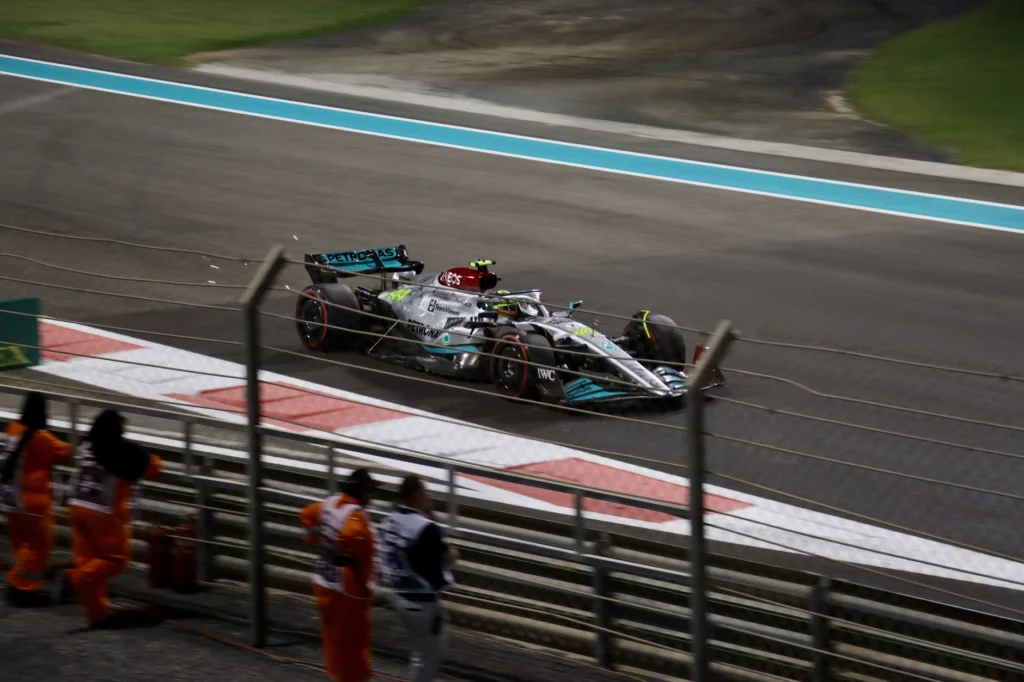
Kimi Antonelli left Zandvoort with a 59-point lead in the 2026 Formula 1 championship, but the Dutch Grand Prix also exposed the limit of Mercedes' early-season advantage. Lando Norris won by more than 11 seconds, while Antonelli finished second after Mercedes used a late Virtual Safety Car to put him on fresh soft tyres and then ordered George Russell to give up third place. (formula1.com)
That is a useful snapshot of Antonelli's title campaign so far. Mercedes did not build his lead by winning every strategic battle or keeping the fastest car all year. It built it by repeatedly putting Antonelli in position to collect the maximum available points, then making increasingly explicit decisions around the championship as McLaren and Ferrari closed the performance gap.
After 12 Grands Prix, Antonelli has six victories, 10 podiums and 242 points. Russell and Lewis Hamilton are tied on 183, leaving Antonelli 59 points clear of both. (skysports.com)
Mercedes started 2026 with a car that made the simplest strategy work
The championship campaign began with an unusually valuable advantage: Mercedes had both performance and operational flexibility.
At the Australian Grand Prix, Russell and Antonelli qualified first and second and converted that into a Mercedes 1-2. The decisive tactical point was not an exotic strategy. Both Mercedes cars used a one-stop approach after pitting during a Virtual Safety Car, while Ferrari stayed out. (formula1.com)
Antonelli finished second, only 2.974 seconds behind Russell. That immediately gave Mercedes the points cushion and, more importantly, demonstrated that its 2026 package could turn strong qualifying pace into a controlled race without needing to manufacture an advantage through aggressive strategy. (formula1.com)
The pattern continued in China. Antonelli took pole and briefly lost the lead to Lewis Hamilton at the start, but retook it before the end of Lap 2. His only pit stop came under the race's sole Safety Car period, after which he controlled the race to win by 5.515 seconds over Russell. (formula1.com)
At Suzuka, the strategic picture became even clearer.
Antonelli started from pole, but both Mercedes cars lost positions at the opening phase. Russell challenged Oscar Piastri for the lead, while Antonelli stayed out as other front-runners began making their stops. When Ollie Bearman's crash brought out the Safety Car on Lap 22, Antonelli took his stop under neutralised conditions and emerged in the lead. He then won from Piastri and Charles Leclerc. (formula1.com)
That was not simply a case of having the fastest car. Mercedes and Antonelli had preserved a strategic option by extending the first stint. The Safety Car then converted that option into track position.
The four-race winning streak changed Antonelli from a prospect into the title favourite
By Miami, Antonelli had established a rhythm that is more important to a championship than any individual victory.
He arrived on a third consecutive pole and won the race despite an eventful opening. After locking up at Turn 1, he lost the lead to Leclerc, then overtook the Ferrari later in the race. Safety Cars created further uncertainty, but Antonelli ultimately resisted pressure from Norris to take his third straight Grand Prix victory. (formula1.com)
Canada was more revealing because Mercedes' two drivers were fighting each other rather than merely managing the opposition.
Russell and Antonelli exchanged the lead repeatedly. Russell eventually retired on Lap 30 with a power-unit problem, leaving Antonelli to win and extend his championship advantage over his team-mate to 43 points. (formula1.com)
Mercedes did not respond by immediately imposing a rigid hierarchy. Toto Wolff said the drivers had been trained to race each other while the team still pursued both championships. (formula1.com)
That distinction matters. The team was allowing Antonelli to earn his advantage on track rather than simply assigning him priority from the start.
Monaco then produced Antonelli's fifth consecutive win. He led from pole, built a substantial advantage and survived a late Safety Car and red-flag sequence to win the final eight-lap sprint to the finish. (formula1.com)
By this point, the campaign was no longer just about Mercedes having a strong car. Antonelli had built a large points buffer while repeatedly finishing the races that mattered.
Mercedes' biggest contribution may have been limiting the damage when its advantage disappeared
The most revealing part of a championship campaign is usually the period when the dominant car stops dominating.
That arrived quickly.
Antonelli retired from the Barcelona Grand Prix, where Hamilton won for Ferrari, while Russell finished second. Ferrari's three-stop strategy was helped by a free stop under a Virtual Safety Car, and Hamilton converted that opportunity into victory. (formula1.com)
At Silverstone, Antonelli was initially in contention for another win. After Ferrari's Leclerc made his pit stop, Antonelli inherited the lead and extended his stint before stopping on Lap 36. He then began chasing Leclerc, only for a wheel-shield failure to cost him performance. Mercedes eventually made two further pit stops trying to resolve the issue, and Antonelli finished 15th. (skysports.com)
Those two races could have started a championship collapse. Instead, Antonelli recovered with third in Austria, victory in Belgium and third in Hungary.
Belgium was particularly important. Antonelli lost the lead to Verstappen on the opening lap, regained it, then had to recover the advantage after Ferrari benefited from a Virtual Safety Car while Antonelli had already stopped. He eventually passed Leclerc and won by 1.952 seconds. (fia.com)
Hungary was different again. Mercedes was no longer the obvious qualifying benchmark, and Antonelli was demoted from fourth to seventh after a yellow-flag infringement. Rather than forcing the race, he used a different strategy and gained positions as rivals stopped, finishing third ahead of both major title challengers. (formula1.com)
That is championship arithmetic in practice: when victory is available, take it; when it is not, protect the points.
The Dutch Grand Prix showed Mercedes is now managing the championship, not just races
Zandvoort provided the clearest example yet of Mercedes making a decision specifically in Antonelli's championship interest.
Antonelli started third and passed Russell at the opening corner. After Max Verstappen's crash caused the race to be red-flagged, Antonelli made an even better restart and took the lead from Norris. He held first for much of the race, but Norris gradually recovered the advantage. (formula1.com)
The critical moment came with 16 laps remaining.
A Virtual Safety Car gave Mercedes an opportunity to pit Antonelli for fresh tyres. He emerged in third, behind Russell, while Norris stayed out. Antonelli quickly closed on his team-mate, but Zandvoort is not a circuit where following closely automatically produces an easy overtake. Mercedes therefore ordered Russell to let Antonelli through. (skysports.com)
The call was defensible on pure championship logic. Russell had 183 points entering the result, the same total as Hamilton, while Antonelli was already the clear leader. Mercedes could not realistically expect Antonelli to catch Norris for the win, but it could ensure its championship leader finished ahead of his nearest internal rival.
Norris ultimately won by more than 11 seconds despite being on older tyres. Antonelli finished second and Russell third. (formula1.com)
It was not a perfect Mercedes race. It was a very useful championship result.
Antonelli's lead has been built as much on Mercedes' consistency as its speed
The numbers explain why the campaign has survived Mercedes' recent loss of dominance.
Antonelli has won half of the 12 Grands Prix so far and stood on the podium in 10 of them. His only Grand Prix retirement came in Barcelona, while his Silverstone failure left him 15th. (formula1.com)
The early advantage was enormous: Mercedes won the first six Grands Prix of the season, although the victories were split between Antonelli and Russell. Since then, the competitive order has become less comfortable. Norris won Hungary and the Netherlands, while Leclerc won Britain and Hamilton won Barcelona. (formula1.com)
Antonelli himself now acknowledges that Mercedes no longer has the fastest car. He said after Zandvoort that McLaren had made significant gains, particularly following its upgrade in Hungary. Mercedes also faces the practical limitation of the cost cap when responding to rivals' development. (reuters.com)
That makes the remaining championship fight less about recreating Mercedes' spring dominance and more about preserving the advantage already created.
The evidence so far suggests Mercedes understands that distinction. It has allowed Antonelli and Russell to race when the risk is manageable. It has exploited Safety Cars and Virtual Safety Cars without relying on them. It has recovered points when the car was imperfect. And at Zandvoort, when the situation demanded it, Mercedes chose the championship leader over an equal opportunity for its two drivers.
Antonelli's 59-point advantage is therefore not simply the product of a dominant Mercedes W17. It is the accumulated result of poles converted into wins, one-stop races executed cleanly, opportunistic Safety Car timing, recovery drives after compromised weekends, and increasingly deliberate team decisions.
With McLaren closing and Ferrari still capable of winning races, Mercedes may not be able to give Antonelli the fastest car every Sunday. What it has already given him is something potentially more valuable: enough points in the bank to make every remaining race about defending a lead rather than chasing one.
If your company or product is mentioned in this article, you're welcome to share it.