

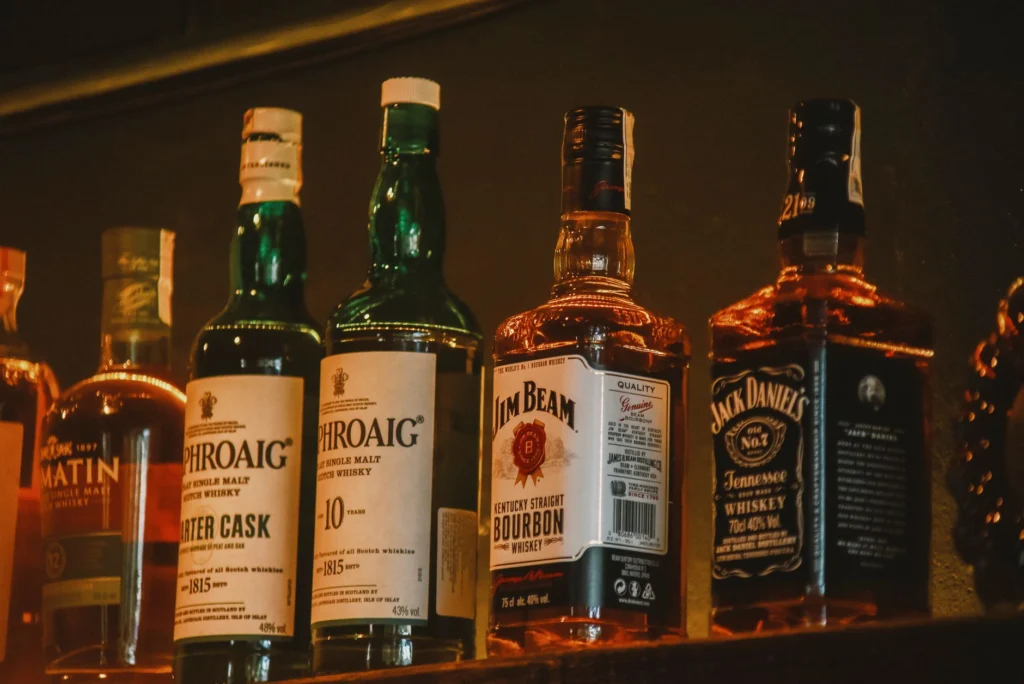
Is Jack Daniel’s Whiskey or Bourbon?
Jack Daniel’s is whiskey. More specifically, it is Tennessee whiskey, a category of American whiskey. It also satisfies the U.S. legal requirements for bourbon. The reason it is not labeled bourbon comes down to production method and branding, not a failure to meet bourbon’s rules.
That distinction sounds small, but it matters. Bourbon and Tennessee whiskey share most of the same federal standards. Tennessee whiskey adds one required step: the Lincoln County Process, a charcoal filtration step before barrel aging.
Whiskey, Bourbon, and Tennessee Whiskey
Whiskey is the broad category. It covers distilled spirits made from fermented grain mash, aged in wooden barrels. American whiskey includes bourbon, rye whiskey, wheat whiskey, corn whiskey, and Tennessee whiskey, among other styles.
Bourbon has a fixed legal definition under U.S. law. It must be made in the United States from a mash bill of at least 51 percent corn. It must be distilled to no more than 160 proof and entered into the barrel at no more than 125 proof. It must age in new, charred oak barrels. It cannot contain added flavoring, coloring, or other additives.
Those rules produce the familiar bourbon profile: vanilla, caramel, oak, and often spice from the grain and the char. Jack Daniel’s meets those requirements. Its mash bill is 80 percent corn, 8 percent rye, and 12 percent malted barley. It is distilled in Tennessee, aged in new charred oak barrels, and made without additives.
What Makes Jack Daniel’s Tennessee Whiskey
Tennessee whiskey must meet the bourbon standards and also go through the Lincoln County Process. For Jack Daniel’s, that means filtering the new make whiskey through charcoal made from sugar maple before it goes into the barrel. The charcoal is packed into vats, and the whiskey seeps through it over several days. The company calls this charcoal mellowing.
The process does not make the whiskey neutral or remove its identity. Jack Daniel’s Old No. 7 still shows vanilla, caramel, banana, and oak notes, with a lighter, softer edge than many high-rye bourbons. The filtration is one reason the brand argues Tennessee whiskey deserves its own label.
Why Jack Daniel’s Is Not Labeled Bourbon
Jack Daniel’s could legally be called bourbon. It chooses not to be. The company uses the Tennessee whiskey label to emphasize the Lincoln County Process and its location in Lynchburg, Tennessee. That is a real production difference, not just a marketing slogan, though it is also a marketing position.
The category has legal backing. Tennessee law codified the definition of Tennessee whiskey in 2013, including the charcoal filtration requirement. Trade agreements also recognize Tennessee whiskey as a distinctive product of the United States. So the label is not simply a style note. It has a regulatory basis.
Common Misconceptions
One misconception is that Tennessee whiskey is always smoother or better than bourbon. Quality depends on the brand, the barrel, the age, and the drinker’s preference. A bold bourbon can be excellent, and a Tennessee whiskey can be ordinary. The Lincoln County Process tends to soften the spirit, but it does not guarantee a better result.
Another misconception is that charcoal filtration strips out all bourbon character. It does not. Jack Daniel’s still tastes like an American whiskey aged in charred oak. The filtration changes the texture and tempers some harsh notes, but the corn, rye, malt, barrel char, and yeast still shape the flavor.
How to Compare Bourbon and Tennessee Whiskey
A side-by-side tasting is the clearest way to see the difference. Pour a standard bourbon such as Maker’s Mark or Jim Beam next to Jack Daniel’s Old No. 7. Use the same glass and a small amount of water if needed.
- Aroma: Check for corn sweetness, oak, vanilla, and spice. Bourbon may show more grain spice or barrel intensity. Jack Daniel’s often reads softer and sweeter on the nose.
- Palate: Compare texture and weight. Note whether the whiskey feels sharp, oily, round, or light. Look for caramel, banana, oak, and spice.
- Finish: See how long the flavor lasts and whether it ends warm and spicy or soft and sweet. The charcoal-filtered whiskey often has a shorter, gentler finish.
These differences are tendencies, not rules. Barrel selection and proof matter as much as the charcoal step.
Bourbon and Tennessee Whiskey at a Glance
| Characteristic | Bourbon | Tennessee Whiskey (Jack Daniel’s) |
|---|---|---|
| Grain bill | At least 51% corn | At least 51% corn; Jack Daniel’s uses 80% corn, 8% rye, 12% malted barley |
| Aging | New, charred oak barrels | New, charred oak barrels |
| Distillation proof | No more than 160 proof | No more than 160 proof |
| Entry proof | No more than 125 proof | No more than 125 proof |
| Additives | None allowed | None allowed |
| Lincoln County Process | Not required | Required; charcoal filtration before aging |
| Location | United States | Tennessee; Jack Daniel’s is made in Lynchburg |
| Typical profile | Vanilla, caramel, oak, spice | Softer vanilla, caramel, banana, oak |
FAQ
What is the Lincoln County Process?
It is the required charcoal filtration step for Tennessee whiskey. The new make whiskey is filtered through sugar maple charcoal before barrel aging. Jack Daniel’s uses this step and calls it charcoal mellowing.
Can Jack Daniel’s legally be called bourbon?
Yes. Jack Daniel’s meets the U.S. legal standards for bourbon. The company labels it Tennessee whiskey to highlight the Lincoln County Process and its Tennessee origin.
Is Tennessee whiskey always smoother than bourbon?
No. The charcoal filtration can soften the spirit, but smoothness varies by brand, age, proof, and barrel. Some bourbons are softer than some Tennessee whiskeys, and preference is subjective.
Is Jack Daniel’s a bourbon?
By federal rules, it qualifies as bourbon. By label and category, it is Tennessee whiskey. The most accurate description is Tennessee whiskey that also meets bourbon’s legal requirements.
If your company or product is mentioned in this article, you're welcome to share it.


