A customer buys a $200 pair of shoes with a credit card, pays the statement in full a few weeks later, and never pays a cent of interest.
It looks like a bad deal for the card company.
The customer borrowed money for almost nothing, collected cash back or points, and gave the issuer no late fee to collect. Yet the card can still be profitable.
That is because the customer is only one part of the transaction. Behind the purchase are a merchant, an acquiring bank, a card network such as Visa or Mastercard, and the bank that issued the card. Money changes hands at every stage.
The basic answer to how credit card companies make money is therefore more interesting than “they charge interest.” They make money from lending, payments, fees and commercial relationships. And for rewards cards, the economics are deliberately built around the fact that different customers use the product very differently.
The biggest source of money is still interest from people who carry balances
Credit cards perform two jobs at once.
They are payment instruments, allowing customers to buy something without handing over cash immediately. They are also revolving credit lines, allowing customers to borrow and repay over time.
The second function is where the economics can become extremely lucrative.
When a cardholder carries a balance beyond the grace period, the issuer generally charges interest based on the card's APR. Many issuers calculate interest daily using the average daily balance. Customers who pay their purchase balance in full by the due date can generally avoid purchase interest when the card offers a grace period. (consumerfinance.gov)
The scale is enormous. The Consumer Financial Protection Bureau reported that U.S. credit card companies charged consumers more than $105 billion in interest in 2022, alongside more than $25 billion in fees. (consumerfinance.gov)
The CFPB later estimated that major card issuers earned about $25 billion in additional interest revenue in 2023 from the expansion of APR margins over the previous decade. That figure is an estimate, not a universal industry accounting number, but it illustrates how significant pricing can be to issuer economics. (consumerfinance.gov)
This is why a customer who pays $2,000 a month on a rewards card and clears the statement every month is fundamentally different from someone who spends $2,000 and carries $1,500 forward.
The first customer is primarily a payment customer.
The second is also a borrower.
Every swipe can generate money even when the customer pays no interest
Interest is only half the story.
Suppose that same $200 shoe purchase is paid with a Visa or Mastercard credit card. The merchant does not simply receive $200 and the card issuer receive nothing.
The merchant pays a fee for accepting the card. This is generally described through the merchant discount rate, which includes several components. Interchange is the portion associated with the card issuer, while the payment network and acquiring side also receive compensation.
The CFPB describes interchange as the fee that forms the majority of the merchant discount rate, with issuing banks receiving the majority of interchange revenue. The exact amount varies according to factors including the transaction, merchant and type of card. (files.consumerfinance.gov)
That distinction matters because credit-card interchange is not the same thing as the interest paid by the cardholder.
A customer can pay a credit card bill in full and still generate revenue for the issuer because the merchant-side economics occurred when the purchase was processed.
This is also why a credit card can make money from someone who never carries a balance.
One caveat is worth keeping straight: the Federal Reserve's widely cited interchange regulations concern debit cards, not ordinary credit-card interchange. Regulation II caps interchange received by covered debit-card issuers, while credit-card interchange generally operates under a different pricing structure. (federalreserve.gov)
Rewards are expensive, but they can still make sense for the issuer
The phrase “cash-back credit card” makes the economics sound almost backwards.
The bank receives interchange revenue from purchases, then gives part of that value back to the customer as cash back, miles or points.
So why bother?
Because rewards can encourage more spending, attract customers, increase card usage and differentiate one card from another. The issuer is not necessarily trying to make a profit on every individual transaction. It is managing the economics of the entire customer relationship.
The Federal Reserve's analysis of credit-card profitability found something particularly revealing: on average in its study, the credit function accounted for roughly 80% of credit-card profitability, while the transaction function was slightly negative because rewards and other transaction expenses exceeded interchange revenue. Usage fees contributed roughly 15%. The study used detailed data from 13 large banks covering about 80% of reported credit-card balances during its 2014–2021 sample period, so these figures describe that research sample and period rather than a permanent industry rule. (federalreserve.gov)
In other words, the rewards transaction itself does not necessarily need to be highly profitable.
The customer relationship does.
A rewards card can effectively say: Spend more with us and we'll give some of the economics back to you.
The issuer hopes the customer will either generate enough payment revenue, remain profitable through other fees and products, or eventually carry a balance.
The rewards card is not charity, and the numbers show why
There is a simple way to understand the rewards business.
Imagine an issuer receives $100 in interchange and related merchant income from a customer's spending. It might return some portion through rewards, while paying network costs, fraud losses, servicing expenses and other operating costs.
If that customer always pays in full, the remaining margin may be modest.
If the customer later revolves a balance at a high APR, the economics change dramatically.
The CFPB has explicitly observed that consumers who carry revolving balances can pay far more in interest and fees than they receive in rewards. (consumerfinance.gov)
That does not mean every rewards customer is unprofitable. Quite the opposite: issuers compete aggressively for customers who spend heavily and pay reliably because those customers can produce substantial interchange revenue and valuable long-term relationships.
The important point is that the rewards themselves are a cost of acquiring and retaining customers, not a gift disconnected from the business model.
The financial statements make this visible.
In 2025, American Express reported $17.36 billion in net interest income, while its card-member rewards expense was $18.41 billion. Its largest revenue line, discount revenue, also grew as billed business increased. American Express explicitly reported that rewards, card-member services and business-development expenses grew faster than revenue as it invested in customer value propositions and premium products. (sec.gov)
That is a useful reminder that “rewards expense” can be enormous without making the rewards strategy irrational. It sits inside a much larger business model.
Annual fees are another piece of the equation
Premium credit cards add a simpler revenue stream: annual fees.
A card with a $95, $250 or $695 annual fee does not need to recover its entire cost through interest from that individual customer. The fee itself is revenue.
That changes the target customer.
Premium issuers can offer airport lounge access, travel credits, points, insurance benefits and other perks while charging customers directly for the package. The issuer then calculates whether the revenue and expected lifetime value of the cardholder justify the rewards and service costs.
The CFPB's 2023 survey of credit-card products found that annual fees at the largest issuers were approximately 70% higher, on average, than at small institutions. (consumerfinance.gov)
The business model is therefore not simply “high interest versus no interest.” It is a portfolio of different products aimed at different types of customers.
Late fees and other fees matter, but they are not the whole business
Credit cards can also generate revenue from fees associated with particular types of usage, including late payments and certain other account services.
The Federal Reserve's profitability research groups these under usage fees and found that they contributed about 15% of credit-card profitability in its historical sample, with late fees particularly important. (federalreserve.gov)
But it would be misleading to describe the entire credit-card industry as a late-fee machine.
The largest economic engine is the combination of lending and transaction activity. Fees sit alongside those two functions.
And regulation has changed how some fees can be charged. That is one reason an issuer's profitability cannot be understood simply by adding up every fee printed in a card agreement.
Visa and Mastercard do not make money the same way as your card issuer
There is another common misunderstanding: the company printed on the card is not necessarily the company providing the credit.
With a typical Visa or Mastercard credit card, the bank issues the credit while the network facilitates the transaction. The merchant's bank, the network and the issuing bank each occupy different positions in the payment chain.
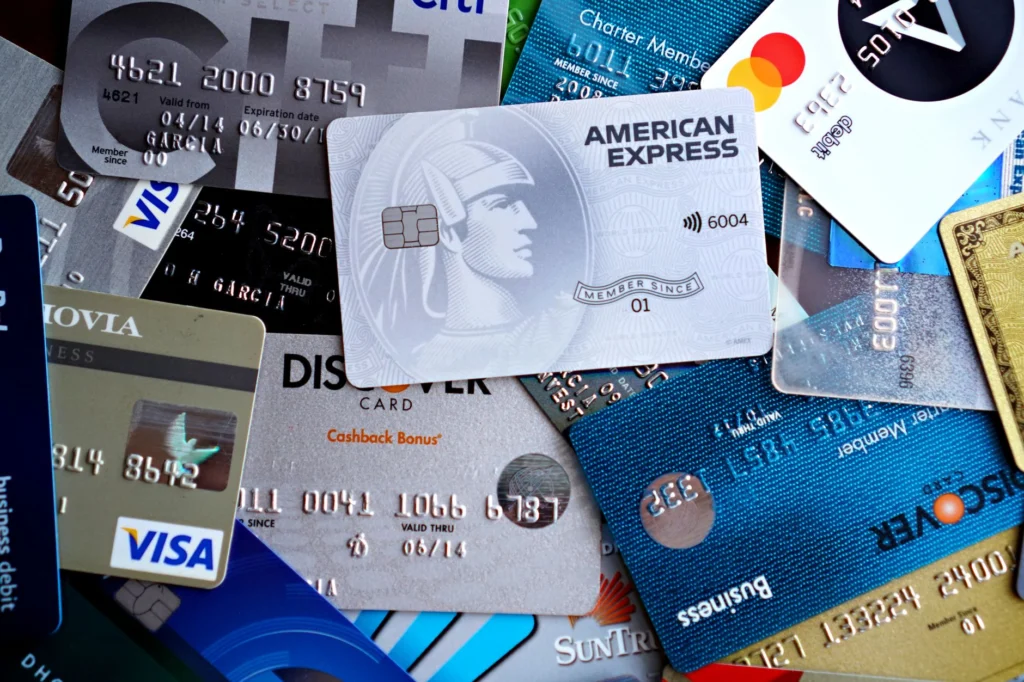
American Express has historically operated a more integrated model, and Discover has also operated a closed-loop structure in which the network and issuer can be part of the same company. The CFPB describes American Express and Discover as examples of systems where the company can act as network, issuer and acquirer rather than relying on the traditional four-party structure. (files.consumerfinance.gov)
That distinction explains why saying “Visa makes money from your credit-card interest” is generally wrong. Visa is primarily a payment network; the issuer is the party extending the credit and collecting the interest.
The real business is getting two kinds of customers at once
The most interesting part of credit-card economics is that issuers do not need every customer to behave the same way.
One customer spends heavily, pays every statement in full and generates interchange revenue.
Another carries a balance and generates interest income.
Another pays an annual fee for premium benefits.
Another uses a co-branded card heavily, creating value for both the issuer and its commercial partner.
A retailer can also participate in the economics. The CFPB found that store-card arrangements can involve profit-sharing, signing payments and other financial arrangements between retailers and issuers. (consumerfinance.gov)
The issuer is effectively building a portfolio of these behaviors and pricing the product accordingly.
That is why the best credit-card customer from the bank's perspective is not necessarily the person who pays the most fees. It is the person whose total revenue to the issuer, after rewards, funding costs, credit losses and operating expenses, produces an attractive return.
And that brings the whole model back to the seemingly strange $200 shoe purchase.
If you pay it off immediately, the bank can still earn money from the transaction.
If you carry the balance, the bank can earn interest.
If you pay an annual fee, that is another revenue stream.
If you use a premium or co-branded card, the issuer can monetize the broader relationship.
The rewards are simply the price the issuer is willing to pay to make you keep using the card.
The trick is not that credit-card companies found a way to give customers free money. They built a system in which the money can come from several places at once, and the profitability of any one customer depends on what that customer does after the swipe.
For related “how does this industry actually make money” explainers, see why prices end in 99 and why airlines make money very differently than most people assume.
For the debit-card side of this story — a genuinely different revenue model, with no interest involved — see how banks actually make money from debit cards.
Related: how a credit score is actually calculated, factor by factor — including why utilization, the thing credit card use directly affects, is the second-heaviest factor in the entire score.
If your company or product is mentioned in this article, you're welcome to share it.