Anti-lock brakes are one of the few pieces of car safety technology most drivers have actually felt working — that rapid pulsing through the brake pedal during a hard stop isn’t a malfunction, it’s the system doing its job roughly 15 to 17 times a second. What most explanations skip is the actual physics underneath that pulsing, and the genuine, counterintuitive scenario where a locked wheel can stop a car faster than ABS does.
What the sensors are actually measuring
Each wheel carries its own speed sensor — typically a toothed reluctor ring spinning past a fixed sensor, generating a pulsed electrical signal whose frequency rises and falls directly with wheel speed. Four sensors, four independent streams of data, all feeding a dedicated ABS control unit dozens of times per second. The control unit isn’t just watching raw speed — it’s comparing each wheel’s deceleration rate and slip ratio (the difference between how fast the wheel is actually spinning and how fast the car’s actual road speed says it should be spinning) against the other three wheels in real time.
The moment a wheel actually locks
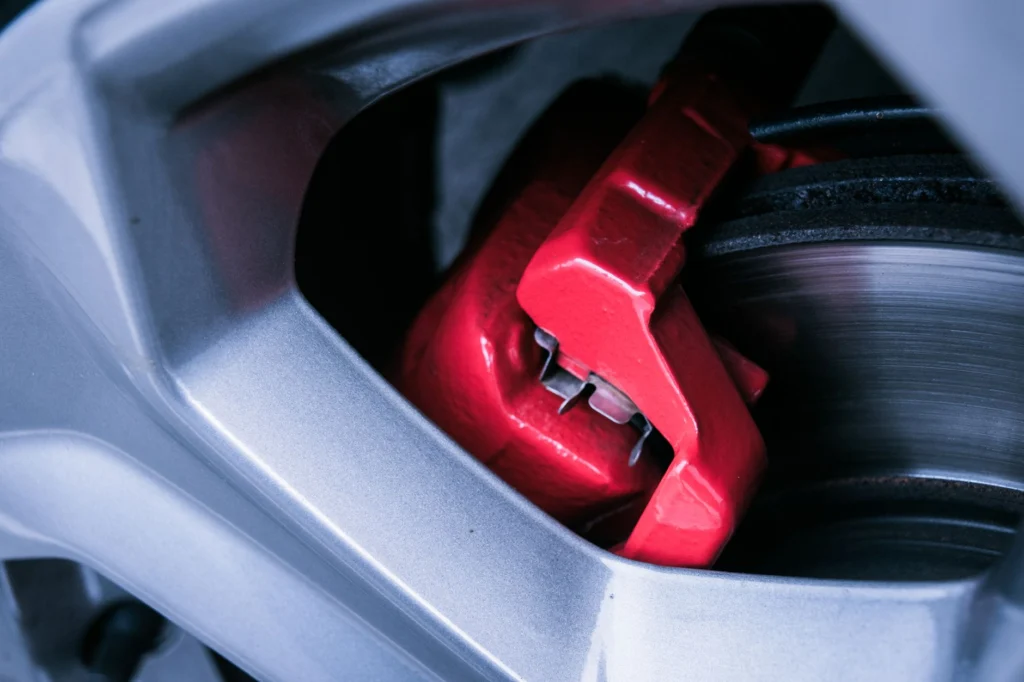
When you brake hard enough that a wheel’s deceleration rate or slip ratio crosses a calibrated threshold — the wheel is slowing far faster than the car itself is — the control unit reads that as the wheel about to stop rotating entirely while the car is still moving, which is the definition of a lock-up. Rather than letting the brake caliper keep clamping at full driver-applied pressure, it intervenes directly at the hydraulic level: releasing pressure at that wheel, letting it spin back up to match the road, then reapplying pressure, then releasing again if it detects another lock-up threat. That release-reapply-release cycle, repeated up to 17 times a second, is what you feel as the pulsing in the pedal. It’s the system executing, automatically and far faster than any driver could manually modulate, the exact technique professional drivers call threshold braking — hovering right at the edge of lock-up without crossing it, because a tire at the edge of slipping generates more stopping friction than a tire that’s already skidding.
Why ABS can genuinely be slower — on loose gravel or snow
This is the nuance most explainers skip entirely, and it’s real: on loose, granular surfaces like gravel, sand, or deep snow, a fully locked wheel builds up a small wedge of displaced material in front of the tire, and that wedge itself provides significant extra braking resistance — friction ABS is specifically designed to prevent by never letting the wheel fully lock. On pavement, that tradeoff never applies, because a locked tire on asphalt just skids and loses grip, which is exactly why ABS reliably outperforms an unaided driver’s braking on every paved surface. But on loose surfaces, some vehicles genuinely do stop in a measurably longer distance with ABS engaged than a skilled driver locking the wheels deliberately would — which is also part of why some off-road-oriented vehicles include a driver-selectable “off-road ABS” mode that changes the intervention thresholds specifically for loose terrain.
The actual takeaway
ABS isn’t magic and it isn’t simply “brakes that don’t lock” — it’s a genuine real-time physics system, reading wheel-speed data dozens of times a second and executing threshold braking automatically at a precision no human foot can replicate on a paved road. The pulsing pedal is the system working exactly as designed, not a fault. And the one place it can lose to old-fashioned locked wheels — loose gravel, sand, deep snow — isn’t a flaw in the system either; it’s a genuine, well-documented physics tradeoff between two different kinds of friction that most explanations flatten into a false absolute.