Hadrian has raised $1.37 billion in a Series D round at a $7.87 billion valuation.
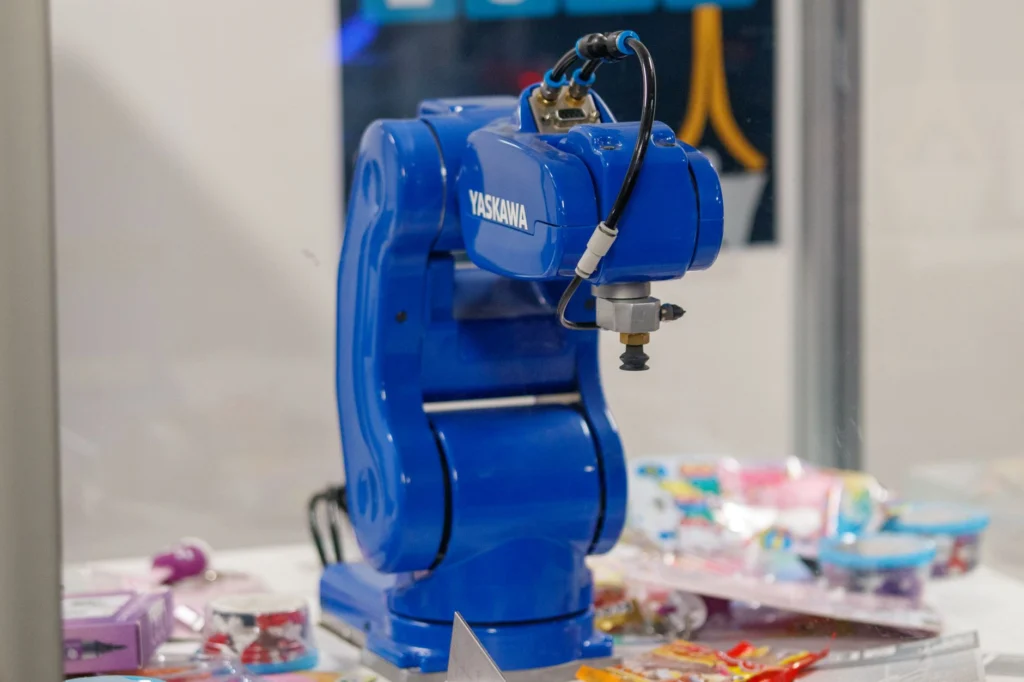
That is an enormous financing for a company whose central product is, in the least glamorous sense, manufacturing capacity. Hadrian is not selling another AI chatbot to defense contractors or developing a new autonomous weapons platform. It is building highly automated factories designed to make the precision metal parts that aerospace and defense companies already need.
The money matters because Hadrian is betting that one of America's most consequential industrial problems is not a shortage of ideas. It is the ability to turn designs into physical things at scale.
The company says its factories combine software, robotics, automated machine tools and skilled workers to produce precision components faster than the traditional aerospace and defense supply chain. Its customers and partners include Lockheed Martin, RTX businesses and Anduril. (techcrunch.com)
Hadrian's $1.37 billion round is therefore not simply a startup financing story. It is a large wager that rebuilding industrial capacity can itself become a venture-scale business.
A $7.87 billion valuation for the company building the factories
Hadrian announced the $1.37 billion Series D in August 2026. The financing valued the company at $7.87 billion, according to reporting by TechCrunch and Bloomberg. (techcrunch.com)
The investor list reflects how much larger the company's ambitions have become. The round included WCM Investment Management, Washington Harbour Partners, Valor Equity Partners, 137 Ventures and Baillie Gifford, with participation from investors including CapitalG, Andreessen Horowitz, Founders Fund, Lux Capital, Apollo-managed funds, Morgan Stanley Wealth Management, T. Rowe Price and 1789 Capital. (techcrunch.com)
That follows Hadrian's $260 million Series C announced in July 2025, led by Founders Fund and Lux Capital. At the time, Hadrian said it was expanding beyond individual precision components toward a broader manufacturing stack covering raw material, components, assemblies and complete products. (hadrian.co)
Funding databases differ somewhat on Hadrian's cumulative capital because private-company financing records can include extensions and other transactions differently. But TechCrunch, citing PitchBook estimates, reported that the latest round brought the company's total capital raised to roughly $2 billion. (techcrunch.com)
The larger point is clearer than the exact cumulative number: investors are funding Hadrian at a scale normally associated with companies that have already proven much larger industrial footprints.
Hadrian now has to build one.
Hadrian's business is manufacturing capacity, not robots for their own sake
Calling Hadrian a robotics company is not exactly wrong, but it can obscure what the company actually sells.
Aerospace and defense manufacturing is full of bottlenecks. A company may have a finished design and a government contract, yet still wait months for suppliers to program machines, qualify production processes and produce acceptable parts.
RTX described this problem directly in a June 2026 article about its manufacturing investments. The company said onboarding a new aerospace manufacturing supplier can require weeks or months of programming, engineering and prototyping before production begins. RTX says Hadrian's software-defined production system is designed to compress that process. (rtx.com)
The model begins with a customer's digital design file. RTX says Hadrian's software analyzes the part, determines manufacturing steps, generates instructions, schedules production and coordinates automated equipment with human workers. The goal is to move from design to production more quickly than conventional supplier onboarding allows. (rtx.com)
That distinction is important.
Hadrian is not arguing that factories should become completely human-free. RTX specifically describes skilled operators working alongside robots inside Hadrian facilities. The company's pitch is closer to software-defined industrial production: automate repetitive and time-consuming processes while using human expertise where manufacturing still requires it. (rtx.com)
Hadrian calls its broader approach "Factories-as-a-Service." The company has said it intends to build manufacturing capacity that customers can use without constructing and operating every production system themselves. (hadrian.co)
That makes Hadrian's ambition unusually capital-intensive for a venture-backed startup. Software companies can scale primarily by adding computing infrastructure and employees. Hadrian has to build facilities, install expensive equipment, recruit technicians and engineers, qualify production processes and convince major aerospace and defense customers that a relatively young company can reliably manufacture critical parts.
Lockheed Martin, RTX and Anduril show where Hadrian is gaining traction
Hadrian's customer relationships are one of the strongest indications that its manufacturing model is being tested beyond startup demonstrations.
In December 2025, Lockheed Martin and Hadrian announced a memorandum of understanding focused on expanding advanced manufacturing capacity. Under the agreement, Hadrian would deploy a scalable machining and inspection cell at a Lockheed Martin Missiles and Fire Control site. (news.lockheedmartin.com)
That arrangement matters because it places Hadrian's factory model directly inside the production environment of one of America's largest defense contractors.
RTX has also publicly described working with Hadrian. In June 2026, RTX said Hadrian had worked with Collins Aerospace and Raytheon, and said parts associated with Javelin and TOW weapon systems achieved a 98% on-time delivery rate. RTX also described Hadrian as one of the startups it is using to address manufacturing bottlenecks. (rtx.com)
Anduril announced a strategic partnership with Hadrian in 2023. The agreement said Hadrian would manufacture precision parts for Anduril's autonomous systems and help the defense technology company increase production while reducing cost and lead time. (anduril.com)
These relationships also explain why Hadrian occupies an interesting position in defense technology.
Companies such as Anduril are often identified with new weapons systems, autonomous aircraft and advanced sensors. Hadrian is working further down the industrial chain. It is trying to make the physical production system faster.
That may sound less futuristic than a fighter drone. But a weapons program cannot scale if the supply chain cannot produce enough machined components.
The real bet is that production has become a strategic problem
Hadrian's founder and CEO, Chris Power, has consistently framed the company around the decline and rebuilding of American industrial capacity.
In a 2022 company post, Power wrote that Hadrian's goal was to scale manufacturing capacity quickly enough to compete with what he described as an aging high-precision machining supply chain in the United States. (hadrian.co)
By 2025, the company's language had expanded into a more explicit reindustrialization thesis. Hadrian said it was building production capacity across areas including munitions and shipbuilding and argued that the United States needed to respond to industrial competition with actual production rather than policy alone. (hadrian.co)
The Series D arrives when that argument has become considerably more mainstream.
Russia's invasion of Ukraine exposed how quickly inventories of ammunition and other military equipment could become strategically important. Tensions with China have intensified concerns about supply chains and domestic industrial resilience. U.S. defense companies are under pressure to increase output, while commercial aerospace continues to face production constraints of its own.
Hadrian's argument is that software and automation can make manufacturing infrastructure itself more scalable.
There is no guarantee that argument will hold at the scale implied by a $7.87 billion valuation. Manufacturing is notoriously difficult to standardize. Different components require different materials, tolerances, certifications and inspection procedures. A software system that improves production of one family of precision parts does not automatically make every industrial process easy to automate.
That is why Hadrian's expansion into larger facilities will matter more than its fundraising headlines.
Building factories is much harder than announcing them
The $1.37 billion round gives Hadrian something most manufacturing startups never have: substantial capital to physically expand.
TechCrunch reported that Hadrian had opened a facility in Alabama to mass-produce submarine components, making it the company's fourth facility at the time. The company said the project was structured as a public-private partnership valued at $2.4 billion, although that figure refers to the broader project arrangement rather than simply Hadrian's equity investment. (techcrunch.com)
The company is also expanding its manufacturing footprint in Arizona. Its 2025 Series C announcement described plans to build new advanced manufacturing capacity in the state. (hadrian.co)
This is where the story moves beyond the usual venture-capital arithmetic.
Hadrian's valuation can rise quickly because investors believe its future manufacturing capacity could be valuable. But factories cannot be scaled with a few additional software engineers. They require buildings, equipment, supply chains, operators, maintenance, quality systems and customers willing to place production orders.
The challenge is not simply building robots.
It is building an industrial organization that can repeatedly turn a digital design into a qualified physical part, on time and at scale.
Hadrian has now raised enough money that the company will be judged less on whether that idea sounds compelling and more on whether its factories can do it repeatedly.