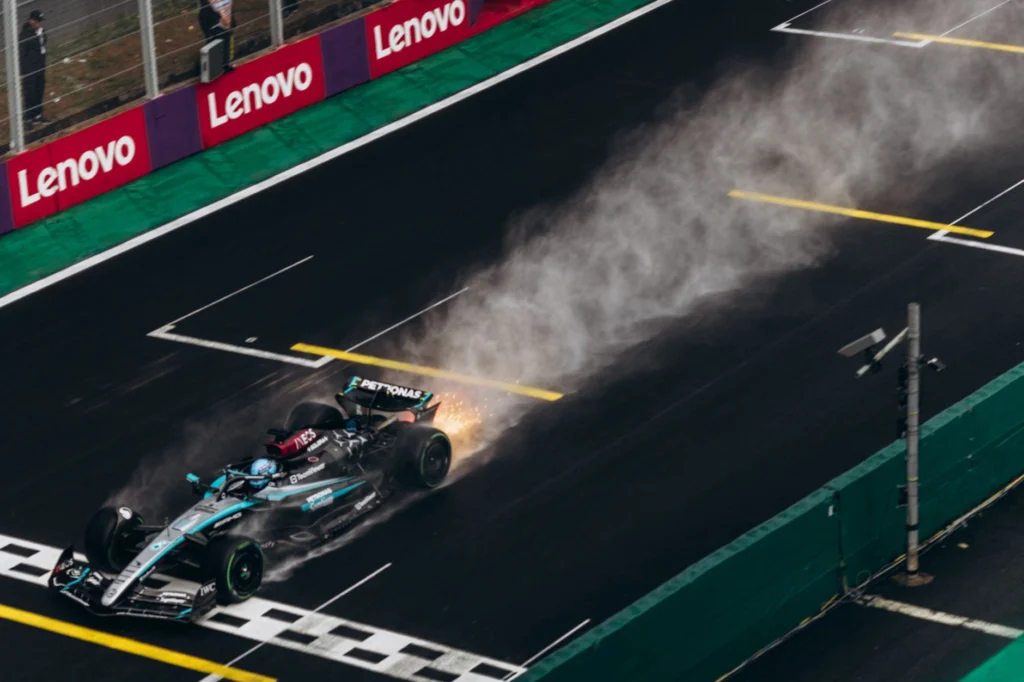
Mercedes had the pace to fight at Zandvoort, but not quite enough to beat Norris
Mercedes left the final Dutch Grand Prix with Kimi Antonelli second and George Russell third, but the result understates how close the team came to controlling the race.
Russell had already won Saturday's Sprint from pole. Antonelli then took second on the opening lap of Sunday's Grand Prix and, after Max Verstappen's crash triggered the red flag, went one better at the restart by passing Lando Norris for the lead. Mercedes therefore had both cars at the front of the race before the strategic picture became more complicated. (formula1.com)
The key point is that Mercedes was not simply handed its double podium by Verstappen's retirement or Ferrari's problems. The W17 was genuinely competitive at Zandvoort. Antonelli led for much of the race, while Russell spent the afternoon defending a podium position against the Ferraris.
What Mercedes did not have was the long-run pace on the hard tyre to keep Norris behind.
The strongest evidence came before the Grand Prix itself
The weekend's results make Mercedes' competitiveness easier to understand.
Antonelli was fastest in Friday's sole practice session with a 1:12.949, 0.121 seconds ahead of Norris. Russell was third fastest. Those were not race-condition simulations, so they cannot be treated as a definitive ranking of race pace, but they established Mercedes as a serious contender immediately. (reuters.com)
Russell then took Sprint pole and converted it into victory, leading all 24 laps. His advantage over the chasing cars was generally small, but he managed his tyres well enough to keep Leclerc and Norris from mounting a decisive challenge. (formula1.com)
That matters because the Sprint removed one possible explanation for Mercedes' Sunday performance: a lucky one-off qualifying lap. The team had usable pace over a race distance as well.
Sunday's qualifying reinforced the picture. Norris took pole, but Russell and Antonelli were immediately behind him. Mercedes had two cars starting at the sharp end, giving the team options that Ferrari and McLaren did not have in quite the same form.
Antonelli's starts put Mercedes in control
The first major tactical advantage came from the simplest part of the race: getting off the line.
At the original start, Antonelli beat Russell into Turn 1 to take second. After Verstappen's crash caused the red flag and a standing restart, Antonelli again made the better getaway, this time passing Norris for the lead. (formula1.com)
Those two starts effectively created Mercedes' strategic advantage.
At Zandvoort, track position is particularly valuable because overtaking can be difficult even when a following car has a pace advantage. Mercedes therefore did not need to prove that its car was dramatically faster than McLaren. It needed to stay ahead and force Norris to find a way through.
For several laps, that worked.
Antonelli gradually opened a gap to Norris after the restart, reaching a point where Norris could not use Overtake Mode. Mercedes had achieved exactly what a front-running strategy requires: control the pace from the front rather than chase it from behind. (formula1.com)
The hard tyre changed the balance of the race
The decisive shift came after the first round of pit stops.
The leading cars had started on different compounds, with Antonelli and Russell among the front-runners using the medium tyre while several others began on the soft. Mercedes' first stops brought both drivers onto the hard compound. (formula1.com)
This is where the Mercedes advantage began to disappear.
Norris had struggled more on the opening tyre phase but found considerably better pace once McLaren put him onto the hard tyre. Formula 1's official race report records Norris closing on Antonelli during the second stint, while Sky Sports described Norris as significantly quicker on the hard compound. (formula1.com)
Antonelli himself later described the second half of the race as difficult and said the pace was simply not there. That is a more useful explanation than assuming Mercedes suddenly made a strategic mistake. The team had track position, but Norris had the stronger tyre performance.
By Lap 52, Norris was close enough to attack. Antonelli was able to use Overtake Mode while running within a second of Hamilton, but it was not enough to prevent Norris from passing him into Turn 1. (formula1.com)
The Mercedes had been strong enough to lead. It was not strong enough to hold the lead once McLaren's tyre performance came alive.
Mercedes' second big decision came under the late VSC
The race then produced the tactical decision that ultimately shaped the podium.
With around 16 laps remaining, Esteban Ocon's Haas stopped on track and triggered a Virtual Safety Car. Antonelli was still second, but Mercedes chose to pit him for fresh soft tyres. Russell stayed out.
The calculation was straightforward. Fresh tyres offered Antonelli a chance to attack Norris again and, at minimum, protect second place from the Ferraris. The cost was track position: Antonelli rejoined behind Russell in third. (skysports.com)
It was a risky call, but not an irrational one.
The VSC dramatically reduced the time cost of a pit stop. Ferrari also brought its cars in, meaning Mercedes was not giving Antonelli a fresh-tyre advantage in isolation. The difference was that Russell remained ahead on older tyres, while Antonelli now had a much stronger tyre position for the final stint.
The problem was that Norris stayed out.
When the VSC ended, Norris retained the lead, Russell was second and Antonelli was third. Antonelli's fresh tyres were enough to close rapidly on Russell, but not enough to erase the gap to Norris. Mercedes had effectively chosen the best available route to protect a strong result rather than gamble everything on a win that was already becoming unlikely.
The Russell-Antonelli swap was about protecting the team's result
This is where Mercedes' tactics became more interesting than the final classification suggests.
Antonelli caught Russell with fresher tyres. At Zandvoort, simply having more grip does not guarantee an easy pass, so Mercedes did not leave the matter entirely to the drivers.
On Lap 65, the team instructed Russell to let Antonelli through.
Russell was understandably unhappy. He had been running ahead and was being asked to surrender third place to his championship-leading team mate. But the strategic logic was clear: Antonelli had earned second before the VSC, and he now had the faster tyre strategy. Keeping Russell ahead risked the two Mercedes cars fighting each other while Lewis Hamilton and Charles Leclerc approached on fresher tyres. (formula1.com)
Russell later accepted that the decision was the right one. Toto Wolff defended it as the logical consequence of the different strategies. (formula1.com)
The danger was obvious: Russell's older tyres left him exposed to Hamilton.
That risk nearly materialised. Hamilton closed in during the final laps, only for another VSC to interrupt the Ferrari driver's charge. Russell then held on to third, finishing less than a second ahead of Hamilton. (skysports.com)
Mercedes had therefore used the late VSC twice: first to give Antonelli fresh tyres, then indirectly to help Russell defend the position that strategy had put at risk.
So why was Mercedes so competitive at Zandvoort?
The evidence points to several factors working together rather than one secret advantage.
Mercedes had strong single-lap pace, demonstrated by Antonelli's fastest practice time and Russell's Sprint pole. It also had strong race execution, particularly at the starts, where Antonelli gained positions that became strategically valuable.
Most importantly, Mercedes could generate enough pace to control track position. Antonelli led the Grand Prix for a substantial portion of it, and Russell remained in podium contention despite spending much of the race under pressure from Ferrari.
The weakness was revealed later. Norris' McLaren was better on the hard tyre, and once Norris found that performance, Mercedes could no longer control the race purely from the front. The final result therefore reflects both sides of the Mercedes performance: enough pace and execution to produce a double podium, but not enough sustained tyre performance to beat Norris on equal terms.
That distinction matters.
Zandvoort was not a race Mercedes lost because its strategy was poor. The team made an aggressive late call with Antonelli, accepted the risk to Russell, and came away with second and third. The strategic decisions were largely about converting a car that was competitive but not dominant into the maximum team result.
Norris finished 11.536 seconds ahead of Antonelli. Russell was another 4.370 seconds behind his team mate, with Hamilton only 0.849 seconds further back. (formula1.com)
The clearest conclusion is therefore also the simplest: Mercedes was competitive at Zandvoort because it had enough pace to seize and defend track position, and because its drivers executed the opportunities that came with it. But once the race moved onto the hard tyre phase, McLaren had the stronger weapon. Mercedes could still manage the podium. It could not quite manage the win.
If your company or product is mentioned in this article, you're welcome to share it.