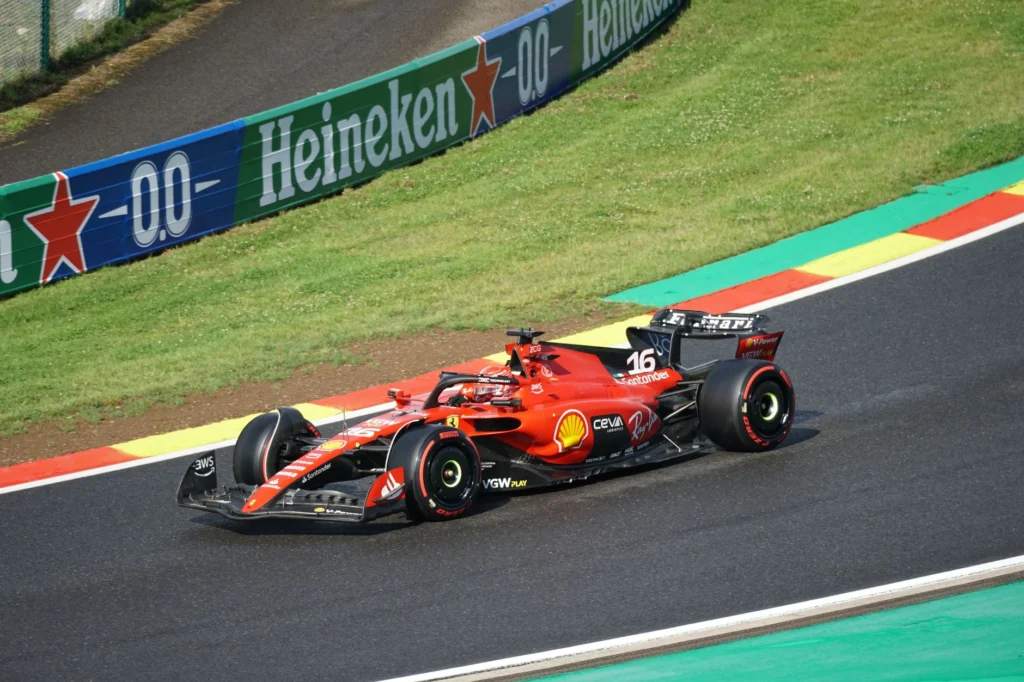
Ferrari finished the 2026 Dutch Grand Prix fourth and fifth, with Lewis Hamilton 0.849 seconds behind George Russell at the flag and Charles Leclerc another 0.503s back. The result looks competitive on paper. The race itself showed why Ferrari still could not turn that competitiveness into a genuine fight with McLaren and Mercedes for victory.
At Zandvoort, Ferrari's problem was not simply that its car was slower. It was that the team started behind the two Mercedes and the leading McLaren, then lost time in traffic and made a strategic decision that left Hamilton chasing Russell rather than attacking him with a clear track.
Lando Norris won by 11.536 seconds over Kimi Antonelli, while Russell completed the podium. Ferrari had both cars in the fight for fourth, but never created the circumstances needed to turn that fight into a podium challenge. (formula1.com)
Ferrari's first problem was qualifying, not the race itself
Zandvoort is a difficult circuit at which to manufacture overtaking opportunities, making grid position unusually valuable. Ferrari knew this before the race, and Hamilton had already acknowledged that qualifying would be crucial.
The final order reflected that problem. Norris took pole in 1:11.163, Russell was second in 1:11.265, Antonelli third in 1:11.296 and Piastri fourth in 1:11.305. Hamilton was fifth in 1:11.494 and Leclerc sixth in 1:11.558. (formula1.com)
The margins were small. Hamilton was only 0.331 seconds from pole, while Leclerc was 0.395s away. But those fractions put both Ferraris behind four cars from McLaren and Mercedes.
That mattered immediately.
After the restart caused by Max Verstappen's Lap 1 crash, Antonelli jumped Norris for the lead. Leclerc moved ahead of Piastri for fourth, while Hamilton remained behind the McLaren. Russell, meanwhile, was under pressure from both Ferraris.
Ferrari therefore had speed. What it did not have was track position at the front of the race. (formula1.com)
The tyre strategy gave Ferrari an opportunity, but not a free pass
The opening strategy was not uniform across the field. Most of the pack started on soft tyres, while the top four, including the two Ferraris, chose mediums. That was a deliberate attempt to trade initial grip for greater flexibility over the first stint and a longer tyre life. (formula1.com)
It worked reasonably well.
Leclerc was able to pressure Russell, and Hamilton eventually moved past Piastri. By the halfway point, Antonelli led Norris, followed by Russell, Leclerc, Hamilton and Piastri.
Ferrari was not being dropped.
The crucial distinction was that being close to Mercedes is not the same as being in position to pass it. Russell's early pit stop changed the tactical picture. He came in for hard tyres while Leclerc and Hamilton remained on track, allowing Ferrari to inherit track position temporarily.
Leclerc then used that position to attack Piastri, passing the McLaren around the outside. Hamilton followed and also got ahead of Piastri.
For Ferrari, this was the strongest part of the race. The cars had moved forward without needing an aggressive undercut. But the team still had Russell to clear if it wanted the podium. (formula1.com)
Ferrari's biggest tactical problem came from its own garage
The pivotal Ferrari decision arrived when Hamilton caught Leclerc.
Hamilton was on the alternative strategy and was clearly faster behind his team-mate. Ferrari asked Leclerc to pit, but he did not come in immediately. He followed the instruction one lap later, on Lap 44.
That single lap mattered because Hamilton was trying to use his fresher tyres to attack the cars ahead.
After Leclerc finally stopped, Hamilton's radio response was blunt: "Great waste of time there, guys." Ferrari's team principal Fred Vasseur later explained that the team had deliberately tried to manage the situation rather than immediately sacrifice Leclerc's position. (formula1.com)
The consequence was straightforward. Ferrari had two cars capable of fighting near the podium, but instead of giving its faster car a clean run at Russell, it spent part of the race managing the order between its own drivers.
That was not the only reason Ferrari missed the podium. But at a circuit where overtaking is difficult and the margins were less than a second at the finish, giving away time inside the team was costly.
McLaren had the better response when the race changed
Norris's victory also shows why Ferrari's problem cannot be reduced to one bad pit-wall decision.
Norris initially led after the restart, but Antonelli's Mercedes was faster through the first part of the race. Antonelli built a lead of 1.4 seconds, enough to keep Norris outside Overtake Mode.
Later, however, Norris began closing the gap. By Lap 40 he was within 0.7 seconds. Antonelli eventually stopped for hard tyres on Lap 41, with Russell following.
Norris stayed out until Lap 48.
That decision temporarily handed Hamilton the lead, but it gave McLaren a much fresher strategic position. Norris returned from his stop more than five seconds behind Antonelli and then rapidly reduced the deficit. Within three laps, the gap was down to 1.4 seconds. By Lap 52, Antonelli was reporting rear-tyre problems.
Norris eventually passed him and controlled the race to the finish. (formula1.com)
The important point for Ferrari is that McLaren turned its tyre situation into an attack on the lead. Ferrari, by comparison, spent much of the same phase fighting for fourth.
Mercedes did not need to be faster everywhere to keep Ferrari behind
Mercedes' advantage at Zandvoort was partly positional and partly tactical.
Russell started second and Antonelli third. That meant Mercedes controlled the first group behind pole-sitter Norris before Ferrari had a chance to interfere.
When Russell stopped early, he did fall behind, but Mercedes still had Antonelli fighting for the win. Later, Russell recovered enough track position to defend third.
The closing laps made the difference particularly clear. Ferrari's Hamilton was charging towards Russell, but Russell had enough to hold him off. Ferrari's two cars eventually finished fourth and fifth, with Hamilton only 0.849 seconds behind Russell and Leclerc another 0.503 seconds behind Hamilton. (formula1.com)
Mercedes also used its two-car advantage at the end. On Lap 65, the team ordered Russell to let Antonelli through, preserving Antonelli's championship position. Russell was unhappy with the call, but obeyed it. (skysports.com)
Ferrari had no equivalent opportunity because it was already behind the Mercedes pair.
Ferrari's underlying pace was better than the result suggests
That is what makes the Dutch GP more interesting than a simple Ferrari disappointment.
Ferrari had entered the weekend with a car that was being improved through setup changes. Hamilton said the changes made a substantial difference, while Leclerc was less convinced because he struggled more with the same direction. (formula1.com)
Hamilton had also believed before the race that Ferrari could challenge the cars ahead over the full race distance, despite starting fifth. (skysports.com)
The race broadly supported that assessment.
Ferrari passed Piastri twice through the course of the race. Leclerc spent long periods close to Russell. Hamilton finished less than a second behind the Mercedes driver. Neither Ferrari was comfortably outpaced.
But the cars that matter most in a championship fight are the ones ahead. Norris had enough pace to recover from a strategic disadvantage and win by more than 11 seconds. Antonelli had enough to lead for much of the race and finish second. Russell had enough track position and defensive pace to preserve third.
Ferrari had enough to finish fourth and fifth.
That is a meaningful distinction.
Ferrari's problem is the gap between being competitive and controlling a race
The Dutch GP did not show Ferrari as a slow team. It showed a team that was close enough to punish mistakes but not yet strong enough to dictate the race.
The qualifying deficit left both Ferraris behind four McLaren and Mercedes cars. The medium-tyre strategy gave them useful race flexibility, but not an automatic route through traffic. Their pace allowed them to pass Piastri and pressure Russell, yet Ferrari could not convert that pressure into the podium.
Then the internal delay between Hamilton and Leclerc cost additional time at precisely the point when Hamilton needed a clear run.
By the finish, Ferrari's two cars were separated from the podium by fractions rather than seconds. That makes the result frustrating, but it also makes the diagnosis fairly precise.
Ferrari did not need an entirely different car at Zandvoort. It needed a little more qualifying performance, cleaner execution once the race order became fluid, and a strategy that prioritised the fastest Ferrari when the podium was within reach.
At Zandvoort, McLaren found a way to turn tyre management into a victory and Mercedes used its starting position to protect a double podium. Ferrari had the pace to threaten both, but too much of its race was spent trying to catch the opportunity rather than creating it.
If your company or product is mentioned in this article, you're welcome to share it.