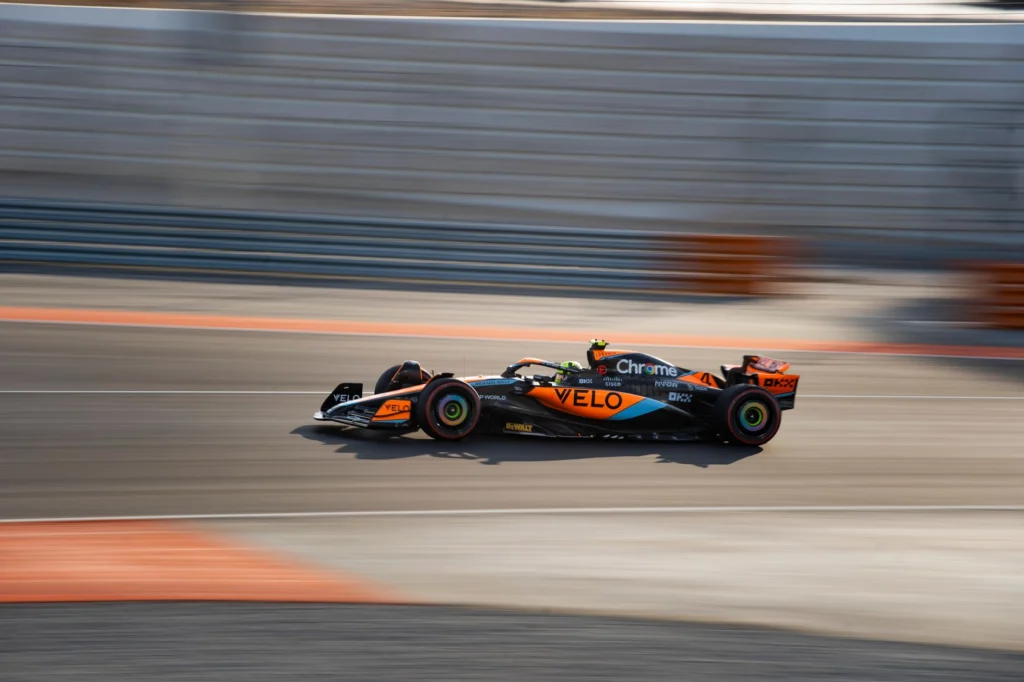
Lando Norris won the final Dutch Grand Prix at Zandvoort by 11.5 seconds over Kimi Antonelli, but the result does not tell the most interesting part of the weekend. Across qualifying and the race, Norris, George Russell and Antonelli repeatedly found time in different parts of the lap, using different strengths of their cars and different approaches to the new-generation 2026 machinery. (formula1.com)
That makes “fastest driver” a more complicated label than the championship table suggests. Antonelli leads the standings with 242 points after 12 rounds, while Russell and Lewis Hamilton are tied on 183, Norris has 159 and Charles Leclerc 155. (formula1.com)
The clearest way to separate them is to look at the sectors where their speed actually appears.
Sector 1: Russell had the straight-line advantage, while Norris gave away very little
Zandvoort’s first sector rewards a driver who can combine heavy braking with confidence through the opening sequence. In Dutch GP qualifying, Russell’s best sector was 24.381 seconds, compared with 24.622 for Norris. That 0.241-second advantage was significant in a lap where the entire pole margin was only 0.102 seconds. (the-race.com)
Russell’s Mercedes was also stronger at the end of the lap in terms of peak speed. Analysis of the qualifying data put the Mercedes at roughly 317 km/h approaching the timing line, compared with about 307 km/h for Norris’s McLaren. (the-race.com)
But this was not simply a case of Mercedes having the faster car everywhere.
Norris himself admitted that his final qualifying lap began badly. He said he had his “worst Turn 1” of the weekend, then committed more heavily through the remainder of the lap. That decision mattered because Zandvoort punishes hesitation: the opening corner is fast enough and cambered enough that a small loss of confidence can compromise the following sequence. (autosport.com)
Antonelli had the opposite problem in Q3. He reported being around two-tenths down in Sector 1 after making a mistake at Turn 1, yet recovered much of that deficit later in the lap. He ultimately qualified only 0.031 seconds behind Russell. (formula1.com)
So Sector 1 tells us something useful about the three drivers. Russell was extracting the most from Mercedes' acceleration and braking performance. Norris could absorb a poor opening without abandoning the lap. Antonelli had enough underlying pace to recover from an error, but was less consistent across the weekend.
Sector 2: This was where Norris actually won pole
If Sector 1 belonged to Russell, Sector 2 belonged to Norris.
The qualifying data showed Norris at 24.983 seconds in the middle sector against Russell's 25.434. That is a 0.451-second swing in Norris's favour, more than four times the eventual gap between them at the finish. (the-race.com)
This is the crucial piece of the Zandvoort qualifying puzzle. Mercedes was not simply beaten by McLaren's overall lap time. Russell was faster in one part of the circuit by a substantial margin, but Norris created an even larger advantage in another.
That difference is partly about how the 2026 cars use energy. The new regulations have made deployment strategy an important part of lap construction, so a driver can gain time by deciding where to spend electrical energy rather than merely carrying more speed everywhere. (the-race.com)
Norris's advantage also fits what he said about the car after qualifying. McLaren had made small setup changes after the Sprint, specifically to give him more confidence in the car. He said those changes were not worth a tenth or two on their own, but they allowed him to attack Zandvoort more aggressively. (formel1de.com)
That distinction matters. The fastest driver is often not the driver with the biggest theoretical advantage. It is the driver who can actually access the car's performance repeatedly.
Norris did that when it counted.
Sector 3: Mercedes could recover the time, but McLaren had already done enough
Russell's final sector was 21.752 seconds, compared with Norris's 22.003. Mercedes therefore recovered another 0.251 seconds before the line. (the-race.com)
That explains why the final qualifying gap was so small despite Norris's huge Sector 2 advantage. Russell effectively built his lap around two strengths: a strong opening sector and a very fast run to the finish. Norris concentrated his advantage in the middle of the lap and managed the overall lap better.
Antonelli's comments are revealing here too. He said he struggled particularly in Sector 3 and the chicane during qualifying before making changes that restored some of the car's feeling. (racer.com)
This was not a weekend where Antonelli suddenly lost his underlying speed. He had been fastest in the sole practice session, beating Norris and Russell by roughly a tenth. (formula1.com)
The difference was execution.
That is an important distinction for a championship leader who has already won six races this season. Antonelli's 2026 campaign has been built on an unusually high level of consistency, but Zandvoort showed how quickly the margin disappears when a driver is slightly out of rhythm.
Race pace: Norris's real advantage appeared after the tyre switch
Qualifying alone might have suggested that Mercedes and McLaren were almost inseparable. The race told a different story.
After Verstappen crashed on the opening lap and the race was red-flagged, Antonelli took the lead from Norris at the standing restart. Norris then struggled to put meaningful pressure on the Mercedes during the early phase. (formula1.com)
The balance changed after the first pit-stop cycle.
Norris was significantly faster once he moved onto the hard tyre. He eventually passed Antonelli after making a second stop that left him with substantially fresher rubber. The McLaren driver had therefore combined outright pace with better tyre utilisation when the race entered its decisive phase. (skysports.com)
Antonelli's own assessment was blunt: he struggled in the second half of the race on the hard compound.
That is perhaps the strongest evidence yet that McLaren's recent improvement is more than a single qualifying-session spike. Norris won in Hungary before the summer break and then followed it with another victory at Zandvoort. Formula 1's official results show that the Dutch win was his second consecutive Grand Prix victory. (formula1.com)
Strategy: Antonelli still scored heavily even when Mercedes got the balance wrong
The most interesting tactical decision came with 16 laps remaining.
A virtual safety car gave Mercedes the opportunity to pit Antonelli for fresh tyres. He rejoined behind Russell, who was on an older set and had not made the same third stop. Mercedes then instructed Russell to let his team-mate through. (skysports.com)
On paper, that sounds like a straightforward championship-management decision. In practice, it was risky.
Russell was immediately exposed to Hamilton and Leclerc, both on fresher tyres. At Zandvoort, overtaking is difficult enough that Mercedes could not assume Antonelli would simply drive past Russell without consequences. Another VSC later in the race helped Russell survive the pressure and retain third place. (skysports.com)
The result was strategically valuable even though Antonelli did not win. He finished second, Russell third and Hamilton fourth. Antonelli's championship lead increased to 59 points over Russell and Hamilton. (formula1.com)
That is the other side of evaluating driver performance. Norris was the fastest driver in the decisive phase, but Antonelli was still the driver who left the weekend with the strongest championship position.
The fastest driver right now is probably Norris, but the fastest package is harder to identify
There is a temptation to declare that McLaren has now overtaken Mercedes completely. The evidence is not quite that simple.
Antonelli himself said Mercedes was no longer the fastest car after Zandvoort, describing it as probably second or third on that day. Sky Sports also reported that Mercedes had won only two of the previous six races after taking all of the opening six. McLaren's development gains, particularly after its Hungary upgrade, have clearly reduced the early-season Mercedes advantage. (skysports.com)
But Zandvoort showed that Mercedes still had major strengths. Russell could produce enormous sector gains through the lap, won the Sprint from pole and qualified second for the Grand Prix. (formula1.com)
Norris, meanwhile, currently has the strongest argument for being the driver extracting the most from his package. His back-to-back wins, pole at Zandvoort and ability to turn a difficult opening phase into a race-winning second half make the case stronger than any single fastest-lap statistic.
Antonelli remains the benchmark for sustained performance. He has 242 points after 12 rounds and six wins, and even a weekend where he made several mistakes still ended with second place and an enlarged championship lead. (formula1.com)
Russell is the harder driver to classify. His Zandvoort weekend was a reminder that his raw speed has not disappeared. He took Sprint pole, won the Sprint, qualified second and finished third in the Grand Prix. (formula1.com)
The sector data explains why these drivers can look unbeatable on different days. Russell can build a lap around acceleration and deployment. Norris is currently exceptional at turning confidence and tyre performance into sustained race pace. Antonelli's greatest strength remains the ability to convert competitive machinery into points almost every weekend.
And that may be the real story of F1's 2026 season. The gap between the fastest drivers is no longer visible as a single number on a stopwatch. It moves from Sector 1 to Sector 2, from qualifying to tyre management, and from raw pace to the strategic decisions made when the race stops behaving as planned.
At Zandvoort, Norris won because he had the strongest answer when those advantages finally converged.
If your company or product is mentioned in this article, you're welcome to share it.