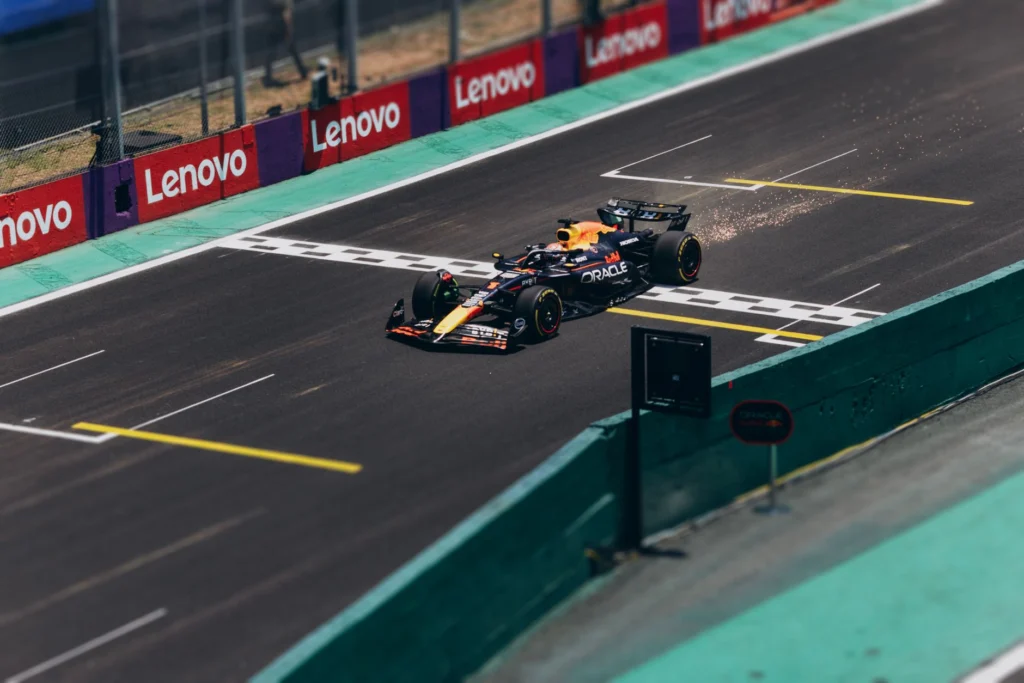
Mercedes arrived at several of the early 2026 races looking like the benchmark, but the season has steadily shown that there is no single "fastest car" independent of circuit layout. The more useful question is where each car is fast.
Barcelona exposed Red Bull's weakness on a circuit dominated by high-speed demands. Austria then produced a very different picture. Ferrari won at Barcelona, Mercedes controlled Austria, and McLaren has since demonstrated that its strongest performance can appear when tyre behaviour and slower corners become decisive.
The evidence from the races points to a more complicated hierarchy: Mercedes has generally been the most complete package, Ferrari has become particularly dangerous on circuits demanding aerodynamic grip and tyre management, McLaren has shown major race pace while still carrying a weakness in slow-speed corners, and Red Bull has made progress but remains more sensitive to circuit characteristics.
Barcelona showed why high-speed performance matters
The clearest high-speed test of the season so far was Barcelona.
Red Bull went into the Spanish Grand Prix expecting trouble because the Circuit de Barcelona-Catalunya places substantial demands on aerodynamic performance through its long, fast corners. Team principal Laurent Mekies later described the weekend as a "reality check", acknowledging that Red Bull knew the circuit's high-speed layout would expose the car's weaknesses. (formula1.com)
The race result reflected that. Lewis Hamilton won for Ferrari, George Russell finished second for Mercedes and Lando Norris was third for McLaren. Max Verstappen was fourth, more than 40 seconds behind Hamilton at the finish. (skysports.com)
That does not mean Red Bull suddenly had a fundamentally slow car. Verstappen had qualified fifth, only 0.342 seconds from Russell's pole position, while the two Red Bulls were also inside four-tenths of a second in Q3. (skysports.com)
The difference was therefore less about absolute one-lap speed and more about sustaining performance over a race distance.
Ferrari's advantage was particularly significant because Hamilton's victory was built around strong tyre management in a high-tyre-wear race. (skysports.com)
Barcelona consequently became an important reference point for the season: a car can look competitive on the timing screens while still losing ground when a circuit repeatedly asks for aerodynamic stability and sustained cornering performance.
Ferrari's Barcelona win was about more than straight-line speed
Ferrari's strength in Spain is useful because it illustrates what "high-speed performance" actually means in modern F1.
It is not simply about carrying the highest speed at the end of a straight. A car needs to generate enough aerodynamic load to enter a fast corner confidently, maintain stability while the driver changes direction and protect its tyres while doing so.
Ferrari's Barcelona weekend was not universally dominant. Russell took pole, with Hamilton just 0.064 seconds behind him, while Norris and Verstappen were also within roughly three-tenths of a second of pole. (skysports.com)
But Ferrari converted that competitiveness into a race win.
That distinction matters. A car that is slightly slower in one sector can still be the better race package if it manages its tyres more effectively or maintains its performance later in a stint.
Ferrari subsequently struggled to reproduce that advantage in Austria. Hamilton finished fifth at the Red Bull Ring after Ferrari had initially looked competitive, while Mercedes' George Russell won ahead of Kimi Antonelli and Max Verstappen. Hamilton openly questioned why Ferrari had been so slow relative to expectations. (formula1.com)
That swing is precisely why circuit-specific analysis is more useful than assigning a permanent ranking to the teams.
Mercedes has been the most adaptable package
If one team has the strongest argument for being the most complete across different circuit types, it is Mercedes.
The Austrian Grand Prix demonstrated its ability to combine qualifying performance, race pace and tyre strategy. Russell led from pole and built enough of a margin to control the timing of his pit stop rather than being forced to react to Verstappen. Antonelli recovered from an awkward opening phase and finished third. (formula1.com)
Silverstone then presented a different challenge. Mercedes showed strong long-run pace, while George Russell specifically identified straight-line speed as an area where the car was losing out. Despite that limitation, Antonelli won the Sprint and qualified on pole, showing that the underlying car remained competitive around a fast circuit. (formula1.com)
That combination is significant.
Mercedes does not need to dominate every individual corner type to win. It can often compensate for a weakness in one area through tyre management, setup, strategy or performance elsewhere.
The current championship picture reinforces that broader consistency. At Barcelona, Mercedes had two cars capable of fighting at the front before Antonelli's late retirement. At Zandvoort, the team produced another double podium, with Antonelli second and Russell third. (skysports.com)
That is the profile of a car that is difficult to eliminate from contention simply by changing circuit type.
McLaren's Zandvoort result exposed its slow-speed weakness
McLaren provides the clearest current example of a team whose race pace can be excellent without having a completely rounded car.
Lando Norris won the Dutch Grand Prix at Zandvoort, following his victory at the Hungaroring. But his own description of the race was unusually revealing: the McLaren struggled on the Soft tyre, improved dramatically on the Hard, and still had weaknesses in slow-speed corners. (formula1.com)
That matters because Zandvoort is not a conventional low-speed circuit. It contains high-speed corners, banked turns and a flat-out final corner, but overtaking is difficult because there is essentially one major straight leading toward Turn 1. (skysports.com)
Norris therefore did not win simply because McLaren was universally superior.
He initially struggled to pressure Antonelli. Once the Hard tyre transformed the balance and pace of his car, however, McLaren became much more effective. Norris eventually passed Antonelli and pulled away to win by more than 11 seconds. (skysports.com)
The important detail is what Norris said afterward: McLaren still needed to improve its slow-speed performance if it wanted to fight for the championship.
That is a much more useful assessment than simply saying McLaren is "fast."
Red Bull's weakness is more circuit-sensitive than the results suggest
Red Bull has produced some of the biggest swings in performance during 2026.
Barcelona was poor. Austria was much better. At Silverstone, Verstappen said the team struggled with balance and top speed, although the race pace eventually improved enough for him to fight near the podium before a rear-wing problem caused his retirement. (formula1.com)
At Spa, the picture changed again. Verstappen finished third behind Antonelli and Charles Leclerc, while Red Bull also had Isack Hadjar recover from 21st to sixth. Team principal Laurent Mekies said the team had been able to fight for podiums across the previous three races. (formula1.com)
That suggests Red Bull's problem is not simply "slow in high-speed corners" or "fast in low-speed corners."
The more defensible conclusion is that the RB22 has been unusually sensitive to the exact combination of aerodynamic load, balance, tyre behaviour and circuit layout.
Barcelona exposed it badly. Austria suited it far better. Spa produced a podium. That is a pattern of circuit sensitivity rather than one permanent corner-speed weakness.
Zandvoort showed why slow corners can decide a race even on a fast circuit
The Dutch Grand Prix is perhaps the best recent example of why the high-speed-versus-low-speed distinction can become misleading.
Mercedes had strong track position and Antonelli led after the second standing start. Norris, however, eventually found enough pace on the Hard tyre to take the lead.
Mercedes then faced another problem: overtaking at Zandvoort is difficult. When Antonelli was brought in under the late Virtual Safety Car, he rejoined behind Russell. Mercedes ordered Russell to let his team mate through because Antonelli was the championship leader, but the decision was not risk-free precisely because passing at Zandvoort is difficult. (skysports.com)
The final result was Norris first, Antonelli second and Russell third.
The McLaren therefore did not need to dominate every section of the circuit. It needed enough performance in the right parts of the lap to make its tyre advantage useful, while Mercedes needed track position because overtaking was so difficult.
That is the tactical side of corner performance: raw speed only becomes valuable if the circuit allows a driver to turn it into position.
So which teams have the advantage?
The 2026 evidence does not support a simple ranking such as "Mercedes is the high-speed team and McLaren is the low-speed team."
Mercedes currently has the strongest claim to being the most versatile. It has won on different types of circuits, regularly qualified near the front and has repeatedly converted strong race pace into large points hauls.
Ferrari has shown that it can become extremely difficult to beat when aerodynamic performance and tyre management align, as Barcelona demonstrated. Its subsequent inconsistency means that advantage cannot yet be treated as universal.
McLaren has become one of the most dangerous race packages, particularly when tyre behaviour works in its favour. But Norris's comments after Zandvoort are a direct warning that slow-speed performance remains an area the team needs to improve.
Red Bull is the hardest team to classify. Its 2026 results suggest a car capable of being highly competitive when the circuit and setup suit it, but vulnerable when the track exposes its balance and aerodynamic limitations.
The next useful test is therefore not simply the next race winner. It is how these four cars behave when the circuit changes from fast, flowing corners to heavy braking and low-speed traction zones.
That is where the real 2026 hierarchy will keep moving. The season has already shown that the fastest car is not necessarily the car with the highest peak speed. It is the one that can keep enough performance across the parts of the lap that actually decide the race.
If your company or product is mentioned in this article, you're welcome to share it.